4.03t - Arrangements of three planes
Read the geometry hidden in three simultaneous linear equations. You will distinguish a single common point, a common line, coincident planes and the different arrangements with no common point, using normals, determinants and the relationships between complete equations.
Parallel and coincident planes
The planes , and each meet the other two. Must there be a point where all three meet? Picture three vertical walls around a triangular space: each pair meets along an edge, yet there is no common corner. We will turn that picture into an exact algebraic argument.
You already know
For , a normal is . A point satisfies three simultaneous equations exactly when it lies on all three planes. A singular coefficient matrix has no inverse and gives no unique solution.
Start with two planes. Their normals determine whether they have the same orientation. For example, and have proportional normals, and the second complete equation is twice the first: they are the same plane. Replace the final by , and the normals stay proportional but the planes separate.
[DIAGRAM: asset_name: Three relationships between two planes; asset_slug: h245_4_03t_plane_pairs; caption: Two planes can coincide, be distinct and parallel, or intersect in a line; description: Three exact three-dimensional panels show the coincident planes x = 0 and 2x = 0, the distinct parallel planes x = 0 and x = 1, and the non-parallel planes x = 0 and y = 0 meeting along the z-axis. Plane patches are finite drawings of infinite planes. The common line is highlighted in sage.]
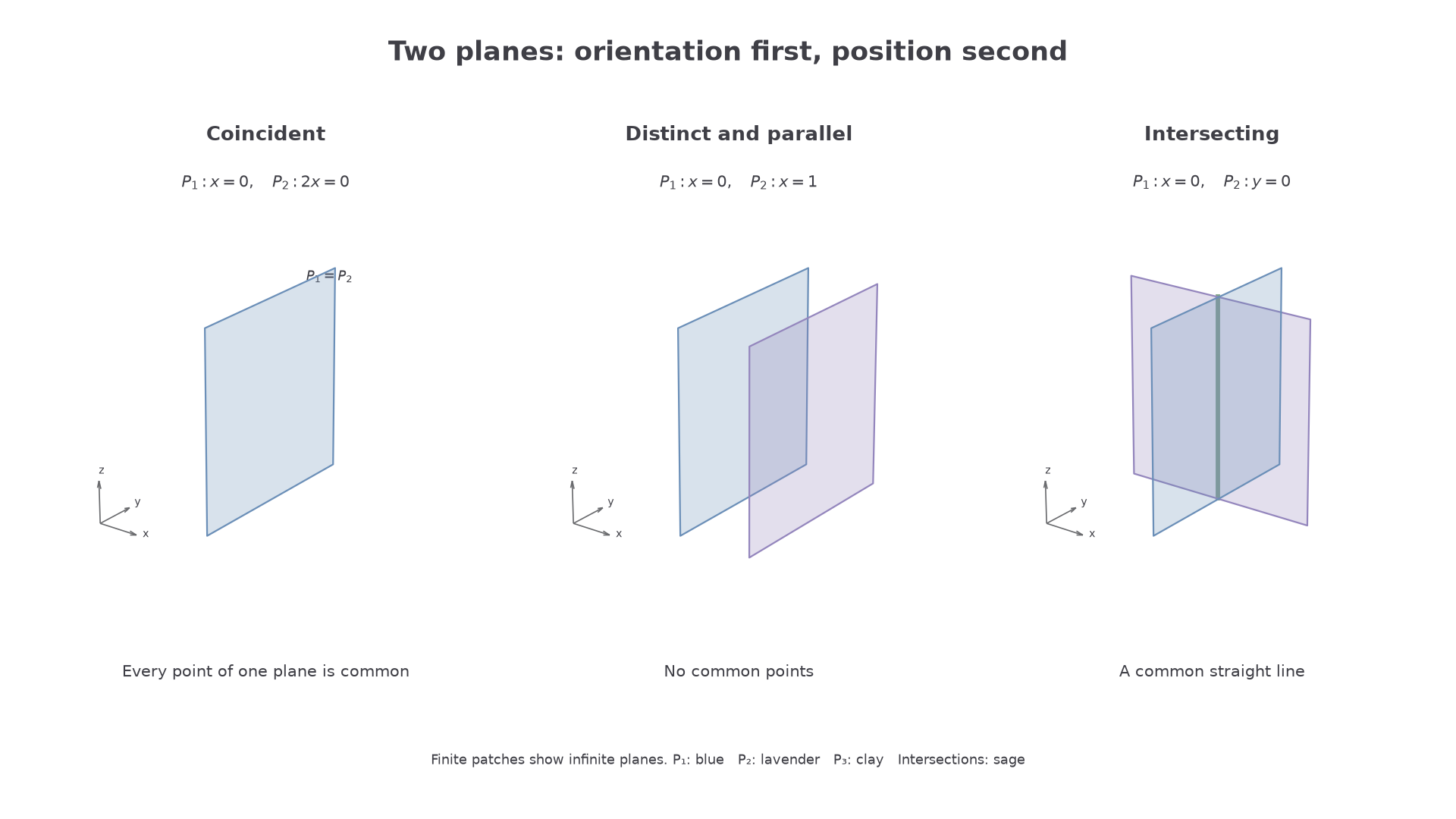
Coincident and distinct parallel planes
Coincident planes contain exactly the same points: one complete cartesian equation is a non-zero multiple of the other. Distinct parallel planes have proportional normals but no common point: the coefficient multiplier fails for the constants. For example, and coincide; and are distinct and parallel.
If the normals are not proportional, the planes meet in exactly one straight line. They cannot be skew: that possibility belongs to lines, not planes. These pair-classification criteria are not in the formula booklet: learn them. The cartesian equation of a plane itself is in the booklet.
Worked example 1: recognising coincidence
Question. Determine the relationship between and .
Plan. Compare the normal vectors, then check whether the same multiplier works for the constants.
Why this step? Proportional normals establish the orientation; only the constants tell you whether the two planes occupy the same position.
Answer. The planes are coincident, so they share every point of a plane.
Check. lies on both, and dividing the whole second equation by gives the first equation exactly.
Worked example 2 changes only the second constant. The orientation stays fixed, so any change in the relationship comes from the position of the plane.
Worked example 2: the same normals, different planes
Question. Determine the relationship between and .
Plan. Divide the second equation by , then compare its right-hand side with the first.
Why this step? A point cannot give two different values of the same expression, so no point can lie on both planes.
Answer. The planes are distinct and parallel, with no common point.
Check. Their normals remain proportional, while satisfies only the first equation.
Changing the right-hand side can move a plane without turning it.
Watch out
Wrong: “The normals are proportional, so the planes coincide.” Right: compare the complete equations. Proportional normals permit either coincidence or distinct parallel planes.
Use a single multiplier for every term in this pair.
A determinant and a common point
A non-zero coefficient determinant means that three planes meet at exactly one point; a zero determinant means that no single common point is determined.
The coordinate planes , and have coefficient matrix , whose determinant is . Their only common point is the origin. In contrast, , and have determinant zero: every point on the -axis satisfies all three equations.
[DIAGRAM: asset_name: Three planes with no parallel pair; asset_slug: h245_4_03t_nonparallel_triples; caption: With no parallel pair, three planes can share a point, share a line, or have no common point; description: Exact three-dimensional panels compare x = 0, y = 0, z = 0 meeting only at O; x = 0, y = 0, x + y = 0 sharing the z-axis; and x = 0, y = 0, x + y = 1 meeting pairwise along three different parallel vertical lines. The third arrangement gives the three side planes of a triangular prism. Common intersections are marked in sage, and each panel labels its equations and conclusion.]
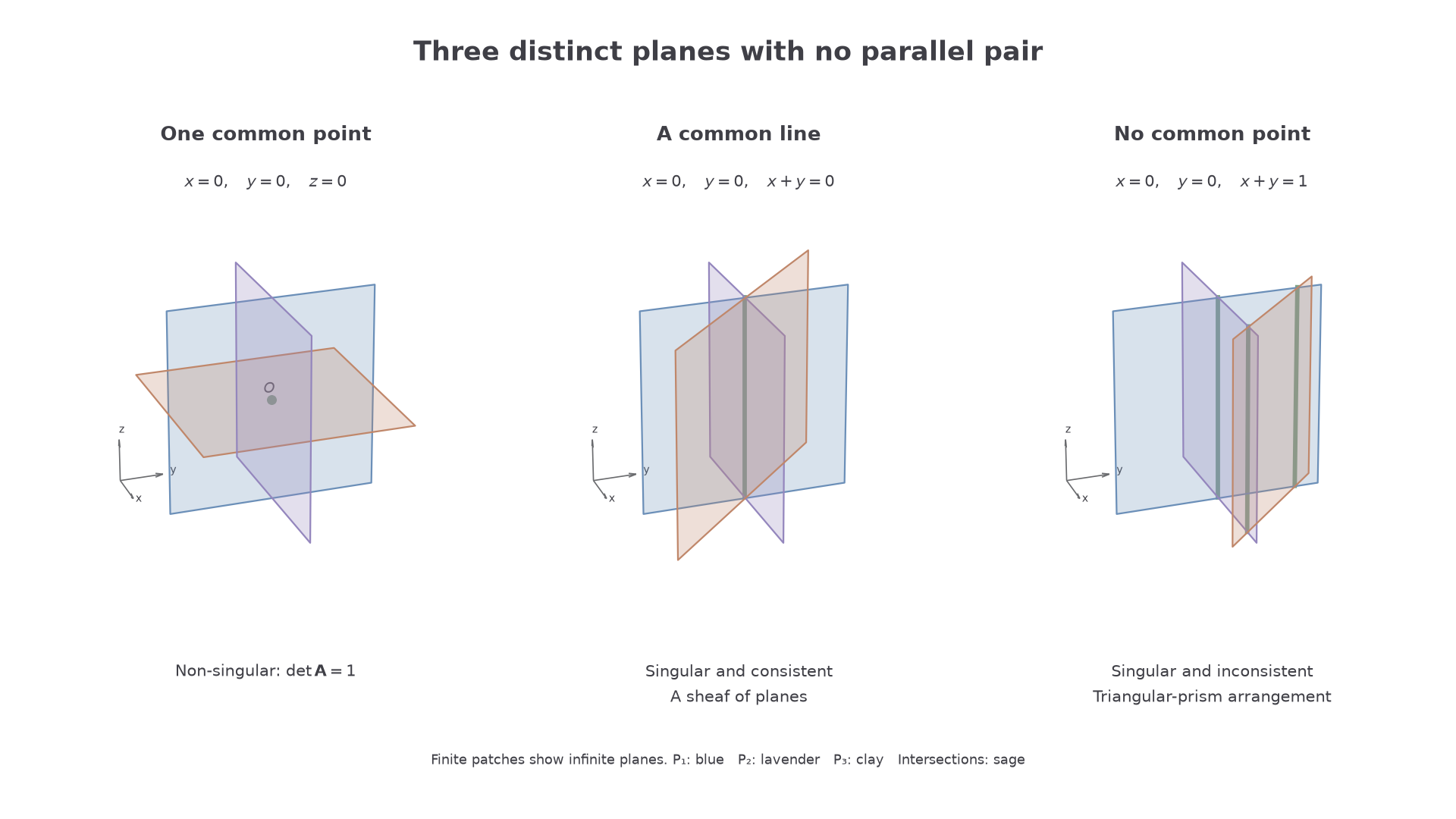
Write the plane equations as , with one plane's coefficients in each row. The entries of determine the positions of the planes; the rows of give their normals.
The determinant and three planes
For three genuine planes in three-dimensional space, with coefficient matrix ,
In the singular case, the common points form a line or a plane if the system is consistent; there are no common points if it is inconsistent.
Not in the formula booklet: learn it.
Here is why the inverse criterion has this geometric meaning. A non-singular matrix gives the unique coordinate column . If a singular system has one solution , a non-zero direction with can be added in any real multiple: . Geometrically, that direction lies within all three planes, so one common point brings a whole common line with it. If all three equations describe one plane, two independent directions remain free instead. You do not need to find these directions to identify the arrangement.
For three distinct planes with no parallel pair, the first two meet along a line. The third plane either crosses that line at one point, contains the entire line, or misses it. In the last case, each pair still meets, but the three pairwise intersection lines are distinct and parallel: they are the edges of a triangular prism. One way to see the parallelism is that the third plane's normal is a combination of the first two normals, so every direction perpendicular to the first two is also perpendicular to the third.
Key idea
A common solution must satisfy all three plane equations at once. Three pairwise intersections need not give a common intersection of all three planes.
Keep “no unique solution” separate from “no solution”: the determinant decides only the first of these.
A common line or a triangular prism
When a singular system has no parallel pair, compare whole equations to decide whether the planes share a line or form a triangular prism.
The normal vectors alone do not distinguish these two arrangements. The constant terms must obey the same relationship as the coefficient rows for the system to be consistent. A common line shared by three distinct planes is sometimes called a sheaf of planes.
Worked example 3: three planes sharing a line
Question. Determine the geometrical arrangement of
Plan. Check for parallel pairs, then compare the third complete equation with the sum of the first two.
No pair of normals is proportional. Thus the first two distinct planes meet in a line, and every point on that line also satisfies .
Why this step? Showing that the complete third equation follows from the first two proves that the third plane contains their entire intersection.
Answer. The planes are consistent and meet in a common straight line; they form a sheaf.
Check. Both and lie on all three planes. The whole-equation identity, rather than these two checks alone, establishes the complete arrangement.
Worked example 4 changes only the third constant from to . The normals, and hence the zero coefficient determinant, stay the same.
Worked example 4: pairwise intersections without a common point
Question. Determine the geometrical arrangement of
Plan. Use the same sum, and compare it with the new third equation.
The normals are unchanged and no two are proportional, so every pair of planes still intersects in a line.
Why this step? The contradiction rules out a point common to all three planes, while the normal comparison rules out a parallel pair. Together they identify the triangular-prism arrangement.
Answer. There is no common point. The three distinct pairwise intersection lines are parallel, so the planes form the side planes of a triangular prism.
Check. The intersection of the first two planes has , whereas every point of has . The third plane therefore misses that whole intersection.
The same singular matrix has now produced two different geometries. Checking the constants made the difference.
Exam tip
To justify a common line, label the equations and show the complete relationship, such as , including constants. State the resulting geometry as well as “consistent”. A zero determinant alone does not establish a common line.
The opening puzzle is the second arrangement: and force , contradicting . Each pair meets, but all three do not.
Parallel families and coincident cases
If two distinct planes are parallel, three planes have no common point, whatever the third plane does.
For example, , and have no common point because no point can have both and . The third plane cuts the parallel pair in two distinct parallel lines. For , and , all three planes are distinct and parallel, so no pair meets. Both arrangements are inconsistent and both have a singular coefficient matrix, but their pairwise geometry differs.
[DIAGRAM: asset_name: Parallel and coincident three-plane arrangements; asset_slug: h245_4_03t_parallel_triples; caption: A parallel pair prevents a common point; coincidence can leave a line or a whole plane of common points; description: Three exact three-dimensional panels show x = -1, x = 0, x = 1 as three distinct parallel planes; x = 0 and x = 1 cut by y = 0 as exactly two parallel planes and a transversal plane; and x = 0, 2x = 0, y = 0 as a coincident pair meeting the third plane in a line. Plane equations and common-set conclusions are labelled.]
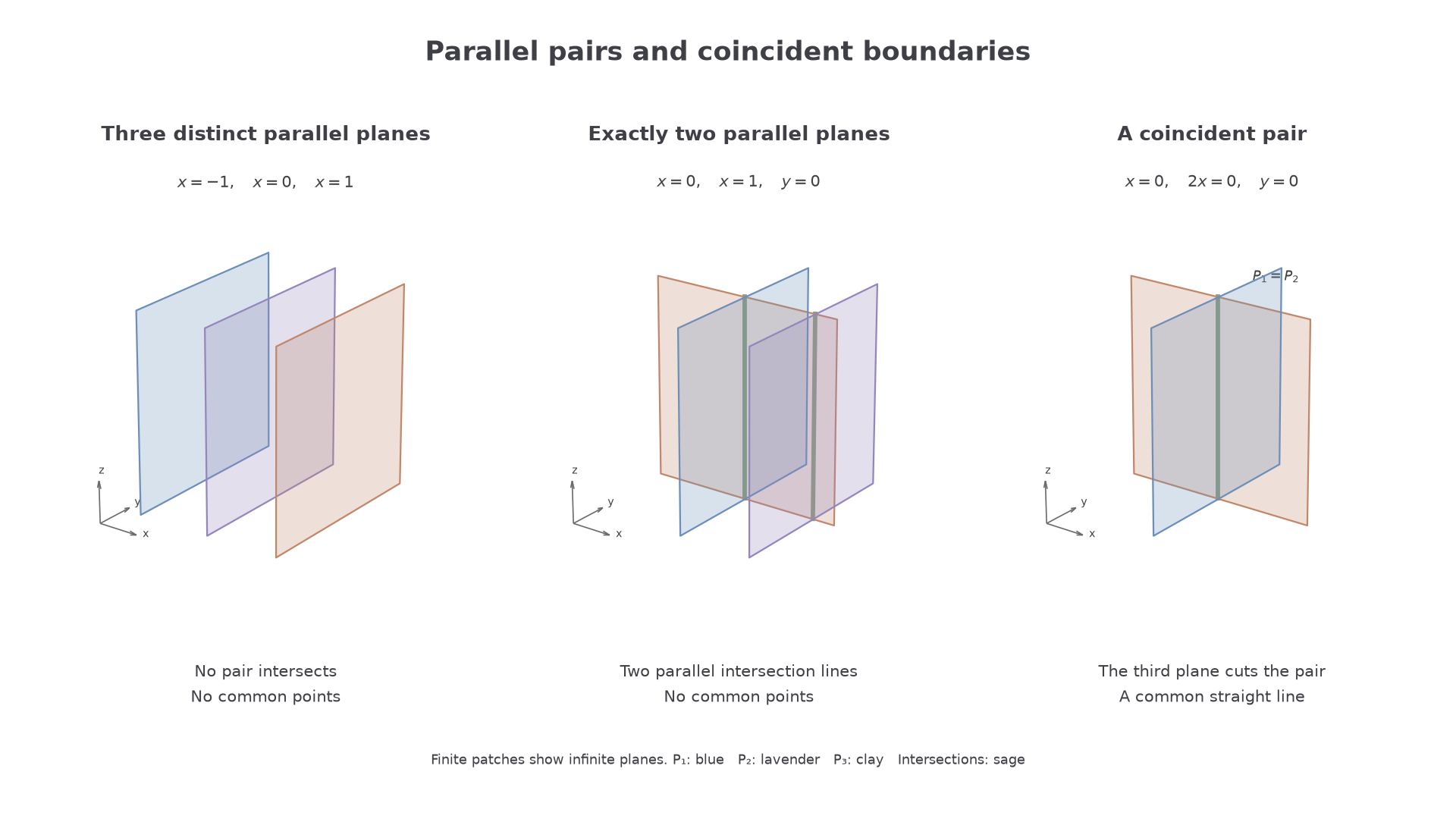
Coincidence needs separate care. If two equations describe the same plane and the third plane cuts it, the common points form a line. If the third is distinct and parallel to it, there are no common points. If all three equations describe the same plane, that whole plane is common. Here is the full set of possibilities.
| Plane relationships | Common points of all three | Coefficient matrix |
|---|---|---|
| Three distinct planes meeting at one point | One point | Non-singular |
| Three distinct planes sharing a line | A line | Singular |
| No parallel pair, triangular-prism arrangement | None | Singular |
| Exactly two distinct parallel planes and a transversal plane | None | Singular |
| Three distinct parallel planes | None | Singular |
| A coincident pair and a third plane cutting it | A line | Singular |
| A coincident pair and a distinct parallel plane | None | Singular |
| All three planes coincident | A plane | Singular |
These classifications are not printed in the formula booklet: learn the reasoning from normals and complete equations, rather than memorising a silhouette.
Worked example 5: a parameter and a common plane
Question. For each real value of , determine the geometrical arrangement of
Plan. Reduce all equations to the same left-hand side, then compare their constants.
Thus and coincide for every . The second plane coincides with them precisely when .
Why this step? Normalising the left-hand sides makes both coincidence and separation visible without attempting an unavailable inverse.
Answer. If , all three planes coincide and their common points form a plane. If , and coincide and is distinct and parallel to them, so there are no common points.
Check. At , lies on all three. At , the second plane requires , incompatible with the other two.
Worked example 6 changes only the third constant from to . There is now a permanently distinct parallel pair, so no parameter value can make the system consistent.
Worked example 6: locating each coincident pair
Question. For every real , determine the geometrical arrangement of
Plan. Compare the three normalised constants , and , identifying exceptional coincidences.
Why this step? A single determinant value, zero for every , cannot identify which pair coincides. Comparing constants supplies the missing positional information.
Answer. For , and coincide; for , and coincide. In either case the remaining plane is distinct and parallel. For every other , all three planes are distinct and parallel. There are no common points for any .
Check. At , the three normalised constants are , and , giving three distinct planes. The permanent contradiction between and is independent of .
A complete geometrical answer identifies which planes are parallel or coincident, as well as the common set. It need not give an equation for a common line.
Watch out
Wrong: “Infinitely many solutions, therefore all three planes coincide.” Right: infinitely many common points may form a line or a plane. Check whether all complete equations are proportional before claiming a common plane.
Compare each possible pair in the final parameter question.
Quick Recap
- Compare normals for orientation and complete equations for coincidence or consistency.
- A non-zero coefficient determinant gives exactly one common point; zero gives no unique common point.
- Three distinct planes with no parallel pair can share a line or form a triangular prism with no common point.
- A distinct parallel pair prevents a common point; all three coincident planes have a whole plane of common points.
The opening planes meet pairwise but have no common point: forces , contradicting the third equation .