4.03h–4.03k - Calculating and interpreting determinants
Calculate determinants of matrices of order two and three, by hand and with a calculator. Use their magnitudes to find areas and volumes after a transformation, and their signs to decide whether orientation is preserved.
A number attached to a square matrix
A unit square is transformed by into a sloping parallelogram. Can you find its area, and tell whether its corners have changed orientation, without finding any side lengths or angles? One number calculated from the matrix answers both questions.
You already know
A transformation matrix acts on column vectors. Its columns give the images of the unit vectors: sends to and to .
Start with the calculation. Multiply down the main diagonal, then subtract the product down the other diagonal. For the opening matrix this gives . The negative sign matters; keep it until you interpret the result.
Determinant
The determinant is a scalar associated with a square matrix. For , it is written , or . For example, . A rectangular matrix such as has no determinant.
Vertical bars around a matrix mean its determinant. They do not mean that you take an absolute value; a determinant can be negative.
Determinant of a matrix of order two
For a matrix of order two,
Not in the formula booklet: learn it.
Keep the products separate until the final subtraction.
Worked example 1: a positive determinant
Question. Find the determinant of .
Plan. Calculate the main-diagonal product and subtract the other product.
Why this step? The subtraction has a fixed order: main diagonal first. Reversing it would change the sign.
Answer. .
Check. Entering as a matrix of order two and evaluating its determinant gives .
Worked example 2 changes just the top-right entry. The matrix still has positive entries, but its determinant becomes negative: the signs of the entries do not decide the sign of the determinant.
Worked example 2: a negative determinant
Question. Find the determinant of .
Plan. Use the same two products, including the changed top-right entry.
Why this step? A determinant is a signed number. Replacing by would discard information about the transformation.
Answer. .
Check. A calculator determinant gives , agreeing with the hand calculation.
On a calculator, define the matrix with the correct dimensions, enter its entries row by row, then apply the determinant function to that stored matrix. If detailed reasoning is required, show the products; a calculator value alone does not show the method.
Watch out
Wrong: . The other diagonal contains , so its product is . Right: .
With a positive entry in every position, the second product can still exceed the first.
Area and orientation in two dimensions
The images of the two unit vectors form the adjacent sides of the image of the unit square. The area of that parallelogram is the magnitude of the determinant; the sign records which way round its corners run.
[DIAGRAM: asset_name: A unit square with its orientation reversed; asset_slug: determinant-area-orientation; caption: The matrix sends an anticlockwise unit square to a clockwise parallelogram of area 7.; description: Left panel shows the unit square OABC with O at (0, 0), A at (1, 0), B at (1, 1), C at (0, 1), and anticlockwise arrows. Right panel shows its image under the matrix with rows (2, 1) and (1, -3): O at (0, 0), A prime at (2, 1), B prime at (3, -2), C prime at (1, -3), with clockwise arrows and area 7.]
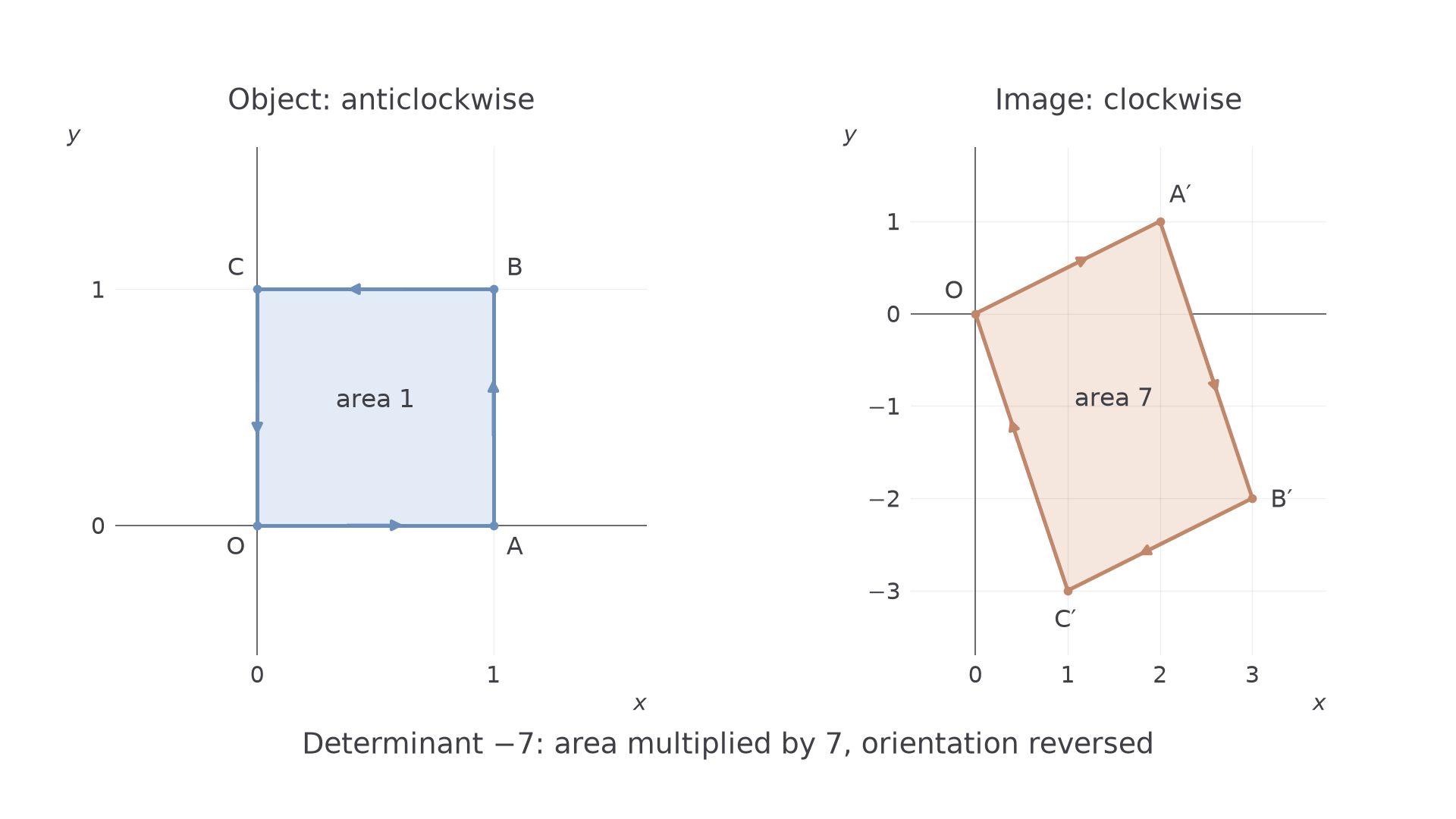
Trace the vertices in their original order. If they originally ran anticlockwise, a positive determinant leaves that order anticlockwise; a negative determinant makes it clockwise. This is orientation, not the direction in which one particular point moves. A half-turn has determinant : it rotates the picture but preserves its orientation.
For columns and , the signed parallelogram area is . One way to see this is to write the column lengths as and , with angles and from the positive horizontal axis. Then
Its magnitude is base times perpendicular height. Its sign changes when the order of the two sides reverses. The same area multiplier applies to every triangle, and hence to a region divided into triangles; it is not restricted to unit squares.
Area scale factor and orientation
For a real matrix of order two representing a linear transformation,
A positive determinant preserves orientation; a negative determinant reverses it. A zero determinant gives an image of zero area.
Not in the formula booklet: learn it.
Apply the area rule to the original area, which need not be one.
Worked example 3: an area scale factor
Question. A triangle has area . It is transformed by . Find its image area and state whether orientation is preserved.
Plan. Calculate the determinant, use its magnitude for area and its sign for orientation.
Why this step? Area uses the magnitude; orientation uses the sign. These are two separate conclusions from the same number.
Answer. The image area is , and orientation is preserved because .
Check. The image of a unit square has area , so an object of area should have image area .
Worked example 4 changes only the bottom-right entry. The determinant changes from to , so the area stays the same while orientation changes.
Worked example 4: the same area, reversed orientation
Question. A triangle has area . It is transformed by . Find its image area and state whether orientation is preserved.
Plan. Keep the determinant's negative sign for the orientation statement, then take its magnitude for area.
Why this step? A negative determinant does not produce a negative area; it tells you that the order of the corners reverses.
Answer. The image area is , and orientation is reversed because .
Check. The diagram shows a unit square becoming a parallelogram of area , with its labelled corners running clockwise.
Here is a useful surprise: a shear has determinant for every real . It can make one side of a unit square arbitrarily long, yet every image still has area . Area preservation does not imply length preservation.
Watch out
Wrong: “The determinant is , so the image area is .” Right: the area is , and the negative sign means orientation is reversed. Also, the determinant is already an area scale factor: do not square it.
Use the determinant once for the area calculation, then interpret its sign in words.
Determinants of order three
A determinant of order three can be reduced to three determinants of order two. Choose a row, remove its row and each entry's column in turn, and combine the smaller determinants with alternating signs.
Using the first row makes the pattern especially easy to see. If the top-left entry is , removing its row and column leaves . The top-middle entry leaves , and the top-right entry leaves . These smaller determinants are called minors of the corresponding entries.
Expansion of a determinant of order three
For a matrix of order three,
This is expansion along the first row. The signs are plus, minus, plus.
Not in the formula booklet: learn it.
You may expand along any row or column. Use the signs in the corresponding positions of the pattern . A row or column containing zeros saves work, since every zero entry contributes zero.
Worked example 5: a zero simplifies the expansion
Question. Calculate , where .
Plan. Expand along the first row; its middle entry contributes zero.
Why this step? Choosing a row with a zero removes one whole minor calculation without changing the determinant.
Answer. .
Check. Expanding down the first column gives .
Worked example 6 changes only the zero in the first row to . The middle contribution now matters, including its minus sign.
Worked example 6: retaining the middle minus sign
Question. Calculate , where .
Plan. Write all three first-row terms before evaluating any minor.
Why this step? Keeping the outside signs separate from the arithmetic inside each minor stops two different subtractions becoming confused.
Answer. .
Check. A calculator determinant of the entered matrix gives . Expanding down the first column also gives .
The calculator method is the same as before, with dimensions set to three by three. Enter the rows carefully, then evaluate the determinant of the stored matrix. Use it to check hand work; when detailed reasoning is required, the expansion must be visible.
Watch out
Wrong: “First-row expansion has three plus signs.” The middle cofactor has a minus sign even when the middle entry itself is positive. If the entry is negative, write both signs: for example, the middle contribution from an entry is times its minor.
Choose a row or column, write its signed minor contributions, then evaluate them.
Volume and orientation in three dimensions
In three dimensions the columns of a matrix give the three edges of the image of a unit cube. Its image is a parallelepiped, and the magnitude of the determinant gives its volume.
For a diagonal matrix , this agrees with ordinary length, width and height: its determinant is , and the image volume is . The determinant also gives the volume multiplier when the image is sloping rather than rectangular.
Volume scale factor and orientation
For a real matrix of order three representing a linear transformation,
A positive determinant preserves orientation; a negative determinant reverses it. A zero determinant gives an image of zero volume.
Not in the formula booklet: learn it.
The sign rule still applies in three dimensions. You can use it directly without trying to explain three-dimensional orientation from a drawing.
Calculate the determinant before applying it to the given volume.
Worked example 7: a volume calculation
Question. A solid of volume is transformed by . Find its image volume and state whether orientation is preserved.
Plan. Expand along the last row, then use the magnitude and sign of the determinant separately.
Why this step? The determinant already combines the effects in all three directions. Cubing it would count those effects again.
Answer. The image volume is , and orientation is preserved because the determinant is positive.
Check. The transformation multiplies horizontal areas by and vertical lengths by , giving a volume multiplier of .
Worked example 8 changes only the middle diagonal entry from to . This makes the horizontal area multiplier negative and changes both the magnitude and the sign of the volume multiplier.
Worked example 8: a negative volume multiplier
Question. A solid of volume is transformed by . Find its image volume and state whether orientation is preserved.
Plan. Expand along the last row, retaining the sign of the two-dimensional determinant.
Why this step? The sign describes orientation; the magnitude describes the volume multiplier. The volume itself cannot be negative.
Answer. The image volume is , and orientation is reversed because the determinant is negative.
Check. The horizontal area multiplier has magnitude , and the vertical stretch has factor , so the volume multiplier has magnitude .
The horizontal transformation and vertical stretch are already combined in the determinant; no further power is needed.
Watch out
Wrong: “A determinant of gives volume ” or “the volume multiplier is .” Right: the image volume is , with orientation reversed.
You can now answer the opening question. The matrix has determinant , so the unit square becomes a parallelogram of area with reversed orientation. No lengths or angles were needed.
Quick Recap
- For a matrix of order two, .
- Expand a determinant of order three using minors and the alternating cofactor signs; choose a row or column containing zeros when possible.
- The magnitude of the determinant multiplies areas in two dimensions and volumes in three dimensions.
- A positive determinant preserves orientation, a negative determinant reverses it, and a zero determinant gives zero image area or volume.
The opening square has image area and reversed orientation, because its transformation matrix has determinant .