4.08d - Volumes of revolution
Build volume formulae from thin circular slices, then use them for rotation about either coordinate axis. You will choose the radius and integration variable, subtract a hollow centre correctly, and calculate volumes when a curve is defined parametrically.
Circular slices about the horizontal axis
The triangle with vertices , and makes a cone when rotated about either coordinate axis. Do the two cones have the same volume?
The sloping side is . Rotating about the horizontal axis turns a vertical strip into a thin disc. Its radius is the distance from the curve to the axis, , and its thickness is a small change in . The circular area is , so adding the disc volumes leads to an integral.
You already know
A circle of radius has area . Definite integration adds the contributions of thin strips; an antiderivative evaluates the resulting integral. You can expand a square before integrating.
If a strip has width , its disc volume is approximately . As the largest strip width tends to zero, the sum tends to . This derives the formula rather than treating it as a rule to guess.
[DIAGRAM: asset_name: A strip becomes a disc; asset_slug: h245_volume_disc_axes; caption: The radius is measured perpendicular to the rotation axis; description: Two panels show the triangle with intercepts two and three. In the left panel a vertical strip has radius y and thickness dx for rotation about the x-axis. In the right panel a horizontal strip has radius x and thickness dy for rotation about the y-axis. The rotation axes are emphasised and the strip dimensions are labelled.]
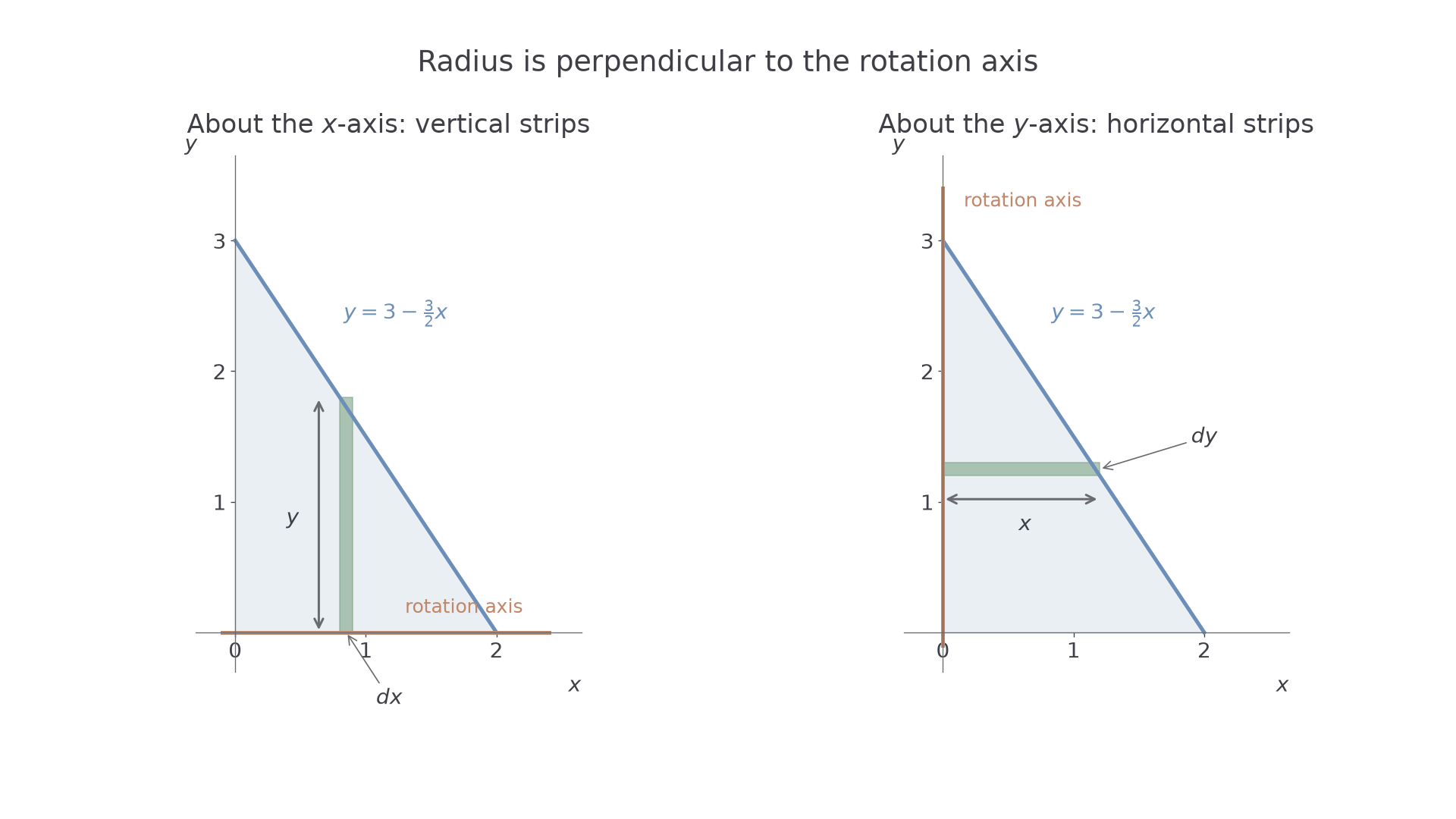
The radius is a length, but squaring makes the same expression work if the curve is below the axis. The region here must extend all the way from the curve to the axis; a gap calls for a subtraction later.
Discs about the x-axis
For the region between , the -axis and , , where , a full rotation gives
The cross-sectional radius is , and the integral must exist.
Not in the formula booklet: learn it.
Start with the triangle in the opening question, keeping the radius as a complete bracket before squaring it.
Worked example 1: deriving a cone's volume by integration
Question. The region bounded by , the coordinate axes and is rotated through radians about the -axis. Determine its exact volume.
Plan. Square the vertical radius, integrate from to , and multiply by .
Why this step? The radius is the height of the sloping line above the rotation axis, so the whole expression must be squared.
Answer. The volume is cubic units.
Check. A cone of radius and height has volume .
The next example changes only the horizontal scale: the triangle is twice as wide, with the same vertical intercept. Each corresponding disc has the same area, but the solid is twice as long.
Worked example 2: stretching along the axis
Question. The region bounded by and the coordinate axes is rotated through radians about the -axis. Determine its exact volume.
Plan. Find the new horizontal intercept, then integrate the squared radius.
Why this step? Changing the horizontal scale changes the integration limit as well as the coefficient of ; keeping the old upper limit would cut the cone short.
Answer. The volume is cubic units.
Check. The axial length doubled while every corresponding radius stayed the same, so the volume doubled from to .
The units offer a quick check: squared radius supplies square units and supplies one more length, giving cubic units.
Watch out
Wrong: , which uses a radius rather than a circular area. Right: . Also, has a middle term; it is not .
Keep the radius and limits visible in the setup before doing the integration.
Circular slices about the vertical axis
For rotation about the vertical axis, horizontal strips become discs, so their radius is and their thickness is a change in .
The derivation is the same as before: a horizontal strip contributes approximately . Adding these and taking the thin-strip limit gives an integral with respect to . The axis determines the perpendicular radius and the direction of thickness.
Discs about the y-axis
For the region between , the -axis and , , where , a full rotation gives
The cross-sectional radius is , and the integral must exist.
Not in the formula booklet: learn it.
Rewrite a curve given as if necessary, so that the radius is expressed in the variable you are integrating.
Worked example 3: the same triangle about the other axis
Question. Rotate the opening triangle, bounded by and the coordinate axes, through radians about the -axis. Determine its exact volume.
Plan. Express in terms of , square that radius and integrate from to .
Why this step? The distance to the -axis is , not ; changing only the label on the old integral would use the wrong radius.
Answer. The volume is cubic units. The two rotations of the same triangle have different volumes.
Check. This cone has radius and height , so .
Change only the horizontal scale, doubling every radius while preserving the vertical height. Squaring the radius means the volume should multiply by .
Worked example 4: stretching perpendicular to the axis
Question. The region bounded by and the coordinate axes is rotated through radians about the -axis. Determine its exact volume.
Plan. Write the horizontal radius in terms of , then use horizontal discs.
Why this step? A perpendicular stretch changes circular areas quadratically, so a doubled radius gives four times the volume, not twice.
Answer. The volume is cubic units.
Check. , as predicted by the doubled radii.
The opening comparison illustrates a useful scaling fact: doubling a solid's axial length doubles its volume, while doubling all its radii with the axial length fixed multiplies the volume by four. If all three dimensions double, the combined factor is eight.
Watch out
Wrong: using -limits in . The limits must be values of the integration variable. Right: use -limits for horizontal discs and express the radius in terms of .
Choose the strip first; that fixes the radius, variable and limits together.
Subtracting the hollow centre
Rotating a region between two curves can produce a hollow centre, so each slice is an outer disc with an inner disc removed.
If the outer and inner radii are and , the slice's area is . It is not : the difference of radii is the ring's thickness, not its radius.
Continue this lesson.
You’re previewing NovaLearn without an account. Create a free account to read the rest.
Create free account