7.02a–7.02c - Graph terminology and notation
Learn the language that describes connections without measuring their lengths or angles. In you will describe vertices, arcs and degrees; in you will recognise simple graphs, connected graphs and trees; in you will distinguish the different kinds of route through a graph.
Vertices and arcs
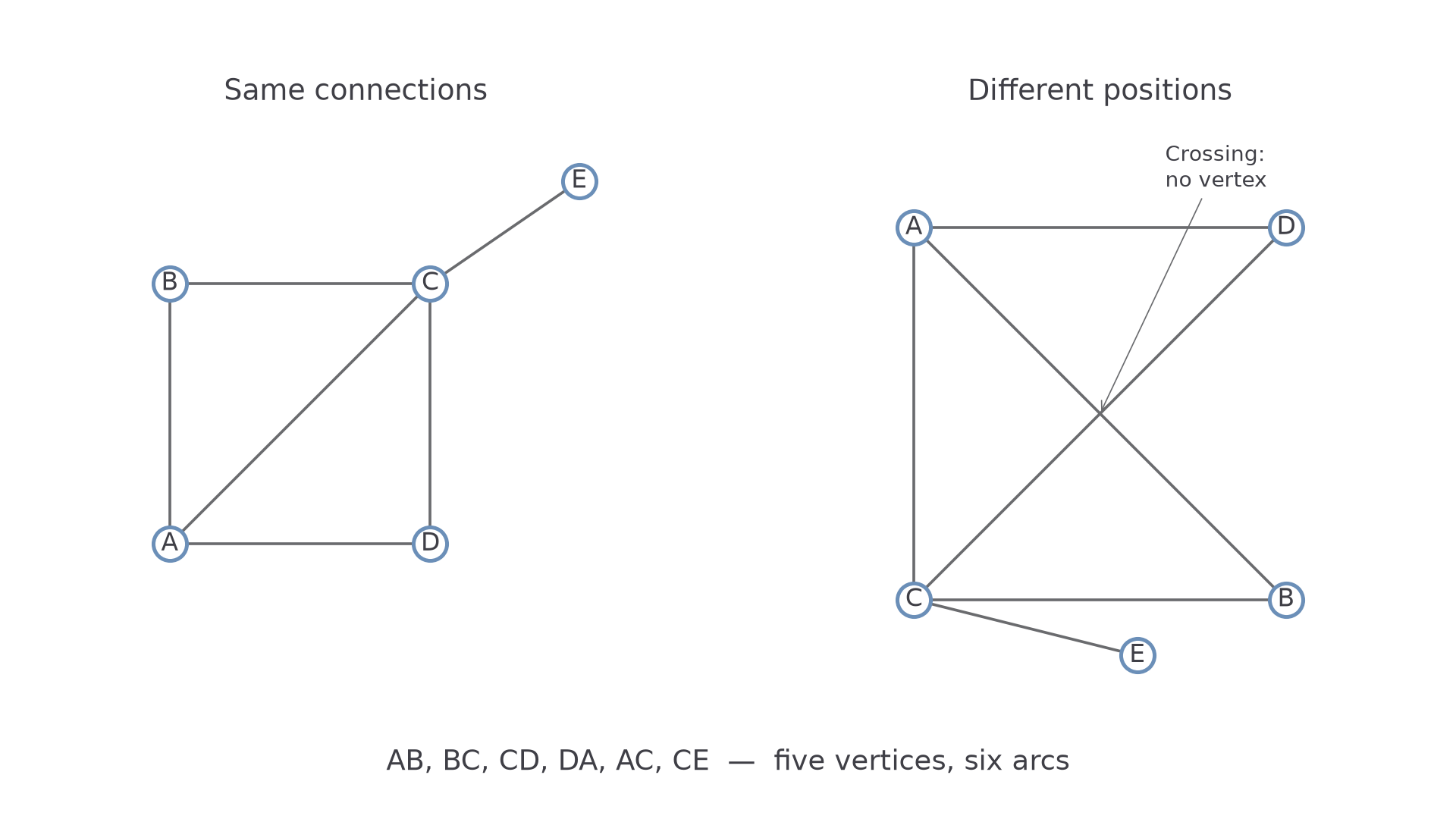
Two drawings show five dots joined by the same six connections. One looks like a square with a tail; the other looks like tangled string. Can they describe exactly the same mathematical object? Yes: a graph records which objects are connected, rather than where you draw them. We will finish by describing a journey in this language, without needing any lengths or angles.
Suppose the objects are , with connections . You can move the dots, stretch the lines or bend them. Keep these six connections and you keep the graph. A crossing is not an extra dot unless a vertex is actually marked there.
[DIAGRAM: asset_name: Connections rather than positions; asset_slug: h245_7_02_same_connections; caption: Two drawings have the same five vertices and six arcs; crossings without a marked dot are not vertices; description: Two panels show the graph with vertices A B C D E and edges AB BC CD DA AC CE in different layouts. A central comparison lists the same six connections. A crossing in the second panel is unmarked and explicitly labelled not a vertex.]
Vertices, arcs and adjacency
A graph consists of vertices and arcs joining them. A vertex is also called a node; an arc is also called an edge. An arc is incident with each of its end vertices. Two vertices are adjacent if an arc joins them; two distinct arcs are adjacent if they share an end vertex. A loop is an arc whose two ends are the same vertex. Multiple arcs join the same pair of vertices more than once.
For the graph above, and are adjacent, and and are adjacent arcs because both are incident with . The arcs and are not adjacent, even if they cross in a drawing. A triangle is a cycle made from three arcs; it is not a loop. These definitions are not supplied in the formula booklet.
Key idea
A graph preserves connections. A crossing, a bend or a change of scale does not change those connections.
Use the end vertices, rather than the appearance of the lines, in this check.
Degrees and counting arcs
The degree of a vertex counts the ends of arcs that meet it. Each ordinary arc contributes one at each end; a loop contributes two at its single vertex, because both of its ends are there.
Degree
The degree of a vertex , written , is the number of incident arc ends, counting a loop twice and counting each multiple arc separately. An isolated vertex has degree . A degree sequence is the list of all vertex degrees, usually written in decreasing order.
Counting at every vertex counts every arc twice. For the opening graph the degrees are , whose sum is , twice its six arcs. This gives a useful result even when the graph is too large to draw.
Degree sum
For a finite undirected graph with arcs,
Consequently, the number of vertices of odd degree is even: an even total cannot contain an odd number of odd summands.
Not in the formula booklet: learn it.
The result counts loops correctly only if their two ends are both included in the degree.
Worked example 1: reading an arc list
Question. A graph has vertices and arcs . State its degree sequence and verify the degree-sum result.
Plan. Count the arcs incident with each vertex, then add the degrees.
Why this step? Count at the labelled vertices first; sorting too early makes it easier to miss a connection.
Answer. The degree sequence is , with sum twice the number of arcs.
Check. Exactly two vertices, and , have odd degree.
The second example changes one feature: one extra arc is a loop. Its contribution to the degree is two, not one.
Worked example 2: adding a loop
Question. The graph in Worked example 1 gains a loop at . State the new degree sequence and number of arcs.
Plan. Increase by two, leaving all other degrees unchanged.
Why this step? The loop is one extra arc but contributes two extra incident ends.
Answer. The sequence is , and there are arcs.
Check. The original five arcs plus one loop give six arcs directly.
Degree sums provide a quick check, but an even sum alone does not prove that a proposed sequence is possible for a simple graph.
Watch out
Wrong: “A loop adds to the degree.” It adds . Also, has even sum but cannot be the degree sequence of a simple graph on four vertices: a vertex can have at most three distinct neighbours.
Try a different extra arc, this time joining two different vertices that were already adjacent.
Simple graphs, connected graphs and trees
Three different restrictions answer three different questions: are connections repeated, can every vertex be reached, and are there any closed circuits?
Simple and connected graphs
A simple graph has no loops and no multiple arcs. A graph is connected if there is a path between every pair of vertices. In this course simply connected means both simple and connected. A tree is a connected graph with no cycles.
Continue this lesson.
You’re previewing NovaLearn without an account. Create a free account to read the rest.
Create free account