8.03l, 8.03m - Isomorphism and abstract groups
Two groups can have different-looking elements but identical multiplication structure. You will establish or rule out an isomorphism, and use group laws to solve equations, prove identities and complete abstract Cayley tables. The reasoning will depend on the stated algebraic properties rather than on what the element labels happen to resemble.
Showing that groups are isomorphic
Can addition on a four-hour clock really be the same structure as multiplication of complex numbers? Adding one step four times returns to zero; multiplying by four times returns to . Matching those cycles is the start of an exact correspondence, not just a visual analogy.
You already know
A finite cyclic group consists of the powers of a generator. An order- generator has powers , with exponents reduced modulo . Isomorphic-looking patterns must still respect the operation, and a group's size alone does not determine its structure.
Label the clock positions under addition modulo , and match them to under multiplication. The rule preserves the calculation: adding clock positions corresponds to multiplying their complex images, because .
[DIAGRAM: asset_name: A correspondence between two cyclic groups; asset_slug: h245_8_03_isomorphism; caption: Adding one modulo four and multiplying by i trace matching cycles, and the correspondence also preserves every combined product; description: A left panel shows the cycle from 0 to 1 to 2 to 3 and back to 0 under addition modulo 4. A right panel shows the matching cycle from 1 to i to minus 1 to minus i and back to 1 under complex multiplication by i. Matching positions have the same relative placement. A central mapping sends k to i to the power k, with 0 mapped to 1 and 2 mapped to minus 1.]
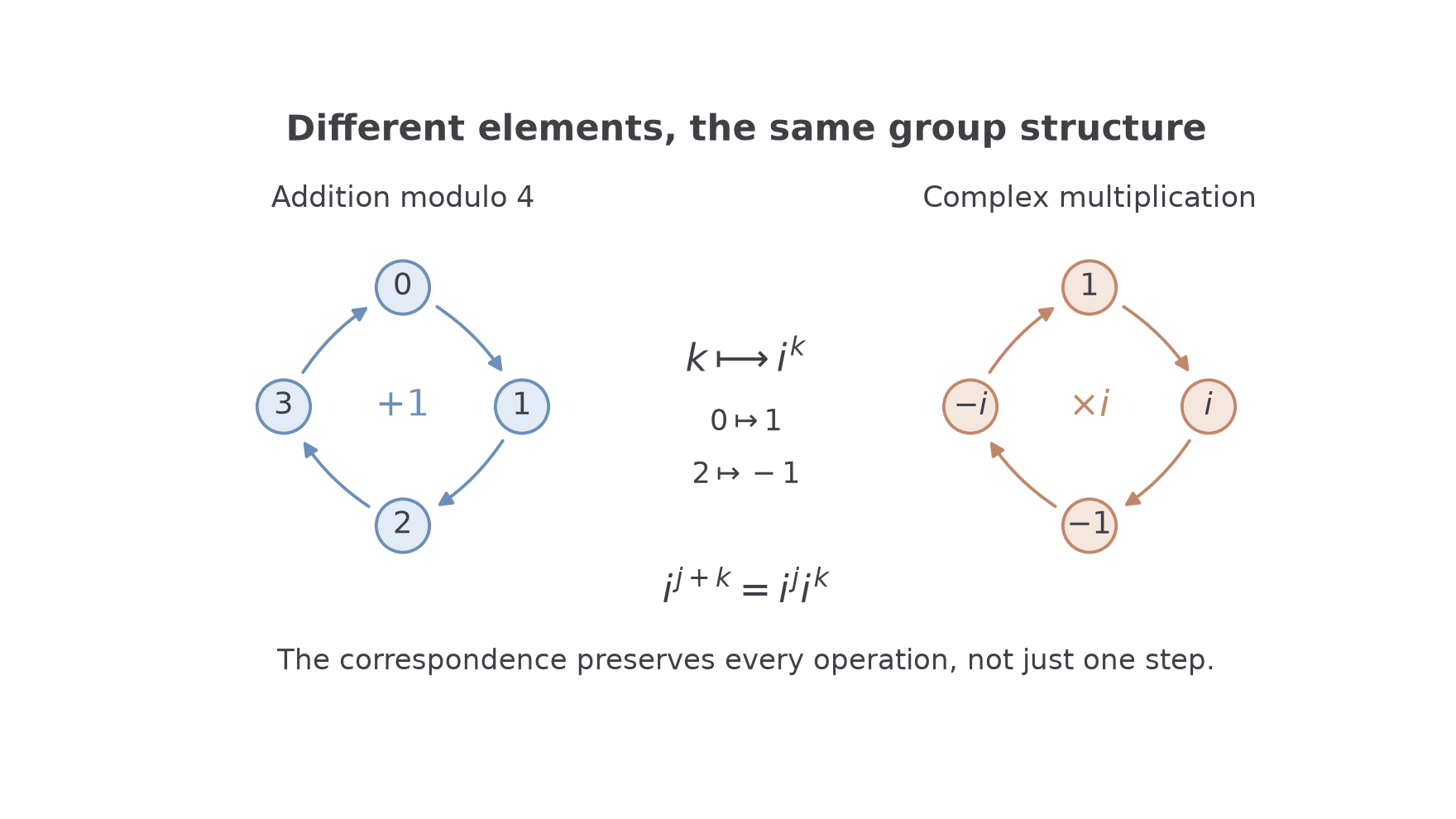
The identities must match: clock corresponds to multiplicative . Their different names do not matter.
Isomorphism
Groups and are isomorphic, written , if there is a one-to-one correspondence from all elements of onto all elements of that preserves the operation:
The correspondence is an isomorphism. Equivalently, consistently rename the row headings, column headings and entries of one Cayley table to obtain the other table. Equal group orders alone do not establish an isomorphism.
For finite cyclic groups of the same order, match one generator to another and extend by powers. This gives a correspondence because the powers in each group are distinct until the same first return; it preserves products because both add exponents modulo that common order. Thus two cyclic groups of the same finite order are isomorphic. The definition and this result are not in the formula booklet.
Worked example 1: matching generators
Question. Let have order , and let under multiplication. Show that the correspondence is an isomorphism.
Plan. List all images to establish a one-to-one correspondence, then check products using the exponent rule.
Why check arbitrary powers? They represent every pair of elements in , so the equality proves product preservation for the whole group.
Answer. The correspondence is bijective and preserves products, so .
Check. maps to , the correct identity image.
Change just the image of the generator from to the other order- element, . The correspondence changes, but the structures still match.
Worked example 2: another isomorphism between the same groups
Question. For the same groups, show that is also an isomorphism.
Plan. Recalculate the images and use the same power law for products.
Why must the generator image have order ? It must provide four different powers, or the correspondence cannot be one-to-one.
Answer. This is another isomorphism from to .
Check. Trying instead would give and , so that attempted correspondence would fail to be one-to-one.
When identifying a group as cyclic, give a generator or establish an element of full group order. Merely describing two groups as cyclic without showing the unfamiliar one has that property leaves the key step unsupported.
Watch out
Wrong: “Both groups have four elements, so they are isomorphic.” Right: preserve the products, for example by showing both are cyclic of order and matching generators. The non-cyclic Klein four-group also has four elements.
The same correspondence works for another modular multiplication group with a different cycle length.
Ruling out an isomorphism
A mismatch in a structural property rules out every possible renaming at once.
An isomorphism sends the identity to the identity and powers to the corresponding powers: . Hence it preserves element orders. To justify the last claim, a first return gives ; a smaller return in the image would, by one-to-one correspondence, give a smaller return for . It also preserves commutativity and subgroup structure. These consequences are not in the formula booklet.
To prove non-isomorphism, compare group orders first, then an informative invariant: a possible element order, the number of elements of some order, cyclicity, or commutativity. Matching one such property does not by itself prove isomorphism.
Worked example 3: an absent element order
Question. Let be the group of pairs , with , , under coordinatewise addition modulo and , respectively. Show that is not isomorphic to .
Plan. Compare the largest possible order of an element with the order of a generator in .
But has a generator of order , while has no element of that order.
Why compare orders rather than names? An isomorphism may rename every element, but cannot change its first return to the identity.
Answer. , since the existence of an element of order differs.
Check. has order , so does have non-trivial cycles; they are simply too short to generate all eight elements.
Keep , but change just the comparison group to the eight triples of binary coordinates. Now neither group has an element of order , so use a finer comparison.
Worked example 4: counting elements of order two
Question. Let be the group of triples , with each coordinate or , under coordinatewise addition modulo . Show that , defined above, is not isomorphic to .
Plan. Count the non-identity elements that return after two additions in each group.
Why count non-identity elements separately? An identity that also squares to itself has order , not .
Answer. , because they have different numbers of elements of order .
Check. The three order- elements of are . Alternatively, contains an element of order , whereas does not.
These groups are all abelian and all have eight elements. Those two matches are insufficient; one structural mismatch settles the question.
Watch out
Wrong: “Both groups have one identity and are abelian, so they are isomorphic.” Right: matching selected properties is necessary evidence, not a correspondence. A mismatch proves non-isomorphism; a match alone need not prove isomorphism.
The two familiar order- structures give a compact further comparison.
Algebra in an abstract group
Group algebra permits cancellation, but a factor must be removed from the side where it occurs.
The identity and the inverse of an element are unique. If were both identities, then using , while using , so . If were both inverses of , then
using associativity. These proofs use no commutativity.
Similarly, can be cancelled by multiplying on the left by , while is cancelled on the right. One must not move a factor past another without a reason.
The inverse of a product
In any group,
The factor order reverses. More generally,
Not in the formula booklet: learn it.
Continue this lesson.
You’re previewing NovaLearn without an account. Create a free account to read the rest.
Create free account