6.04a–6.04c - Centres of mass of composite bodies
Replace a body's distributed weight by one force at its centre of mass. Use symmetry and mass-weighted coordinates to locate that point for particles, joined or cut-out laminae, solids and wires, choosing the correct standard centre from the formula booklet.
Weight, symmetry and empty space
Can an object's centre of mass be somewhere that contains none of the object? A uniform circular wire has its centre of mass at the centre of the circle, where there is only air. The centre of mass describes a balance of mass, not a specially heavy piece of material.
In a uniform gravitational field, every small piece has a downward weight proportional to its mass. These parallel forces have the same overall force and moment as one downward force through the centre of mass. A body of mass therefore has weight , acting at a point usually labelled .
Centre of mass
The centre of mass is the point whose position is the mass-weighted average of the positions of all the body's parts. In a uniform gravitational field, the body's weight may be represented by a single force acting at this point.
For linear motion you may model a rigid body as a particle of the same mass at . That preserves the resultant-force equation for its translation. It does not preserve the way forces turn the body: their lines of action still matter in a rigid-body equilibrium problem.
Uniform body
A uniform body has constant density of the appropriate kind: mass per unit length for a thin wire, mass per unit area for a lamina of negligible thickness, or mass per unit volume for a solid. A symmetrical outline alone is insufficient if one side is denser.
Symmetry is a mass-pairing argument. Reflection in a line pairs equal pieces at equal perpendicular distances on opposite sides, so their contributions cancel in that direction. The centre of mass of a uniform lamina lies on every line of symmetry. Two intersecting symmetry lines therefore fix its position. The corresponding statement uses planes of symmetry in three dimensions. These symmetry principles and the particle model are not in the formula booklet: learn them.
A uniform rectangular lamina with corners , , and has . A uniform rectangular wire frame with those corners has the same centre, despite having no material there. A uniform semicircular lamina has only one symmetry axis: it fixes one coordinate, but not both.
Key idea
Use symmetry of the mass distribution to fix coordinates; never assume that the centre of mass must lie in the material.
Before calculating, decide what the model's symmetry actually tells you.
Mass-weighted coordinates
Two equal masses balance halfway between them; an unequal pair balances nearer the larger mass. The position is an average in which each mass supplies its own weight in the calculation.
You already know
The moment of a force about a point is its magnitude multiplied by the perpendicular distance to its line of action. Clockwise and anticlockwise moments have opposite signs. Weight is , rather than .
Suppose particles of masses have coordinates . Equating the moment of their downward weights to that of the single resultant gives . The common cancels. Turning the coordinate system gives the same equation for the other coordinate.
Centre of mass of particles or components
For masses , with total mass ,
Use each component's own centre of mass as its position, and one common origin for every coordinate. The last equation is needed only in three dimensions.
Not in the formula booklet: learn it.
The equations contain masses because the same gravitational acceleration has cancelled from both sides. That cancellation will not allow you to mix mass and force in a later moments equation.
Worked example 1: three particles in a plane
Question. Particles of masses , and are fixed at , and , respectively. Find their centre of mass.
Plan. Calculate the total mass and the first moment of mass for each coordinate.
Why this step? Each coordinate is multiplied by the mass at that coordinate; averaging the three positions equally would treat the masses as equal.
Answer. The centre of mass is .
Check. About , the signed first moments are ; about , they are .
Change only the third mass, from to . The centre must move towards , so its horizontal coordinate should fall and its vertical coordinate should rise.
Worked example 2: changing one mass
Question. The masses at , and are now , and . Find the new centre of mass.
Plan. Keep the coordinates and recalculate the total mass and the affected moments.
Why this step? Even the horizontal coordinate changes, although its numerator does not, because the total mass in the denominator has increased.
Answer. The new centre of mass is .
Check. Its position is closer to than was, and .
A component can itself be a rigid body. Replace it by its mass at its own centre, then use precisely the same sum.
Watch out
Wrong: for unequal masses. Right: . The plain coordinate average works only when the masses are equal.
Keep the same three positions and vary that upper mass once more.
Adding and removing laminae
For pieces cut from the same uniform sheet, mass is proportional to area. The common mass per unit area cancels, so you can use signed areas in the mass-weighted equations.
A rectangle is centred at the intersection of its diagonals. A triangular lamina is centred two-thirds of the way along any median from its vertex; equivalently, its coordinates are the averages of its three vertices. The triangular result is in the formula booklet. It does not extend to averaging the vertices of an arbitrary quadrilateral: split that shape into rectangles and triangles instead.
For a semicircular lamina, use the booklet's sector formula with half-angle . Its centre lies from the circle's centre towards the curved edge. This derived semicircle form is not listed separately in the booklet; it follows from the sector result given there.
[DIAGRAM: asset_name: Adding or removing the same semicircle; asset_slug: h245_composite_lamina_semicircle; caption: The same semicircle has a positive area when attached and a negative area when removed; description: Two equal-scale coordinate diagrams show a six by four rectangle. Left: an upper semicircle of radius three is attached above its top edge, centred at (3,4), with its centroid at height four plus four over pi. Right: the same upper semicircle is removed above the bottom edge inside the rectangle, centred at (3,0), with its centroid at height four over pi. The remaining body and component centroids are clearly labelled.]
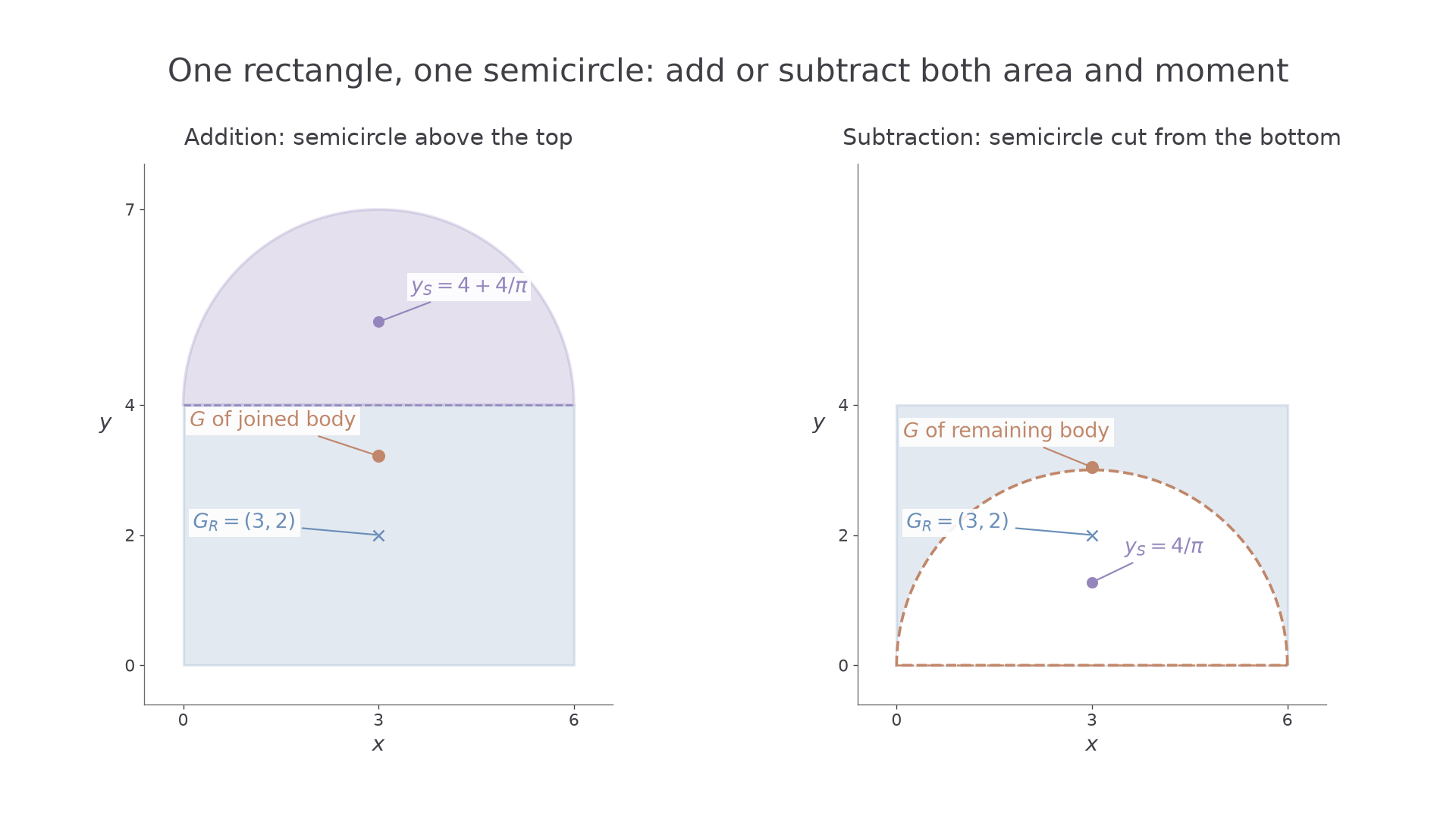
If a hole was cut from a complete lamina, write “whole body minus missing piece”. This subtracts both its area and its first moment; it is an accounting device, not a claim that the hole has physical negative mass.
Composite lamina with a hole
For a uniform lamina of area , formed from a complete lamina of area by removing an area ,
The coordinates locate the centre of the missing lamina relative to the same origin. For addition, replace both minus signs by plus signs. If the pieces have different densities, use their masses instead of their areas.
Not in the formula booklet: learn it.
First attach a semicircle to a rectangle; the centre should move towards the attached part.
Worked example 3: a curved edge added to a rectangle
Question. A uniform lamina consists of the rectangle , , with a semicircle of radius attached above its top edge. Find its centre of mass.
Plan. Use symmetry for , then combine the rectangle and semicircle using their areas and centroid heights.
Why this step? The booklet gives the semicircle's displacement from its own circle centre; add to turn that into a height above the chosen origin.
Answer. , with to three significant figures.
Check. The height lies between the two component heights, and , and is above the rectangle's centre.
Change the operation from attachment to removal. Put the semicircle inside the rectangle, above its bottom edge; its own centroid is now measured from . The subtraction should move the centre away from the missing low material.
Worked example 4: the same curved piece removed
Question. From the rectangle , , remove the upper semicircular region of radius centred at . Find the centre of mass of the remaining uniform lamina.
Plan. Subtract the semicircle's area and first moment from those of the complete rectangle.
Why this step? Removing mass below the original centre raises the remaining centre; adding the hole's moment would predict the wrong direction of movement.
Answer. , with to three significant figures.
Check. This is above the original height and below the top edge . The remaining area is positive.
Continue this lesson.
You’re previewing NovaLearn without an account. Create a free account to read the rest.
Create free account