4.05b - Transforming polynomial equations
Find an equation with prescribed changes to its roots without solving the original equation. You will translate and scale roots, take their reciprocals, and replace them by their squares, using a substitution that connects the old unknown to the new one.
Translating every root
How can you replace every root of by its square without finding the roots? This lesson builds towards that question. First, make a simpler change: move every root the same distance.
You already know
If , then is a root of . Multiplying the whole equation by a non-zero constant leaves its roots unchanged. The coefficients give sums and products of roots, so they can check a transformed equation.
Suppose has roots , , , and you want roots , , . Each new root is the corresponding old root minus . Introduce . To put this change into the old equation you need , so the new equation is .
[DIAGRAM: asset_name: Translating the roots of a cubic; asset_slug: h245_4_05b_root_translation; caption: The rule w = x - 2 moves each old root two units left, but the substitution into f is x = w + 2; description: Two horizontal number lines with identical scales. The upper line is labelled x and has blue roots at 1, 2 and 3. The lower line is labelled w and has clay roots at -1, 0 and 1. Parallel arrows join corresponding roots, each moving two units left. An annotation gives w = x - 2, x = w + 2 and f(w + 2) = 0.]
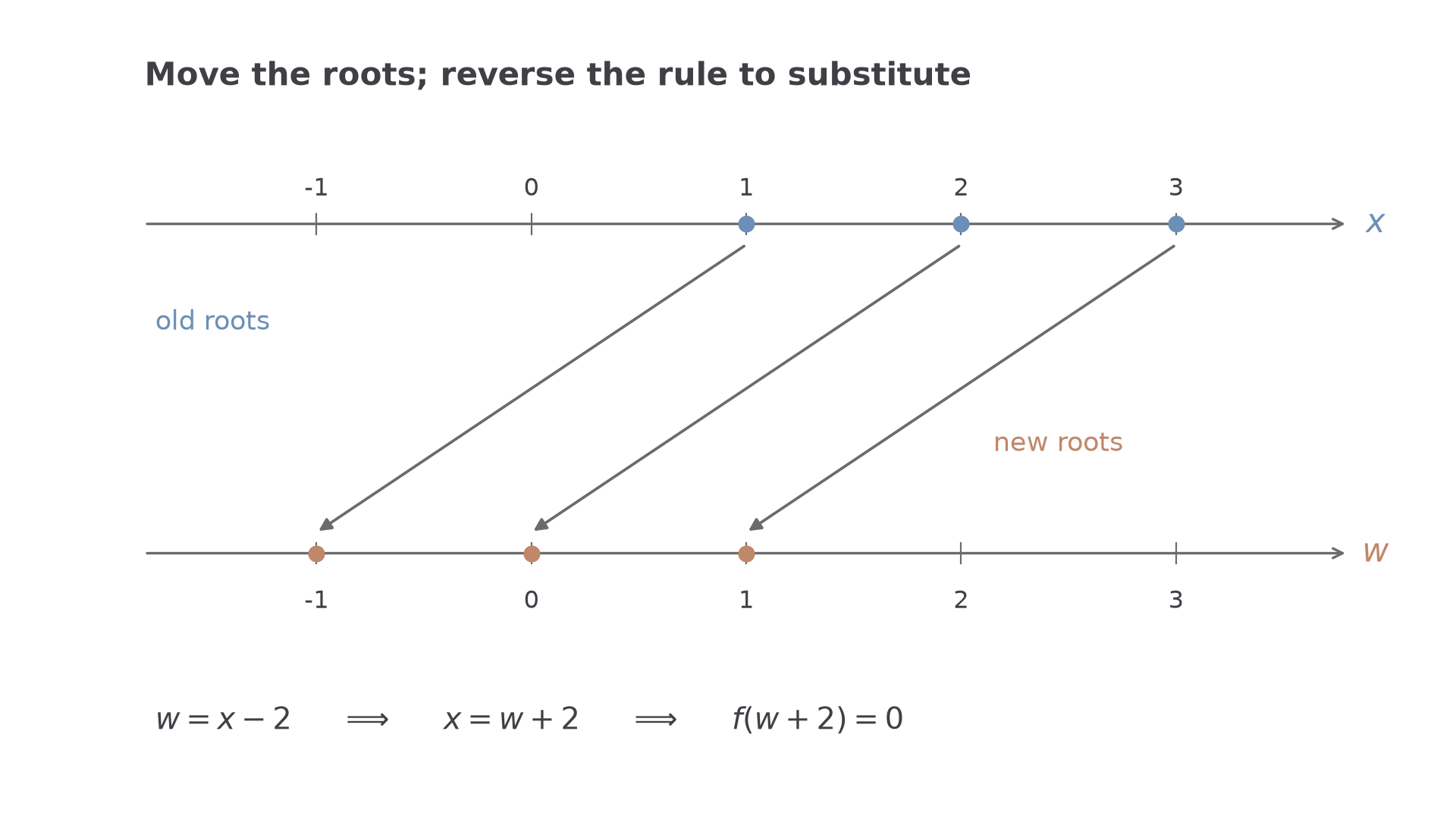
This reversal is the whole decision. The root rule describes where roots go; the inverse rule describes what replaces in the given polynomial.
Translating roots by a constant
If has roots , an equation with roots is
because gives . This holds for real or complex roots and any constant .
Not in the formula booklet: learn it.
Write both directions of the relationship before expanding. That small step prevents a long calculation with the wrong roots.
Worked example 1: adding one to each root
Question. The equation has roots , , . Determine an equation whose roots are , , .
Plan. Set , substitute , then collect powers of .
Why this step? Substituting would produce roots one smaller than the old roots, which is the opposite change.
Answer. .
Check. The old root sum is ; adding to each of three roots gives , agreeing with the new quadratic coefficient. In this case the roots , , become , , , whose product is .
Keep the translation , but change the degree from cubic to quartic. The substitution does exactly the same job; only the expansion has an extra power.
Worked example 2: removing a quartic's cubic term
Question. The equation has roots , , , . Determine an equation with roots , , , .
Plan. Set , so , then expand every bracket.
Why this step? The old root sum is , so their mean is . Adding makes the new sum zero, which removes the cubic coefficient.
Answer. .
Check. gives . Hence the old roots are , , which make zero. Expanding those factors gives the original quartic.
Removing the mean works for complex roots too, because the coefficient relationship is algebraic. You do not need a graph with real intercepts.
Watch out
Wrong: “New roots , so replace by .” Right: write , then rearrange to . The sign in the substitution is opposite to the translation of the roots.
In a “show that” question, expand the brackets and show the collection of terms. Stating the target equation does not demonstrate the change.
Scaling and translating together
If each new root is times the old root, write , not . Adding a translation changes the rearrangement, but no new principle is needed.
A linear change of roots
If the new roots are , where , set
The transformed equation is
Multiplication by a suitable non-zero constant can clear the coefficient denominators.
Not in the formula booklet: learn it.
The condition makes the change reversible. If , every proposed root would collapse to ; this substitution cannot be inverted.
Worked example 3: doubling the roots
Question. The equation has roots , , . Determine a cubic equation with integer coefficients and roots , , .
Plan. Substitute , then multiply the entire equation by .
Why this step? Each power of receives a different power of the scale factor. Scaling the coefficients directly would miss that.
Answer. .
Check. The old product is . Doubling three roots multiplies their product by , giving , as the new constant requires.
Change only the root rule by adding after doubling. Use the same denominator-clearing step, then expand the shifted powers.
Worked example 4: twice each root plus one
Question. For the same cubic, determine an equation with integer coefficients whose roots are , , .
Plan. Set , giving , and multiply by .
Why this step? Solve the complete rule for before substituting; subtracting and dividing by must occur in that order.
Answer. .
Check. The old root sum is , so the new sum is . Also is an old root, so must work: .
Sometimes the scale is disguised. For roots of this cubic, , so , and . Such a question is a scaling problem after using the product relationship.
Exam tip
If asked for an equation with integer coefficients, clear every coefficient denominator and finish with an equation, including . An expression alone does not state the required equation.
You can test a proposed change before expanding: put a known old root into the rule and check the corresponding new root afterwards.
Taking reciprocals of roots
To replace each root by its reciprocal, write , so . This needs every old root to be non-zero: check the constant coefficient before you begin.
For a cubic,
The coefficients reverse their order. This also works for quartics and other degrees, but the substitution explains the reversal and its conditions.
Reciprocal root equation
For , where and , an equation whose roots are the reciprocals of the roots of is
The old roots are non-zero because . The resulting polynomial has non-zero constant , so has not been added as a root.
Not in the formula booklet: learn it.
Keep the non-zero restriction while clearing the variable denominator; afterwards check the new polynomial at zero.
Worked example 5: reciprocal roots
Question. Determine a cubic equation with integer coefficients whose roots are the reciprocals of the roots of .
Plan. Put , clear , then arrange descending powers.
Why this step? The constant in the original polynomial rules out a zero old root, so every required reciprocal exists.
Answer. .
Check. The old product is , so the new product should be , agreeing with . The new constant is non-zero.
Change only the scale of the reciprocal: use instead of . Reversing the coefficients alone is no longer enough.
Worked example 6: scaled reciprocals
Question. For the same cubic, determine an equation with roots , , .
Plan. Set , so , then clear the denominator.
Why this step? A factor of in contributes to the cubic term and to the square term, so the full substitution is safer than a coefficient shortcut.
Answer. .
Check. Its root product is , agreeing with .
If the original polynomial has a zero root, factor out that root first. An equation for reciprocals of the remaining non-zero roots has lower degree; there is no reciprocal corresponding to zero.
Watch out
Wrong: gives . Right: multiply by to get , so . Check the rearrangement before taking powers.
The product relationship gives a particularly quick independent check on a reciprocal transformation.
Replacing each root by its square
The substitution is not reversible in the same way as a translation: opposite roots have the same square. You can nevertheless eliminate without calculating any roots.
For , group the even and odd powers after putting :
The result is cubic in . Each old root supplies one new squared root, counted with multiplicity. If two opposite roots occur, the new equation has a repeated root. For example, and both square to : squaring can turn distinct roots into a repeated one.
A cubic for squared roots
If , with , has roots , , , an equation with roots , , is
This follows by the substitution and elimination shown above. It is a method to derive, rather than a separate rule to memorise.
Not in the formula booklet: learn it.
There is no need to divide by . Avoiding that division retains cases in which it is zero and prevents the loss of a root.
Worked example 7: two roots with the same square
Question. The equation has roots , , . Determine an equation with roots , , .
Plan. Set , isolate the terms containing , then square to eliminate .
Why this step? Dividing by would discard . That is a required squared root, not an unwanted case.
Answer. .
Check. The old polynomial is , with roots , , . Their squares are , , . The new polynomial is .
Change only the constant from to . The same elimination now gives the answer to the opening question, even though the original cubic no longer has that convenient factorisation.
Worked example 8: the opening cubic
Question. The equation has roots , , . Determine an equation whose roots are their squares.
Plan. Use , keeping all terms until the final expansion.
Why this step? Squaring the isolated odd part leaves only , which the substitution replaces by . No individual root is needed.
Answer. .
Check. The old coefficient relationships give , , . The new sum is , the new pair sum is , and the new product is , agreeing with all three coefficients.
Squaring eliminated the sign of , but it did not ask you to choose the positive square root. In particular, complex roots do not have an ordering into positive and negative values.
Watch out
Wrong: from , substituting and keeping only positive real values. Right: eliminate algebraically and keep multiplicities. Two opposite old roots may produce the same new root twice.
The last calculation answers the opening question with a cubic in squared roots. The coefficients provide a check; the substitution provides the requested construction.
Quick Recap
- Define the new root in terms of the old root , then rearrange before substituting into the given equation.
- Translate and scale using ; multiply the whole equation to clear coefficient denominators.
- Reciprocal changes require non-zero old roots; clear variable denominators and check that zero has not become a root.
- For squared roots, put , group odd and even powers, then eliminate by squaring.
The squares of the roots of satisfy , obtained without solving the original cubic.