4.03r, 4.03s - Solving simultaneous equations
Write two or three simultaneous linear equations as one matrix equation and solve a system with a unique solution by using an inverse. When no unique solution exists, use the equations themselves to distinguish an infinite set of solutions from no solutions.
Two equations as a matrix equation
The equations and appear to pin down one pair of numbers. Can you tell before solving whether a system has one solution, infinitely many or none? A determinant makes the first decision; if it is zero, a second check is essential.
You already know
A square matrix has an inverse exactly when its determinant is non-zero. For a non-singular matrix, gives , with the inverse multiplying on the left.
Collect the coefficients in the same variable order in every row. For the opening equations,
Multiplying the first row by the variable column gives the first equation; multiplying the second row gives the second. The matrix of coefficients is , the unknown column is , and the constant column is .
A unique solution by an inverse
For , where is a square coefficient matrix,
The solution is unique. If , there is no unique solution and this inverse method cannot be used.
Not in the formula booklet: learn it.
The multiplication fixes the side: a column must be pre-multiplied by .
Worked example 1: solving two equations
Question. Use an inverse matrix to solve and .
Plan. Form the coefficient matrix, find its inverse and apply it to the constant column.
Why this step? The inverse turns the whole coefficient matrix into the identity at once, leaving the unknown column on its own.
Answer. , . The solution is unique because the determinant is non-zero.
Check. and , so both original equations hold.
Worked example 2 changes only the second constant. The coefficient matrix and its inverse remain the same, so the new solution needs just one new matrix multiplication.
Worked example 2: reusing the same inverse
Question. Use an inverse matrix to solve and .
Plan. Apply the inverse from Worked example 1 to the new constant column.
Why this step? An inverse depends on the coefficients, not the constants. Changing a constant changes the solution but cannot change whether this matrix has an inverse.
Answer. , , again uniquely.
Check. and .
Check both equations after solving. Satisfying just one equation gives no guarantee about the other.
Exam tip
If the instruction is “Use an inverse matrix”, display the inverse and its multiplication by the constant column. Solving by elimination alone does not demonstrate the required method. In a detailed-reasoning question, a calculator's simultaneous-equation answer alone earns no method marks.
Keep the coefficients across rows, and the constants in a separate column.
Three equations as a matrix equation
For three equations, put the coefficients of , and , in that order, across each row. An absent variable has coefficient zero; keep its place.
For example, contributes the row , not a shortened row. Swapping the order of the equations is harmless if you also swap the constants in the same way. Transposing the coefficient matrix generally changes the system.
Worked example 3: three unknowns
Question. Use an inverse matrix to solve
Plan. Include zero coefficients, find the inverse of the coefficient matrix and multiply it by the constant column.
Using the cofactor method, or the matrix inverse operation on a calculator,
Now
Why this step? The constant column follows the equation order, while the answer column follows the chosen variable order.
Answer. , , . The non-zero determinant guarantees uniqueness.
Check. , and .
Worked example 4 changes only the last constant from to . The same inverse now produces a different value for every unknown.
Worked example 4: one new constant, three new answers
Question. Use an inverse matrix to solve
Plan. Keep the same coefficient matrix and apply its inverse to .
Why this step? Each unknown is a combination of all three constants. Changing one equation's constant need not change just one unknown.
Answer. , , .
Check. , and .
When a calculator is allowed to supply the inverse, still write the coefficient matrix and . This records the mathematical operation and makes an entry error easier to trace.
Watch out
Wrong: putting one equation's coefficients down a column. Right: one equation occupies one row, in a fixed variable order. Put a zero in every missing variable's position before entering the matrix.
The next system changes only the coefficient of in the last equation from Worked example 4, so its inverse must be recalculated.
A zero determinant and consistency
A zero determinant says there is no unique solution. It does not tell you whether the equations agree with one another. That distinction comes from their constants as well as their coefficients.
Consider and . The second equation is exactly twice the first, so it adds no new restriction. Change its right-hand side to , however, and the equations contradict one another: twice the first left-hand side cannot equal both and .
[DIAGRAM: asset_name: Consistent and inconsistent singular systems; asset_slug: singular-system-consistency; caption: The same singular coefficient matrix can describe coincident lines or distinct parallel lines.; description: Left panel shows the coincident lines x + 2y = 5 and 2x + 4y = 10, giving infinitely many common points. Right panel shows the distinct parallel lines x + 2y = 5 and 2x + 4y = 11, giving no common point.]
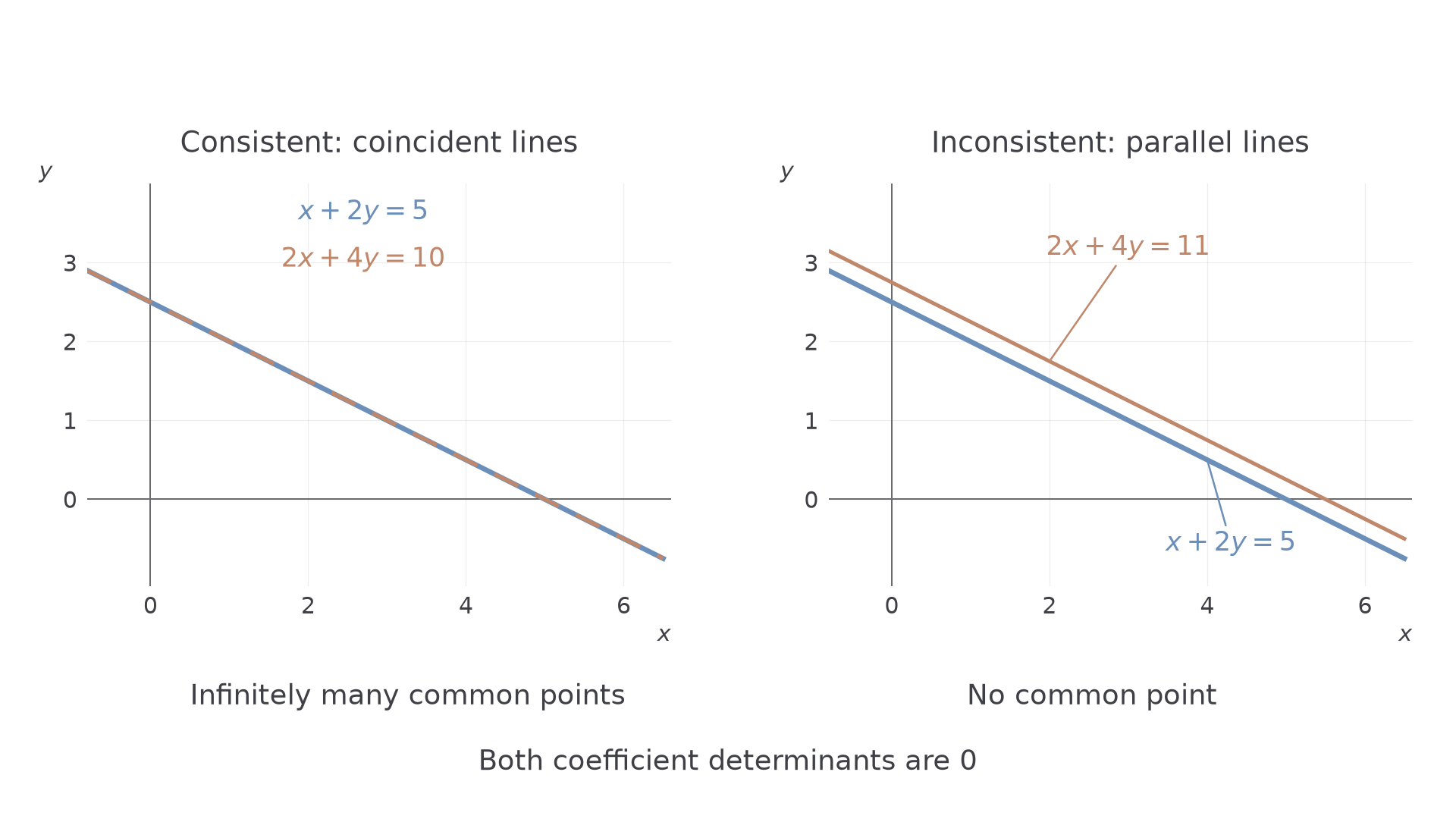
Consistent and inconsistent equations
A system is consistent if at least one set of values satisfies all its equations. It is inconsistent if no set of values does. For a square linear system with zero determinant, consistency gives infinitely many solutions; inconsistency gives no solutions.
Eliminate a variable and see what remains. A statement such as is an identity: it imposes no extra restriction. A statement such as is a contradiction: no values can satisfy it. These consistency criteria are not in the formula booklet: learn them.
Worked example 5: an infinite set of solutions
Question. Determine whether the equations and have a unique solution, infinitely many solutions or no solutions.
Plan. Test the determinant, then subtract twice the first equation from the second.
Why this step? The determinant concerns only the left-hand sides. The subtraction checks whether the right-hand sides obey the same relationship.
Answer. The equations are consistent and have infinitely many solutions, because the second is exactly twice the first.
Check. and both satisfy both equations, and the two equations describe the same line.
Worked example 6 changes only the second constant. The determinant stays zero, but the consistency conclusion changes completely.
Worked example 6: no solution
Question. Determine whether and are consistent.
Plan. Use the same elimination and compare the constants.
Why this step? An impossible constant statement rules out every possible pair , not just a trial pair.
Answer. The equations are inconsistent and have no solutions.
Check. The first equation requires , whereas the second requires , so both cannot hold.
This is the important surprise: the very same zero determinant can accompany infinitely many solutions or no solutions. Its zero value is a prompt to investigate, not the final answer.
Watch out
Wrong: “The determinant is zero, therefore there are no solutions.” Right: “There is no unique solution; check the equations for consistency.” A zero determinant alone cannot distinguish the two remaining cases.
State both the classification and the equation relationship that proves it.
Classifying a system with a parameter
For three equations, first identify the parameter values that make the coefficient matrix singular. In each singular case, compare whole equations, including their constants, and eliminate far enough to expose any contradiction.
Label the equations , and . Writing is precise evidence of redundancy only when both coefficients and constants match. If two independent equations remain in three unknowns and the third is redundant, there are infinitely many solutions. You need not find that infinite solution set to classify the system.
Worked example 7: a parameter with one consistent singular case
Question. Classify the solutions of the following system for all real values of :
Plan. Find the coefficient determinant, then inspect the singular value by comparing with .
For , the determinant is non-zero, so there is a unique solution. For ,
This is exactly . To check the remaining restrictions explicitly,
Only two independent equations remain, with no contradiction.
Why this step? Testing the singular value separately avoids using an inverse where none exists, and the whole-equation comparison establishes consistency.
Answer. If , the solution is unique. If , the equations are consistent with infinitely many solutions.
Check. At , both and satisfy all three equations, agreeing with the redundancy calculation.
Worked example 8 changes only the last constant from to . The exceptional parameter value is unchanged, but the equations there are now inconsistent.
Worked example 8: the same singular value, a contradiction
Question. Classify the solutions of
Plan. Reuse the determinant , then check whether the new third equation agrees with the sum of the first two when .
For , the determinant is non-zero, so there is a unique solution. For ,
Why this step? The coefficient relationship is unchanged, but the constants fail it. That is exactly how a singular system becomes inconsistent.
Answer. If , the solution is unique. If , the equations are inconsistent and have no solutions.
Check. Any solution of the first two equations would force , so it cannot satisfy the third when .
One redundant equation does not by itself establish consistency of an entire system. For instance, , and contain a redundant second equation but a contradictory third. Check every equation.
Exam tip
For a singular system, show the actual linear combination, such as , and its resulting constants. “The equations are consistent” without that evidence leaves the decisive reasoning unstated.
The opening question now has a complete answer: a non-zero determinant gives one solution; a zero determinant requires a compatibility check to separate an infinite set from none.
Quick Recap
- Put one equation's coefficients in each row, with a fixed variable order and zeros for absent variables.
- For a non-zero coefficient determinant, the unique solution is .
- A zero determinant means no unique solution; it does not by itself mean no solution.
- In a singular case, compare complete equations: compatible restrictions give infinitely many solutions, while a contradiction gives none.
The opening system has determinant and the unique solution ; singular systems need the extra consistency check.