4.02r - nth roots of complex numbers
Find every root of a complex equation , give the roots in modulus-argument, exponential or cartesian form, and explain their regular polygon on an Argand diagram. The key is to include all the arguments of before dividing by .
Why there are n distinct roots
Why does have four complex solutions, rather than just the familiar pair suggested by a square root? One root is , because its fourth power has modulus and argument , so it equals .
Now rotate that root through . When you take the fourth power, the extra angle becomes , one complete turn, so the fourth power has not changed. Another quarter turn works again. Four different starting points have the same fourth power.
You already know
Every argument of a non-zero complex number differs from any other by an integer multiple of . If , then . A complex number's argument is undefined when the number is zero.
This makes “undo the power” different from dividing a single angle: first include every full turn that the power could have hidden.
An nth root
An nth root of a complex number is a complex number satisfying , where is a positive integer. For example, is a square root of , since . It is not a square root of .
To derive the complete list, let , with , and write a root as . Equating modulus and allowing every argument gives
Thus and .
All nth roots of a non-zero complex number
For , real and positive integer , the distinct solutions of are
Equivalently, replace the exponential by .
Not in the formula booklet: learn it.
Why the list stops there
The first angles are distinct: their differences are positive multiples of smaller than . Increasing by adds to the root's angle, returning to the same point. Therefore other integer values of repeat this list.
All the roots have modulus , and consecutive roots have angular separation . For , they are the vertices of a regular -gon centred at the origin. For , the two points are opposite ends of a diameter; for , there is just itself.
[DIAGRAM: asset_name: Four roots share one fourth power; asset_slug: h245_4_02r_fourth_roots_negative; caption: The four fourth roots of -16 have modulus 2 and are a quarter turn apart; description: Equal-scale Argand axes labelled Re and Im with origin O, a sage circle of radius 2 and a blue square whose four vertices have arguments pi/4, 3pi/4, 5pi/4 and 7pi/4. Each vertex is labelled with its exponential form 2 exp(i times its angle). A clay angle arc indicates separation pi/2. A side panel says each modulus becomes 16 and each fourth-power argument is pi modulo 2pi]
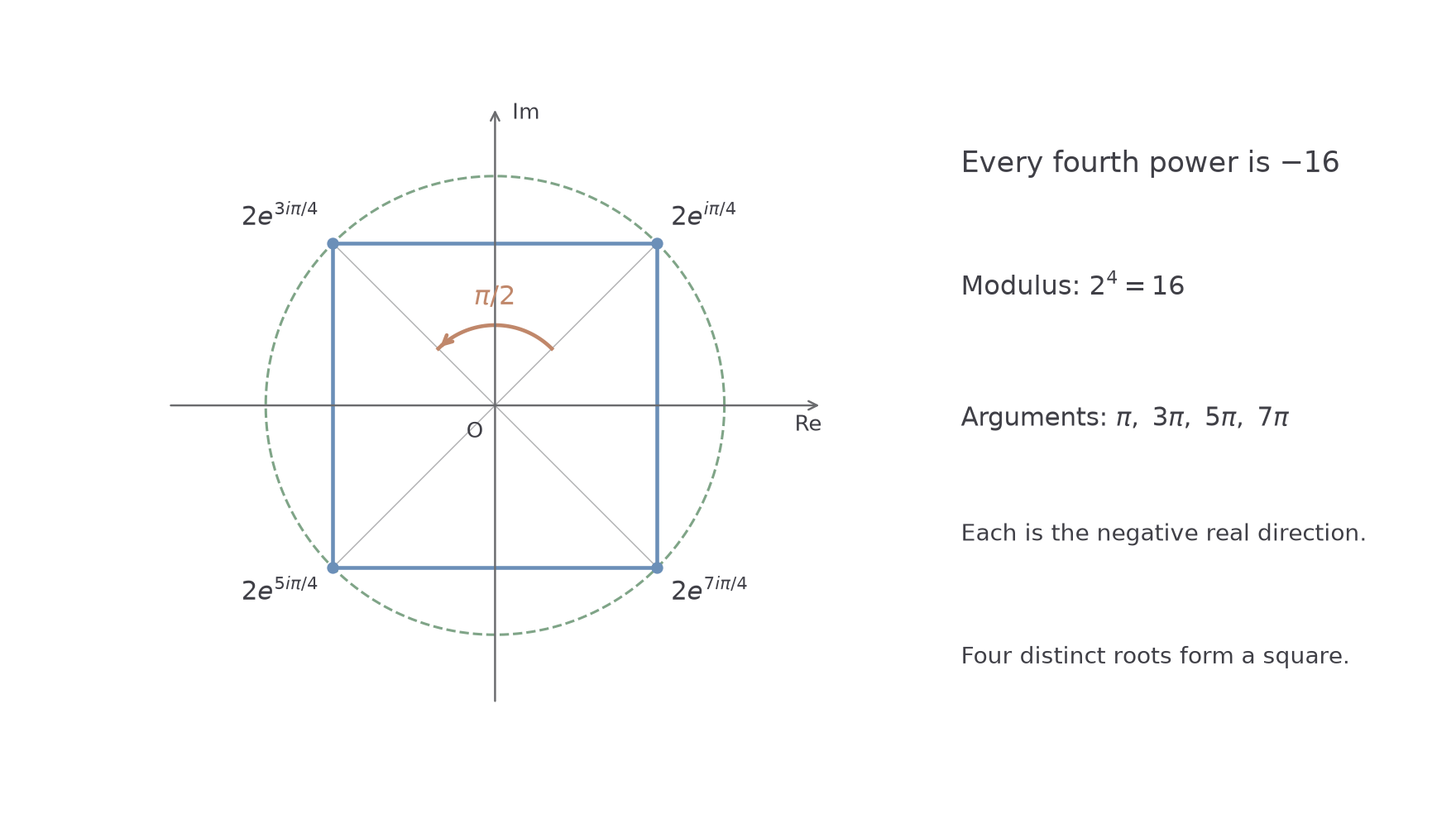
The striking fact is that taking a power loses a regular pattern of directions: roots restore that pattern. If , the only root value is ; the distinct-root result requires .
Key idea
Take the positive nth root of the modulus, and divide every possible argument by ; the roots are equally spaced around one circle.
The size and spacing come from different operations, so check them separately when interpreting an Argand diagram.
Finding the complete root list
Find one argument of the given number, add , divide the whole numerator by , and list distinct values.
A convenient interval such as makes the regular spacing easy to see. If a question fixes a different interval for arguments, move the final root angles into that interval by adding or subtracting full turns; do not change their moduli.
Worked example 1: cube roots
Question. Solve , giving the roots in exponential form with arguments in .
Plan. Write , take the cube root of 8, then divide three consecutive arguments by 3.
Why this step? The full turns are added before dividing; after cubing, each contributes a full turn to the target and leaves unchanged.
Answer. , or .
Check. Their cubed arguments are , and , all equal to modulo , and every cubed modulus is 8.
Worked example 2 changes only the required root order, from cube roots to fourth roots of the same number. Both the modulus root and the angular spacing must change.
Worked example 2: fourth roots of the same number
Question. Solve , giving the roots in exponential form with arguments in .
Plan. Keep the target argument , but divide its arguments by 4 and take the fourth root of 8.
Why this step? Fourth powers identify directions separated by , so there are four roots even though the target is unchanged.
Answer. , , or .
Check. . The first root's fourth-power argument is , and each further root adds to that argument.
These are applications of the general-root formula derived in the first part, which is not in the formula booklet. A compact formula with a stated integer range is a complete root list, but use the form the question requests.
Watch out
Wrong: . All these angles name the same root. Right: , so the spacing is , not .
The count is a useful final check: there must be exactly distinct roots of a non-zero target, each with the same positive modulus.
Giving roots in cartesian form
Once the roots' moduli and angles are known, convert each one using .
Exact cartesian form needs the exact trigonometric values, not rounded calculator coordinates. Check each quadrant before assigning the signs. Geometry can shorten the list: a square centred at the origin has opposite vertices that are negatives of one another.
Worked example 3: the fourth roots of minus sixteen
Question. Solve , giving all roots in the form , where and are exact real numbers.
Plan. Find the four modulus-argument roots, then use the exact values at odd multiples of .
Why this step? Opposite roots differ by , so both coordinates change sign. This avoids recalculating identical trigonometric magnitudes.
Answer. , , or . These are the four vertices in the earlier diagram.
Check. , so its fourth power is . The other roots square to or , with the same fourth power.
Worked example 4 changes only the sign of the target. The radius remains 2, while every root angle rotates by .
Worked example 4: the fourth roots of positive sixteen
Question. Solve , giving all roots in exact cartesian form.
Plan. Use target argument 0, then convert the four axis directions.
Why this step? A positive real target starts at angle 0, so the regular square is aligned with the axes rather than lying halfway between them.
Answer. , , or .
Check. , and . Four distinct values have been found.
The conversion formula is assumed knowledge from the earlier complex-number lessons; it is not printed in the formula booklet.
Watch out
Wrong: has only . Those are all the real roots, but the question asks for all complex roots. Right: include , because raising either to the fourth power also gives 16.
The opening question is now settled: has a square of four roots because the fourth-power map wraps their four directions onto the same direction.
Quick Recap
- Write the target as , with , and take for each root's modulus.
- Use arguments , for .
- The distinct roots are equally spaced by ; for , they form a regular polygon centred at the origin.
- Convert every root if cartesian form is requested, keeping exact values and the correct quadrant signs.
The four roots of the opening equation are , , and .