8.04e - The scalar triple product
Combine a vector product and a scalar product to measure volume in three dimensions. You will calculate volumes of parallelepipeds and tetrahedra, describe the possible positions of a vertex when volume is fixed, and use a zero scalar triple product to test coplanarity.
A signed measure of volume
A box has base area square units and perpendicular height units. Push its top sideways so that the three edges from one corner are now , and . Can such a slanted box still have volume , and which calculation sees through the slant? The scalar triple product measures the perpendicular height, wherever the top ends up.
You already know
is a normal with magnitude equal to the parallelogram area. A scalar product with a unit vector gives a signed projection. Two edge displacements from the same point locate a triangle's plane.
The parallelepiped is the three-dimensional counterpart of a parallelogram: start with three edge vectors at one vertex and complete the six parallelogram faces. It may be slanted; its edges need not be perpendicular. Three coplanar edges give a flattened figure with zero volume.
Scalar triple product
The scalar triple product of , in that order, is the scalar
First calculate the vector in brackets, then take its scalar product with . For example, ; changing to gives .
The definition is not in the formula booklet: learn it. Parentheses make the order of the operations clear. The expression would ask for a vector product involving a scalar, so it is not the same operation.
To see the geometry, use the parallelogram on as a base. If , its area is and its unit normal is . The perpendicular height from the opposite face is . Therefore
[DIAGRAM: asset_name: A scalar triple product measures base times perpendicular height; asset_slug: h245_8_04_triple_height; caption: The slant changes the edge length, while the perpendicular height remains 4; description: Exact three-dimensional diagram of the parallelepiped with edges a=(2,0,0), b=(1,3,0), c=(7,7,4) from O. Its base is the blue and lavender parallelogram spanned by a and b, of area 6. A dashed sage perpendicular from the upper vertex c to (7,7,0) has label h=4. The clay slanted edge c is labelled separately. A side panel states base area=6, perpendicular height=4, volume=24.]
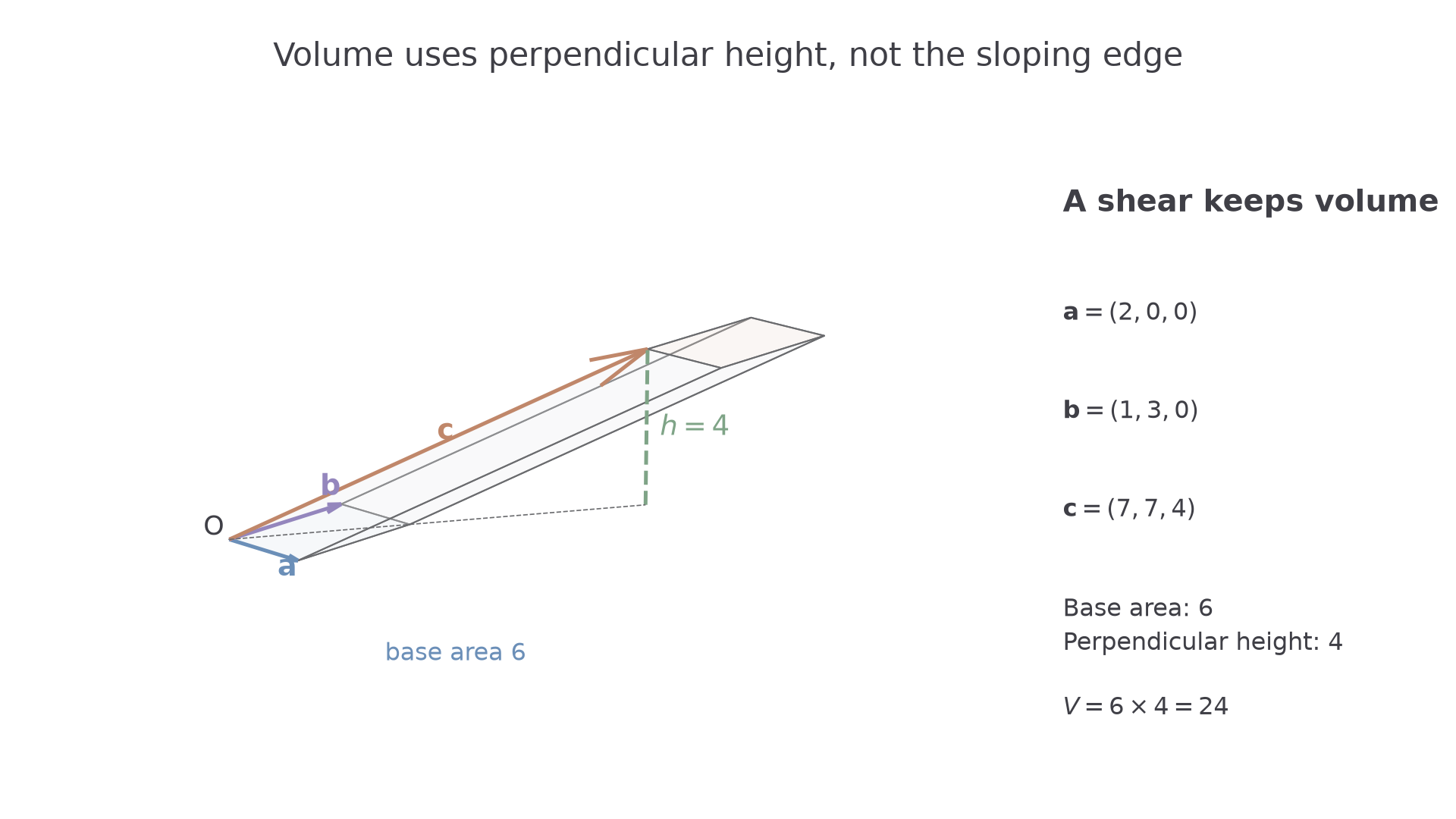
The sign of records orientation: a negative projection means the third dimension points to the other side of the chosen base normal. Volume uses the magnitude. Reversing two inputs changes the sign; cycling all three preserves it:
You can verify the cyclic identity by expanding components: both sides contain . The cyclic identity and sign-change rule are not in the formula booklet: learn them. For a volume, any order of the same three edges gives the same magnitude.
Key idea
A scalar triple product is signed base area times perpendicular height; its magnitude is a volume.
The sign is useful information, but it is not a negative physical volume.
Volumes of parallelepipeds
Use the three edges issuing from one vertex; calculate one vector product and one scalar product, then take the magnitude.
The geometric argument gives a compact rule. It also covers a degenerate base: if the two base edges are parallel, their product and the three-dimensional volume are both zero.
Parallelepiped volume
For three adjacent edges from a common vertex,
The edge vectors may be oblique. The result is zero when the figure is flattened.
Not in the formula booklet: learn it.
Taking the magnitude at the end preserves the cancellation inside the scalar product. Replacing every component by its absolute value would generally change the volume.
Worked example 1: a slanted third edge
Question. Find the volume of the parallelepiped whose edges from one vertex are , , .
Plan. Calculate , then take its scalar product with .
Why this step? Three edge lengths multiplied together would ignore the oblique angles. The triple product automatically keeps only the perpendicular height.
Answer. cubic units.
Check. The base on has area , and the third edge's perpendicular height above the coordinate plane is . Their product is .
Worked example 2 changes one feature: the third edge is sheared by adding . Its endpoint moves sideways in the base directions.
Worked example 2: a shear preserves volume
Question. Find the volume when the edges are , , .
Plan. Recalculate the triple product and compare the perpendicular height with Worked example 1.
Why this step? The last component of the normal changed, but has zero last component. The signed volume stays the same.
Answer. cubic units, unchanged.
Check. The base still has area , and the top still has perpendicular height . This also answers the opening question.
More generally, adding any linear combination of two edges to the third leaves the triple product unchanged: each added triple product repeats an edge and is zero. This shear consequence is not in the formula booklet; derive it using distribution and the zero self-product.
Watch out
Wrong: for every parallelepiped. That multiplication works for mutually perpendicular edges. Right: use the scalar triple product for general edges.
The method remains just as short when no edge lies along an axis.
Tetrahedra and fixed-volume planes
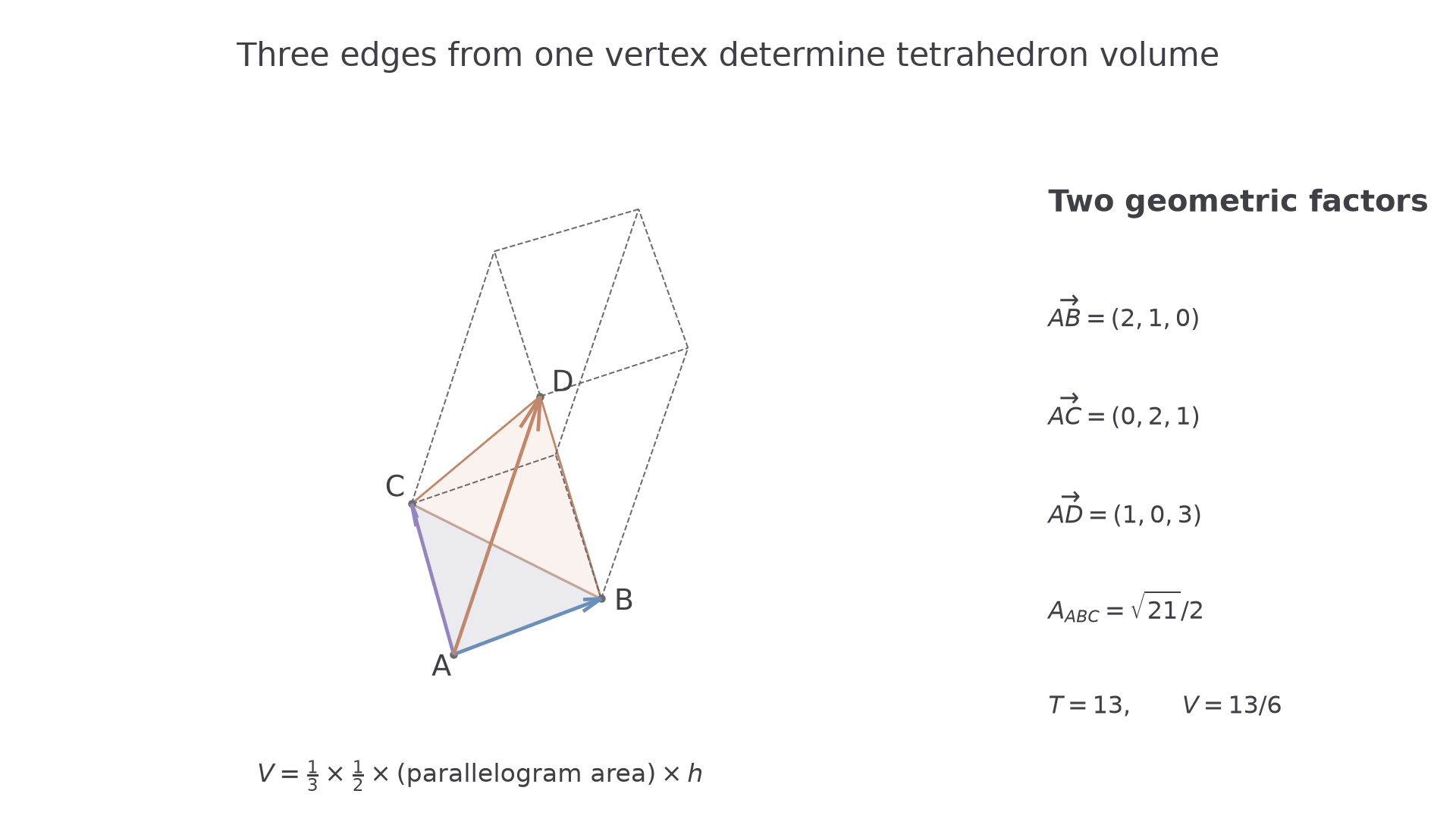
A tetrahedron has four vertices and four triangular faces. Choose any vertex as a common start for three edge displacements.
A triangular base has half the area of the parallelogram on the same two edges. A pyramid on that triangle has volume one third of its base area times its perpendicular height. Together these factors give of the parallelepiped volume. The pyramid result is assumed geometry and is not printed in the formula booklet; an examination question may supply it.
[DIAGRAM: asset_name: A tetrahedron occupies one sixth of the associated parallelepiped volume; asset_slug: h245_8_04_tetrahedron; caption: Half the parallelogram base and one third of base times height give the factor 1/6; description: Exact three-dimensional diagram of tetrahedron ABCD with A=(1,0,1), B=(3,1,1), C=(1,2,2) and D=(2,0,4). Three edges from A are labelled AB=(2,1,0), AC=(0,2,1), AD=(1,0,3). The triangular base ABC is pale blue, the remaining tetrahedron faces are pale clay, and dashed grey edges complete the associated parallelepiped. A side panel shows base triangle area=sqrt(21)/2, scalar triple product=13 and tetrahedron volume=13/6.]
Continue this lesson.
You’re previewing NovaLearn without an account. Create a free account to read the rest.
Create free account