4.04g - Finding a common perpendicular
Find a vector perpendicular to two given vectors using the vector product, then verify it with scalar products. You will use the supplied component formula carefully, recognise the parallel-vector case and solve problems where another perpendicularity condition determines a parameter.
A direction perpendicular to both
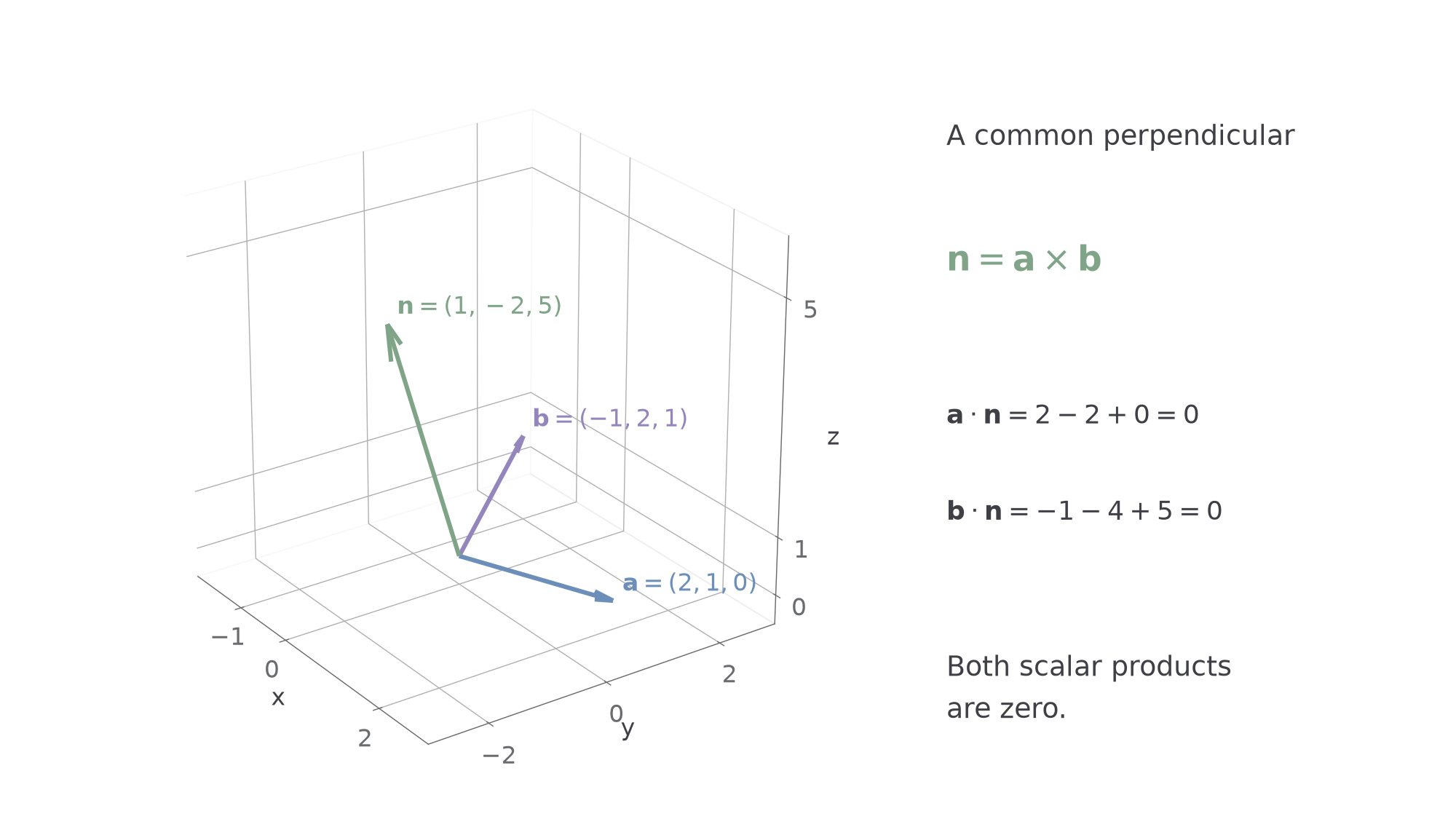
Can one non-zero vector be perpendicular to both and ? Try :
It works. How can we find such a vector systematically, without guessing? The vector product will build it directly from the two given vectors.
You already know
For non-zero vectors, a scalar product of zero tests perpendicularity. The scalar product is a number: multiply matching components and add. Multiplying a non-zero vector by a non-zero scalar preserves its line of direction.
Two non-parallel vectors placed tail to tail determine a flat surface of directions. A vector perpendicular to both points out of that surface. There are two opposite perpendicular directions, and any non-zero length works. A useful surprise: the two vectors can have a very small angle between them, yet the required perpendicular direction still exists. They do not have to form a right angle with each other.
[DIAGRAM: asset_name: One vector perpendicular to two given vectors; asset_slug: h245_4_04g_common_perpendicular; caption: Both scalar products are zero, so n is perpendicular to a and b; description: Three-dimensional coordinate diagram with arrows a=(2,1,0), b=(-1,2,1) and n=(1,-2,5) from the origin, accompanied by the two scalar-product calculations 2-2+0=0 and -1-4+5=0.]
Vector product
The vector product is a vector perpendicular to both and . For non-parallel non-zero vectors it is non-zero. For parallel vectors it is the zero vector, which has no direction and cannot itself serve as a perpendicular direction vector.
Do not confuse the symbols: gives a scalar; gives a vector. For a request to find a common perpendicular, any non-zero scalar multiple of a valid answer is valid. For a request to calculate the vector product, give that product itself.
Key idea
Use the vector product to construct a common perpendicular; use two scalar products to check it.
The distinction between a product and an arbitrary perpendicular matters when an answer is simplified.
Using the component formula
Calculate the three components separately; the order of the subtractions matters, especially in the middle component.
Vector product in components
For and ,
In the formula booklet.
OCR allows this supplied formula or a calculator when a vector product is required. Reading the component expression carefully is safer than trying to remember a half-familiar sign pattern. The geometric check is available even if you use a calculator.
Why does the formula give a perpendicular? Taking its scalar product with gives
Every term cancels with its opposite. The same cancellation occurs with . Also, reversing the order reverses every subtraction, so . This reversal identity is not in the formula booklet: learn it.
Worked example 1: calculating and simplifying a direction
Question. Calculate for , . Hence give a common perpendicular with the smallest possible integer components.
Plan. Substitute into all three component differences, then divide by the common factor only when giving the direction.
Why this step? The question asks for two things. The product is fixed, but the common perpendicular may be shortened without changing its direction.
Answer. ; a common perpendicular is .
Check. and .
Worked example 2 changes one feature: the last component of changes sign. Recalculate each component; the new product need not share the old direction.
Worked example 2: a negative component
Question. Calculate , where , , and verify that it is perpendicular to both vectors.
Plan. Keep negative components in brackets in the supplied formula, then test the answer twice.
Why this step? The middle component is ; the second product here is negative, so subtracting it adds 1.
Answer. , perpendicular to both given vectors.
Check. Reversing the order gives , the negative of the displayed product.
Checking the two scalar products catches an isolated sign error that a second quick glance at the formula may miss.
Watch out
Wrong: using for the middle component while keeping the first and third components unchanged. That reverses only one sign. Right: the middle component is ; copy the supplied formula before substituting.
If the product is zero for two non-zero vectors, their directions are parallel. There are still common perpendiculars, but the zero vector does not select one. For example, , while is a valid common perpendicular. Use the scalar-product condition to choose such a direction in this special case.
A further perpendicularity condition
When a question says that is perpendicular to a third vector, calculate the vector product first, then set its scalar product with that third vector equal to zero.
This is a chain of two familiar operations, with different outputs: the first makes a vector; the second makes an equation. Check that the vector product is non-zero for any parameter values you find.
Worked example 3: determining one parameter
Question. Let , , . Determine , given that is perpendicular to .
Plan. Calculate the vector product in terms of , then apply the scalar-product test.
Why this step? Taking would test a different pair of vectors. The statement names the whole vector .
Answer. .
Check. The product is , which is non-zero, and .
Worked example 4 changes one feature: the last component of also becomes . The final scalar product now contains a quadratic term.
Worked example 4: a quadratic parameter condition
Question. Let , , . Determine the possible values of , given that is perpendicular to .
Plan. Reuse the product expression and multiply its last component by in the scalar product.
Why this step? The term comes from the third pair of components. It must be expanded before the equation can be factorised.
Answer. or .
Check. For , the product is and the scalar product with is . For , the product is and its scalar product with is . Both products are non-zero.
This is also a useful way to organise longer OCR questions: keep the product as a single named vector until the second operation is required.
Watch out
Wrong: setting each component of equal to zero because it is perpendicular to . That would make the vector product zero. Right: set the sum of matching products with equal to zero.
The opening puzzle now has a systematic answer. The component formula gives
and the two zero scalar products prove it is perpendicular to both. No guessing, and no angle calculation.
Quick Recap
- The vector product gives a vector perpendicular to both inputs; the scalar product gives a number.
- Use the supplied component formula and preserve the middle component's subtraction order.
- Any non-zero multiple of a common perpendicular is valid, but the vector product itself has a fixed value.
- For an additional perpendicularity condition, take the scalar product of the calculated vector with the third vector and set it equal to zero.
The opening common perpendicular is , found directly as the vector product and checked by two scalar products.