4.02e - Arithmetic in cartesian form
Learn to add, subtract, multiply and divide complex numbers written in cartesian form , using and the complex conjugate, and to solve equations in and by equating real and imaginary parts, giving exact answers in the form the exam asks for. Along the way you will see how a sixteenth-century formula used the square root of a negative number to reach the answer 4.
Adding, subtracting and multiplying
You add, subtract and multiply complex numbers just as you handle expressions in , and that simple idea settles a puzzle from the sixteenth century.
In 1572 the Italian engineer Rafael Bombelli published a calculation that seemed to need the square root of a negative number, even though the answer it was meant to give was the ordinary number 4.
He was solving . You can check that works: and . The graph of crosses the -axis three times, so all three roots are real. Yet the formula for cubic equations that Gerolamo Cardano had published in 1545 gives
[DIAGRAM: asset_name: Bombelli's cubic has three real roots; asset_slug: h245_4_02_bombelli_cubic; caption: The cubic from Bombelli's puzzle crosses the x-axis three times, once at x = 4, yet Cardano's formula for it contains the square root of -121; description: Graph of y = x cubed minus 15x minus 4 for x from about -4.6 to 4.9, crossing the x-axis at x = -2 - root 3 (about -3.73), x = -2 + root 3 (about -0.27) and x = 4, with the three roots marked as dots and a box showing Cardano's formula with the cube roots of 2 + root(-121) and 2 - root(-121)]
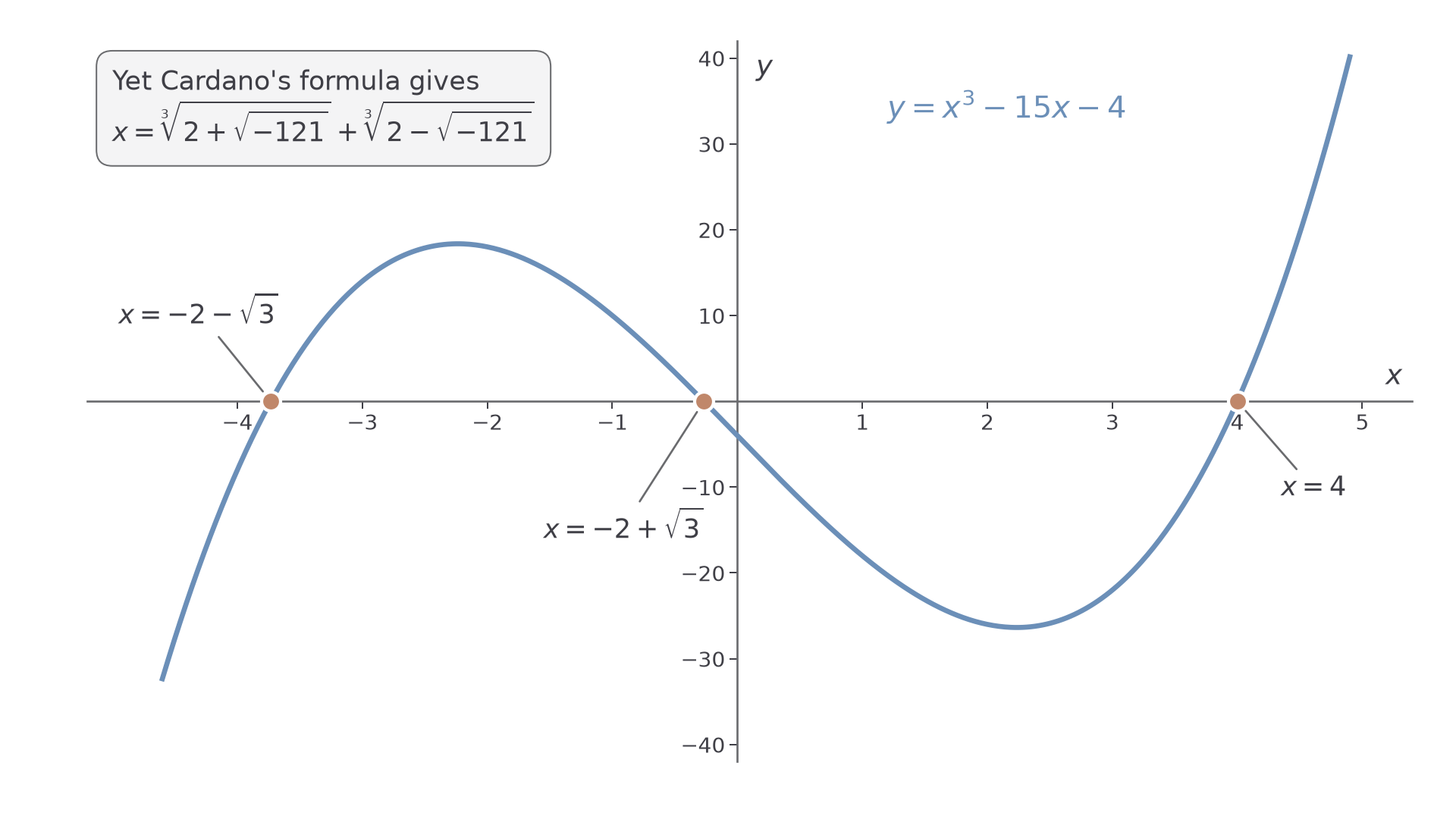
So here is the question this lesson answers: how can a calculation that passes through end at the honest answer 4? Bombelli's idea was to stop calling impossible and simply calculate with it. By the end of this lesson you will be able to do his calculation yourself.
Calculating in cartesian form
You already know
, and a complex number in cartesian form is , where and are real. Expanding brackets: and .
Collect the real parts and the imaginary parts separately, and replace by whenever it appears. To add or subtract, combine the real parts and combine the imaginary parts:
To multiply, expand every pair of terms. The product of the two imaginary terms contains , which is the real number , so that product joins the real part. This single step is the whole difference between complex algebra and the algebra you know.
Arithmetic in cartesian form
For real numbers , , , and :
The product line is what expanding the brackets and using always gives, so you can rebuild it at any time.
Not in the formula booklet: learn it.
Worked example 1: multiplying two complex numbers
Question. Find .
Plan. Expand all four products, then replace by and collect the real and imaginary parts.
Why this step? Replacing by turns into the real number , so it belongs with the 12.
Answer.
Check. The product line of the formula gives and
Worked example 2 changes one thing: instead of multiplying two different numbers, you square one number and then use it inside a longer expression. That matters because the middle term of the square and the minus sign in front of are where most marks are lost.
Worked example 2: an exam-style "show that"
Question. Given that , show that .
Plan. Work out on its own line, then substitute it into the whole expression and collect the parts.
Why this step? Finding first keeps the signs under control, and multiplying out in full stops the from being lost.
Answer. , which is the result required.
Check. Expanding the other way,
You have just shown that is a root of the quadratic equation . Finding roots like this directly, and seeing why must be a root as well, comes in the lesson on solving equations with complex roots.
Watch out
Wrong: , squaring each part separately. A square of two terms has a middle term . Right: .
Multiplication also gives you a way to check any complex answer: multiply back or substitute, exactly as you would check a real solution. Do it every time; it takes seconds.
Exam tip
In a "show that", or when the question says "In this question you must show detailed reasoning", a correct final answer does not earn the method marks on its own. Write the line where becomes , and end by stating the given result.
Complex conjugates
Every complex number has a partner called its conjugate, and multiplying the two together always gives a real number, which is exactly what you need in order to divide.
You already know
The conjugate of is : only the sign of the imaginary part changes, so and . The modulus of is .
A real number is its own conjugate, for example , and taking the conjugate twice gives back the number you started with: .
Try a concrete case first. Multiply by its conjugate:
The answer is real, and it equals . Squaring does not do this: , which still has an imaginary part. In general , which is real only when or .
The cancellation with the conjugate happens for every complex number. With ,
Results with the conjugate
For with and real:
Not in the formula booklet: learn it.
So is real and never negative, and it is 0 only when . It is also the square of the modulus: for , and . The sum is real and the difference is purely imaginary (or 0). A one-mark question asking you to show that is a genuine exam type, and the full answer is one line: let with and real, so and .
These facts come back at the end of this lesson, in Bombelli's puzzle, and again when you solve quadratic equations with complex roots: a number and its conjugate always have a real sum and a real product.
Key idea
is always a real number, so the conjugate is the tool that turns a complex number into a real one.
Dividing complex numbers
To divide by a complex number, multiply the top and bottom of the fraction by the conjugate of the bottom: the denominator becomes a real number, and the answer splits into a real part and an imaginary part.
You already know
Rationalising a denominator: . Division by a complex number uses the same idea, with in place of .
A fraction such as is not yet in the form , because its denominator is complex. Multiplying the top and bottom of a fraction by the same non-zero number does not change its value, and choosing makes the new denominator , which is real. This is the result from the previous part doing its job.
Dividing by a complex number
For real , , , with :
Not in the formula booklet: learn it.
Worked example 3: dividing by a complex number
Question. Express in the form .
Plan. Multiply the numerator and denominator by , the conjugate of the denominator, then split into real and imaginary parts.
Why this step? Multiplying by is multiplying by 1, so the value is unchanged, but the denominator becomes real.
Answer.
Check. Multiply back:
Worked example 4 changes one thing: the division is hidden inside an equation, so you have to get the term on its own before you divide. That matters because the order is the same as for a real linear equation: undo the addition first, then divide by the coefficient.
Worked example 4: solving a linear equation in z
Question. Solve the equation , giving in the form .
Plan. Subtract 4, divide by , then multiply the top and bottom by the conjugate .
Why this step? Treating like any other coefficient keeps the method familiar; the only new move is the conjugate in the last division.
Answer.
Check. Substitute:
Watch out
Wrong: , dividing real part by real part and imaginary part by imaginary part. Fractions do not split like that when the denominator is complex. Right: .
Division is the last of the four operations, so you can now simplify any expression built from complex numbers into the single form .
Exam tip
For a "show that" division, the method mark is for multiplying the numerator and denominator by the conjugate of the denominator. Write that line, and show the real denominator , before you simplify.
Equating real and imaginary parts
Two complex numbers are equal only when their real parts are equal and their imaginary parts are equal, so one equation between complex numbers gives you two equations between real numbers.
Equal complex numbers
If , where , , and are real, then
Not in the formula booklet: learn it.
Why it is true
You already know the special case where one side is 0: if and are real, only when and , because otherwise would be a real number. Now suppose . Subtracting from both sides gives , where and are real, so both are zero. Therefore and .
The proof only works because , , and are real. That is the condition to remember: before you equate parts, every unknown must be a real number, so replace a complex unknown by first.
Worked example 5: an equation in z and z*
Question. Solve the equation .
Plan. Write with and real, so , collect the real and imaginary parts, then equate them.
Why this step? The equation is one statement about complex numbers, but because and are real it splits into two separate real equations.
Answer.
Check.
Worked example 6 changes one thing: is multiplied by . That matters because multiplying by swaps the roles of the parts, so and both appear in each real equation and you must solve them simultaneously.
Worked example 6: when i mixes the parts
Question. Solve the equation .
Plan. Substitute and , expand using , equate parts, then solve the two simultaneous equations.
From the first equation . Substituting into the second:
Why this step? The term is , a real term, so the real equation contains as well as .
Answer.
Check.
Watch out
Wrong: . The second term is , and . Right: . A sign slip here changes both of your real equations.
This method works for any linear equation in and . Later in the course the same comparison of real and imaginary parts is how you find the square roots of a complex number.
Exam tip
Start with the line "Let , where and are real". Examiners have reported answers that treated complex unknowns as if they were real numbers, and those answers could earn no marks.
Bombelli's puzzle solved
You can now answer the question from the start of the lesson, using only multiplication and conjugates. First simplify the square root: , so Cardano's formula reads . Bombelli showed that is a cube root of by multiplying it out:
The second number under a cube root, , is the conjugate of the first. Repeating the same multiplication with in place of , which also squares to , changes the sign of every imaginary part:
So a cube root of is , the matching cube root of its conjugate is , and
The imaginary parts cancel because the two cube roots are conjugates: , and here . The calculation travelled through complex numbers but arrived at a real answer, and results like this began the slow acceptance of complex numbers by mathematicians.
Quick Recap
- Add, subtract and multiply as in ordinary algebra, collecting real and imaginary parts and replacing by .
- is real and never negative; and .
- Divide by multiplying the top and bottom by the conjugate of the denominator, so the denominator becomes the real number .
- Two complex numbers are equal only when their real parts are equal and their imaginary parts are equal; write with and real to turn one complex equation into two real ones.
Bombelli's answer: and , so Cardano's formula gives .