8.05d - First and second partial derivatives
Differentiate a function of two variables while holding one variable fixed. You will use both standard notations, calculate pure and mixed second derivatives, and show that a surface satisfies an identity involving its partial derivatives.
First partial derivatives
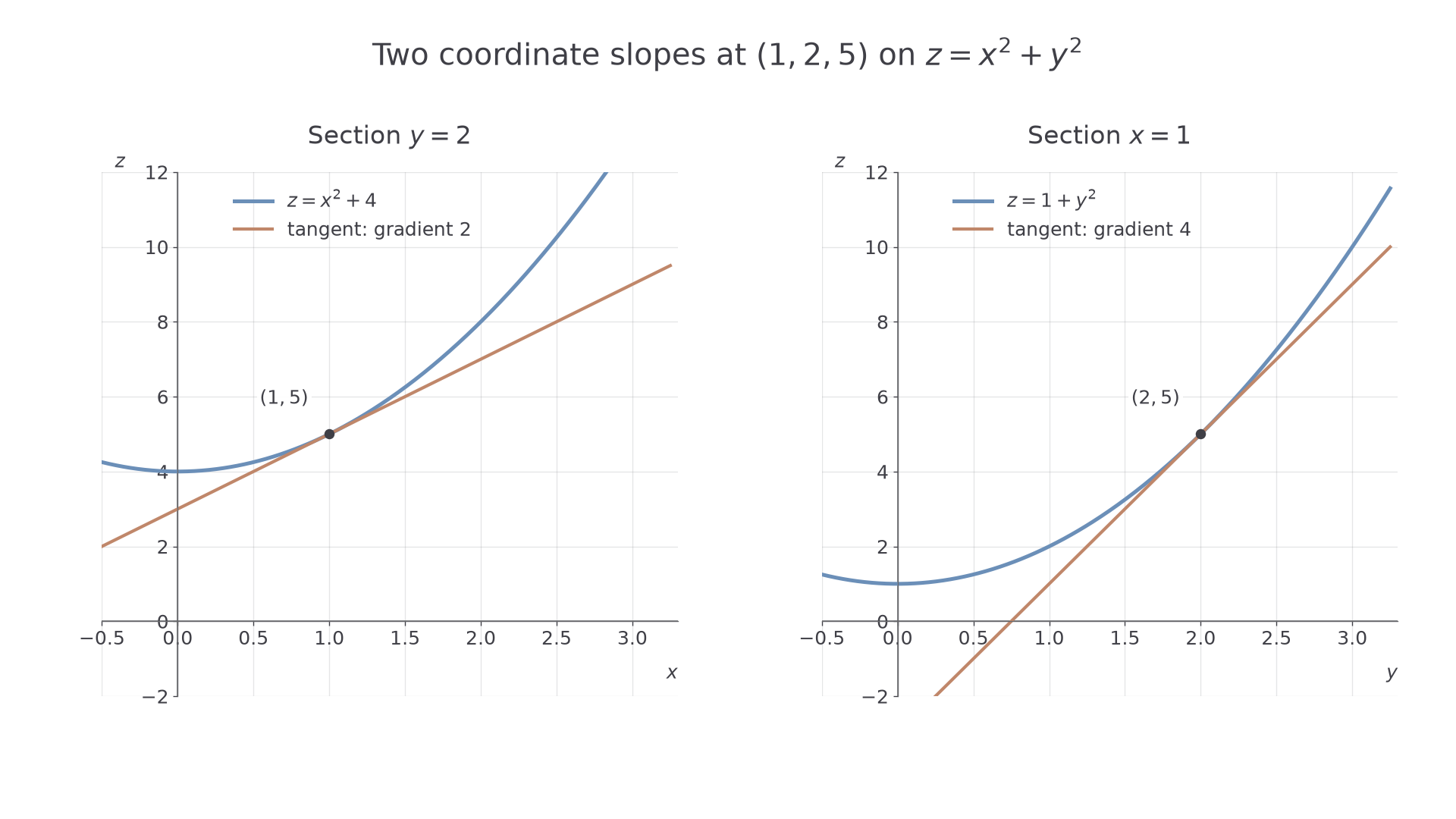
Can the same point on a surface have two different gradients? On , at , the answer is yes: the section parallel to the -direction has gradient , while the section parallel to the -direction has gradient . A gradient needs a direction as well as a point.
You already know
Fixing gives the section ; fixing gives . Use the ordinary power, product and chain rules on a one-variable function.
To find the first gradient, treat as a constant and differentiate with respect to . To find the second, treat as a constant and differentiate with respect to . Thus has derivative with respect to , but with respect to .
First partial derivatives
For , the first partial derivatives are
In , hold fixed; in , hold fixed. For example, if , then and .
The symbol distinguishes these derivatives from an ordinary derivative of a function of one independent variable. In particular, here because and are independent coordinates. It does not say that an arbitrary curve has zero derivative. This notation and the rule of holding the other variable constant are not in the formula booklet.
[DIAGRAM: asset_name: Two slopes at one surface point; asset_slug: h245_8_05_partial_slopes; caption: At the same point, the two coordinate sections have different tangent gradients.; description: Left plot has x and z axes and shows z=x squared+4 with its tangent z=2x+3 at (1,5), labelled y=2 and gradient 2. Right plot has y and z axes and shows z=1+y squared with tangent z=4y-3 at (2,5), labelled x=1 and gradient 4. Both marked points correspond to the surface point (1,2,5).]
Worked example 1: powers with a constant coefficient
Question. For , find and .
Plan. Differentiate once with respect to each variable, in separate calculations, changing which variable is held fixed.
Why this step? In , the term is a constant, so it disappears. In , disappears instead.
Answer. , .
Check. On the section , , whose derivative is , agreeing with .
Worked example 2 changes only to . That term now contributes to both derivatives.
Worked example 2: a term containing both variables
Question. For , find and .
Plan. Hold the other coordinate fixed in each calculation, including in the new product .
Why this step? is times in the first calculation, but times in the second.
Answer. , .
Check. At , these give and . The sections and have exactly those gradients at and .
Constants can be negative powers of the other variable too. For , where , the same rule gives and .
Watch out
Wrong: . That differentiates both independent variables at once. Right: , with unchanged.
The next check changes the coefficient of the mixed term and asks for the gradients at a specified point.
Product and chain rules
A partial derivative uses the familiar differentiation rules, with the other variable acting as a constant throughout.
For example, in differentiating with respect to , the inner function has derivative , so the result is . With respect to , the inner derivative is , giving . The two chain-rule factors differ.
Chain rule for a function of two independent variables
If and is differentiable, then
Hold the other independent variable fixed each time.
Not in the formula booklet: learn it.
For , both inner derivatives are , so both first partial derivatives are , where . For , the inner derivatives are and . Write the relevant inner derivative before simplifying.
Worked example 3: two chain rules
Question. For , where , find and .
Plan. Apply the chain rule to each term, separately for each independent variable.
Why this step? The outer derivative of the exponential stays the same, but the inner derivative changes with the coordinate.
Answer. , .
Check. On , the original section is , whose derivative is . The formula gives too.
Worked example 4 adds just one factor, , in front of the exponential. The -derivative now needs a product rule, while the -derivative treats that factor as constant.
Worked example 4: product and chain together
Question. For , where , find and .
Plan. Use a product rule in , then differentiate with respect to holding the leading fixed.
Why this step? In , both factors and depend on ; differentiating only the second factor would lose the term .
Answer. , .
Check. On , , so , agreeing with the formula.
The ordinary product rule is recalled knowledge; its partial-derivative version is not printed separately in the formula booklet.
Watch out
Wrong: . Right: it is . The missing factor is the derivative of the exponent with respect to the variable named in the denominator.
A power of the leading changes the product-rule term once more.
Continue this lesson.
You’re previewing NovaLearn without an account. Create a free account to read the rest.
Create free account