4.03l, 4.03m - Singular matrices and det(AB)
Recognise singular matrices and explain the significance of a zero determinant. Find parameter values that make a matrix singular, and use the determinant of a product to analyse successive transformations without multiplying out every entry.
When a transformation loses a dimension
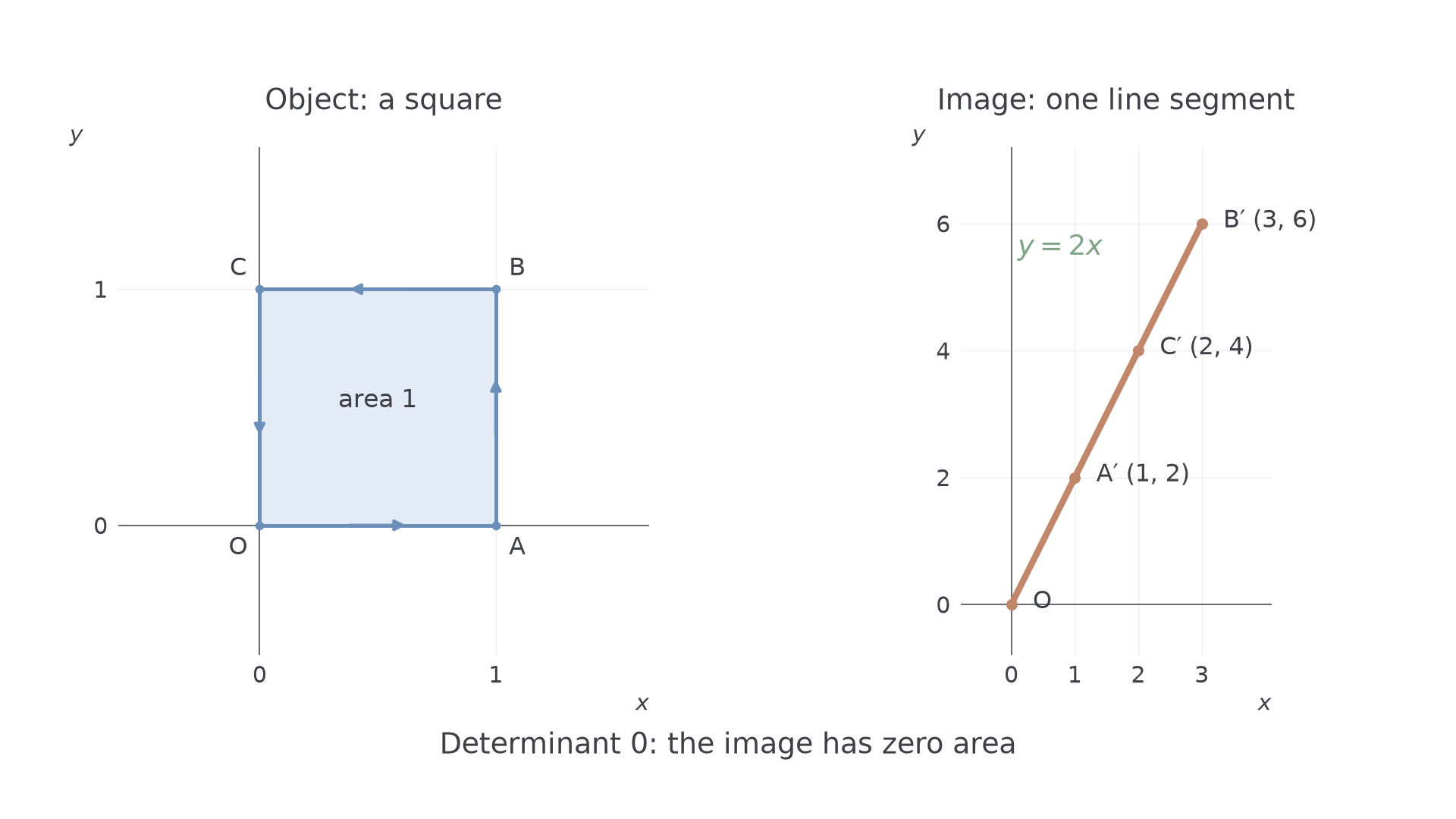
The matrix has no zero entries. How can it nevertheless send an entire square to a line, and can a later transformation restore the lost area? The first clue is its determinant:
You already know
For real transformation matrices, the magnitude of the determinant multiplies area in two dimensions or volume in three dimensions. A zero determinant therefore gives zero image area or zero image volume.
Look at a general image point rather than a particular vertex:
Every image lies on the line with equation . Different object points can have the same image: and both become . The transformation has lost information about where a point started.
[DIAGRAM: asset_name: A singular matrix collapses a square; asset_slug: singular-square-collapse; caption: A square of area 1 is sent to a line segment of area 0.; description: The unit square OABC is shown on the left. The right panel shows the images O at (0, 0), A prime at (1, 2), B prime at (3, 6) and C prime at (2, 4), all on the line y = 2x under the matrix with rows (1, 2) and (2, 4).]
Singular matrix
A square matrix is singular if its determinant is zero, and non-singular if its determinant is non-zero. For example, is singular. The matrix is non-singular, despite containing zeros, because its determinant is .
In two dimensions a singular transformation sends the whole plane into a line or a point. The zero matrix sends everything to the origin; singular matrices need not be zero matrices. In three dimensions a singular transformation sends space into a plane, a line or a point, so a solid has zero image volume. For example, sends to : the entire third coordinate disappears.
These zero-determinant criteria and their area/volume interpretation are not in the formula booklet: learn them. Do not describe a singular transformation as orientation-preserving or orientation-reversing; the image has lost a dimension.
Key idea
Singularity is a property of the determinant, not of whether the matrix contains zero entries. A singular transformation loses a dimension and cannot distinguish all its original points.
Use the determinant test even when the visible entries tempt you to guess.
Finding singular parameter values
When a matrix contains an unknown constant, calculate its determinant and set that determinant equal to zero. The resulting equation identifies every singular case.
A repeated row or a row that is a multiple of another is a useful way to spot singularity. It is not a complete test in three dimensions: one row can be a sum of two other rows without being a multiple of either. The determinant is the general test.
Singularity test
For a square matrix ,
Not in the formula booklet: learn it.
Keep the determinant equation intact until it is factorised.
Worked example 1: two singular values
Question. Determine the values of for which is singular.
Plan. Form the determinant, equate it to zero and factorise.
Why this step? Singularity is the equation ; it does not require any individual entry to be zero.
Answer. is singular when or , and non-singular for all other real values of .
Check. At , the rows and are proportional. At , the rows and are negatives of each other.
Worked example 2 keeps the same block of order two and adds a third coordinate. That extra coordinate can disappear independently, so it contributes another possible singular value.
Worked example 2: an extra singular case in three dimensions
Question. Determine the values of for which is singular.
Plan. Expand along the last row and factorise the determinant completely.
Why this step? Expanding before dividing keeps every zero of the determinant. Dividing by would lose a genuine singular case.
Answer. , or .
Check. At the last row is zero. At or , the first two rows are proportional, just as in Worked example 1.
Each factor identifies a separate way for the transformation to lose a dimension.
Watch out
Wrong: , so divide by and solve only the quadratic. This assumes , exactly the value you must test. Right: set each factor equal to zero.
An extra zero factor can correspond to a whole coordinate being lost.
The determinant of a product
Successive transformations multiply their area scale factors, just as successive percentage changes multiply their multipliers. Their orientation signs multiply too: two reversals preserve orientation.
You already know
represents followed by . Matrix multiplication need not commute: and can be different matrices.
The determinant packages both the magnitude and the sign of the scale factor into one number. This leads to a rule that holds for square matrices of the same order, including matrices that are not being interpreted as transformations.
Determinant of a product
For square matrices and of the same order,
Repeated use gives for positive integers .
Not in the formula booklet: learn it.
You do not need to multiply out to find its determinant if the two individual determinants are known. When asked to verify the rule for given matrices, however, calculate both sides separately.
Worked example 3: verifying the product rule
Question. Given and , verify that .
Plan. Find both individual determinants, then multiply the matrices and calculate the determinant of the product independently.
Separately,
Why this step? Verification needs an independent calculation of the left-hand side; simply quoting the rule would assume the result you are checking.
Answer. Both sides equal , so the stated equality is verified.
Check. Both matrices are non-singular, and their product has a non-zero determinant. One positive and one negative determinant give a negative product.
Worked example 4 changes only the number of times is applied. The product rule now avoids calculating .
Worked example 4: using the rule without multiplying matrices
Question. For the same matrices, find and state whether the transformation represented by preserves orientation.
Plan. Apply the product rule twice, then inspect the sign.
Why this step? means , not twice .
Answer. . Orientation is preserved because the determinant is positive.
Check. reverses orientation twice, so its two applications cancel the reversal. preserves orientation.
A surprising consequence is that , even when the matrices themselves differ. In Worked example 3,
The determinant remembers scale and orientation, not every detail of the transformation.
For square matrices of the same order, a product is singular exactly when at least one factor is singular: a product of real or complex numbers is zero exactly when at least one factor is zero. This answers the opening question. If , then for any later square transformation matrix ,
A later linear transformation can move or stretch the collapsed image, but cannot restore its lost area.
Watch out
Wrong: . Right: determinants multiply. Also, equality of the determinants of and does not imply equality of those matrices.
For a repeated factor, repeat its determinant the same number of times.
Quick Recap
- A square matrix is singular exactly when its determinant is zero; a non-zero matrix can be singular.
- A singular real transformation loses area in two dimensions or volume in three dimensions.
- To find singular parameter values, set the entire determinant equal to zero and retain every factor.
- For square matrices of the same order, , even though matrix multiplication need not commute.
The opening square collapses because . Every later product still has determinant zero, so the lost area cannot be restored by another linear transformation.