4.02e, 4.02f, 4.02m - Working in modulus-argument form
Convert between cartesian and modulus-argument forms, choosing the correct quadrant and principal argument. Use the form that makes each calculation simpler, and see multiplication, division and positive integer powers as changes of length and direction on an Argand diagram.
Converting from cartesian form
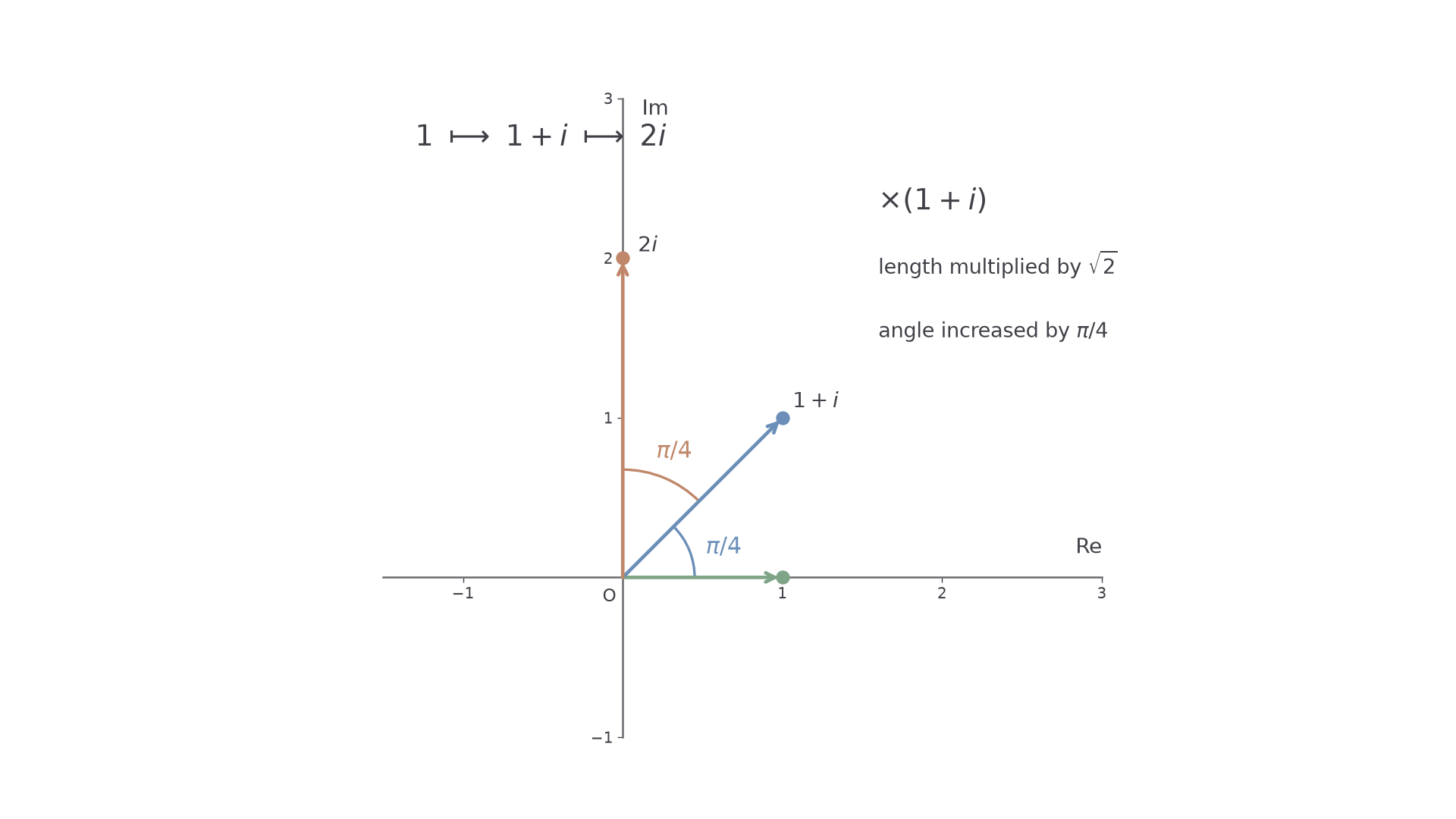
Why does multiplying by itself turn a diagonal arrow into a vertical one? You know that ; the question is what makes that answer inevitable in the picture. To see it, keep track of lengths and angles instead of coordinates.
You already know
A non-zero number with modulus and argument is . Its point is . Principal arguments here lie in unless another interval is specified; has no argument.
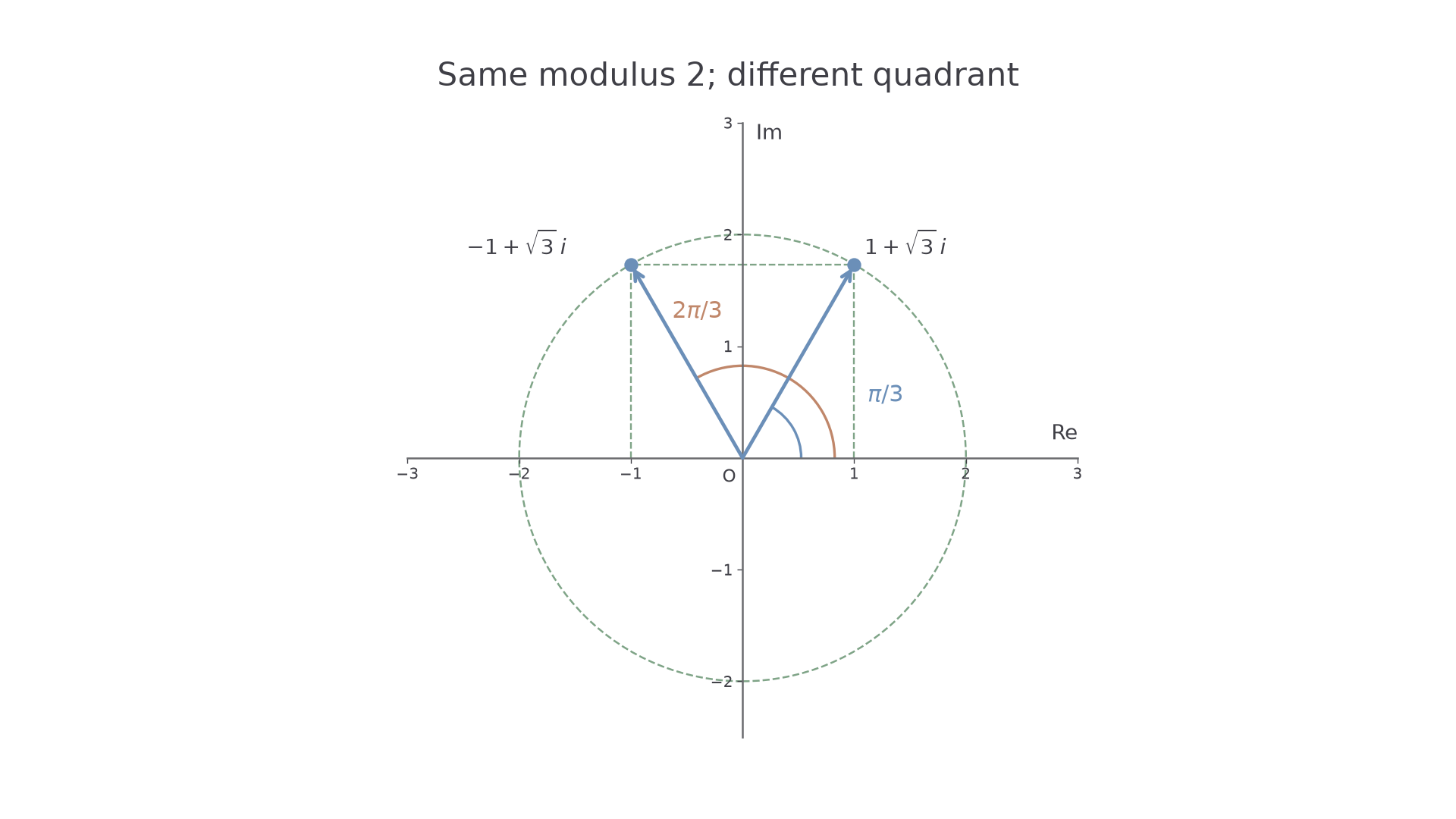
For , Pythagoras gives modulus , and equal positive coordinates give argument . For , the modulus is unchanged but the argument is . A tangent value alone cannot distinguish these quadrants.
[DIAGRAM: asset_name: The quadrant chooses the argument; asset_slug: h245_4_02_polar_conversion; caption: Equal reference angles can give different arguments in different quadrants; description: Equal-scale Argand axes show 1 + root 3 i and -1 + root 3 i on the circle of radius 2, at angles pi/3 and 2pi/3. Right-angle coordinate guides and arcs identify the reference angle pi/3 and the full second-quadrant angle 2pi/3.]
Cartesian to modulus-argument form
For :
When , , but use the signs of both parts to select the quadrant and then the required interval.
Not in the formula booklet: learn it.
Use an acute reference angle and the picture, rather than trusting the range of the inverse tangent button.
Worked example 1: first-quadrant conversion
Question. Express in modulus-argument form.
Plan. Find its modulus and use the positive coordinates to choose the first-quadrant angle.
Why this step? Both coordinates are positive, so the angle must be between and .
Answer. .
Check. and .
Change only the sign of the real part. The modulus and acute reference angle stay the same, but the actual argument moves to the second quadrant.
Worked example 2: second-quadrant conversion
Question. Express in modulus-argument form, with .
Plan. Find the modulus and subtract the acute reference angle from .
Why this step? points down and right, while the given point is up and left.
Answer. .
Check. The real part is , and the imaginary part is .
On an axis, read the angle directly: do not divide by a zero real part. For example, has modulus and principal argument .
Watch out
Wrong: assigning argument from inverse tangent alone. Right: use the signs to choose . Tangent repeats after , so its value does not fix the quadrant.
The final bracket must use a positive modulus, cosine first, a plus sign, and the same angle in both trigonometric functions.
Cartesian conversion for sums and differences
To recover cartesian form, evaluate and . Addition and subtraction then act on those coordinates. There is no rule that adds moduli and arguments to find a sum.
For example, and both have modulus , yet their sum has modulus , not . Their directions determine how their displacements combine.
Modulus-argument to cartesian form
For :
For sums and differences, convert each number and then combine the real and imaginary parts separately.
Not in the formula booklet: learn it.
An exact angle produces exact coordinates, so keep surds throughout.
Worked example 3: adding after conversion
Question. Let and . Find in cartesian form.
Plan. Evaluate each cosine and sine, multiply by its modulus, and then add parts.
Why this step? A sum joins displacement vectors, so the quantities to add are their horizontal and vertical components.
Answer. .
Check. Both original numbers point up and right, and both coordinates of their sum are positive.
Change only the operation to subtraction. Keep the same converted coordinates and apply the minus sign to both parts of .
Worked example 4: subtracting after conversion
Question. For the same , , find in cartesian form.
Plan. Use the two cartesian forms and subtract the whole expression for .
Why this step? The vector from to has destination minus starting coordinates, just as in the Argand diagram.
Answer. .
Check. Adding back gives .
For non-special angles, keep sufficient calculator precision until the end; round final non-exact values to significant figures unless told otherwise.
Watch out
Wrong: . Right: convert to cartesian coordinates before adding. Multiplication will have a rule involving the arguments, but addition does not.
Try the same subtraction with a different modulus.
Multiplication, rotation and powers
Multiplying moduli and adding arguments is what makes modulus-argument form useful. Try : squaring multiplies the length by again and adds another , giving .
The general rule follows by expanding and using the compound-angle identities you know:
[DIAGRAM: asset_name: Multiplication stretches and rotates; asset_slug: h245_4_02_multiply_geometry; caption: Multiplication by 1 + i enlarges lengths by root 2 and rotates through pi/4 anticlockwise; description: Equal-scale Argand axes show the point 1 in sage, 1 + i in blue and 2i in clay, with position arrows of lengths 1, root 2 and 2. Successive angle arcs are pi/4. A caption on the image states that each arrow is the preceding number multiplied by 1 + i.]
Multiplication in modulus-argument form
For non-zero , :
Multiplication by a fixed non-zero is an enlargement of scale factor about , followed by rotation through about , anticlockwise for positive .
Not in the formula booklet: learn it.
Multiplying by zero sends every point to ; its argument is undefined, so the rotation description assumes the multiplier is non-zero.
Worked example 5: multiplying different factors
Question. Find in modulus-argument form and describe the effect of multiplying by .
Plan. Multiply the lengths and add the angles.
Why this step? The multiplier sets a scale factor and an additional turning angle; it does not supply new cartesian coordinates to add.
Answer. . The transformation enlarges by factor and rotates through anticlockwise about .
Check. The length is tripled from to , and .
Change the second factor to a copy of the first. Repeating that multiplication gives positive integer powers: equal lengths multiply to , while equal angles add to .
Positive integer powers
For and a positive integer :
This is the positive-integer case of de Moivre's theorem, obtained here by repeated multiplication.
In the formula booklet.
A power's angle may need full turns removed before it becomes a principal argument.
Worked example 6: a power and its principal argument
Question. For , determine in modulus-argument form, with argument in .
Plan. Raise the modulus to the eighth power, multiply the angle by eight, then remove a full turn.
Why this step? Multiplying the angle gives an argument, but the question asks for its representative in a particular interval.
Answer. .
Check. , , and squaring once more gives the same modulus and direction.
This answers the opening question: the two quarter-diagonal directions add to a vertical direction, and .
Watch out
Wrong: . Right: . Arguments are added under repeated multiplication; moduli are multiplied.
Apply those two different operations to a new power.
Division and inverse transformations
Division undoes multiplication: divide the lengths and subtract the angles. The denominator must be non-zero.
If , then . Multiplication by would multiply the modulus by and add , so division must reverse those two changes.
Division in modulus-argument form
For and , with both non-zero:
Division by enlarges by factor and rotates through , about . A zero numerator gives zero, whose argument is undefined.
Not in the formula booklet: learn it.
Subtracting a negative angle is a common place to lose the direction of rotation.
Worked example 7: a quotient crossing the principal interval
Question. Let and . Find with principal argument in .
Plan. Divide moduli and subtract the entire denominator argument, then adjust the angle.
Why this step? Division by a clockwise rotation undoes that clockwise rotation, so the angle increases by .
Answer. .
Check. Multiplying by gives modulus and angle , equivalent to , as required.
Change only the order of the quotient. Taking the reciprocal inverts the modulus and reverses an argument.
Worked example 8: reversing the quotient
Question. For the same , , find and describe division by geometrically.
Plan. Reverse the modulus ratio and subtract the arguments in the new order.
Why this step? Reversing a division reverses the angle subtraction too; the reciprocal product must have argument zero.
Answer. . Division by enlarges by factor and rotates through clockwise about .
Check. has modulus and argument , so the product is .
A scale factor below is still called an enlargement in transformation language; it reduces distances.
Watch out
Wrong: . Right: numerator angle minus denominator angle, then adjust to the required interval. Write brackets around a negative denominator angle.
The form is a choice of tool: cartesian coordinates for sums, lengths and angles for products and quotients.
Quick Recap
- Convert using and the quadrant; convert back using , .
- Add and subtract in cartesian form.
- Multiply moduli and add arguments; divide moduli and subtract arguments.
- A positive integer power raises the modulus to that power and multiplies the angle. Adjust the final angle to the requested interval.
The opening square combines two lengths and two angles , giving length and angle .