4.08g - Inverse trig and hyperbolic derivatives
Derive the six inverse trigonometric and hyperbolic derivatives by differentiating their defining equations. You will use the correct branches to choose signs, apply the chain rule to composite functions, and find exact normal equations without leaving inverse functions in the final answer.
The slope of an inverse
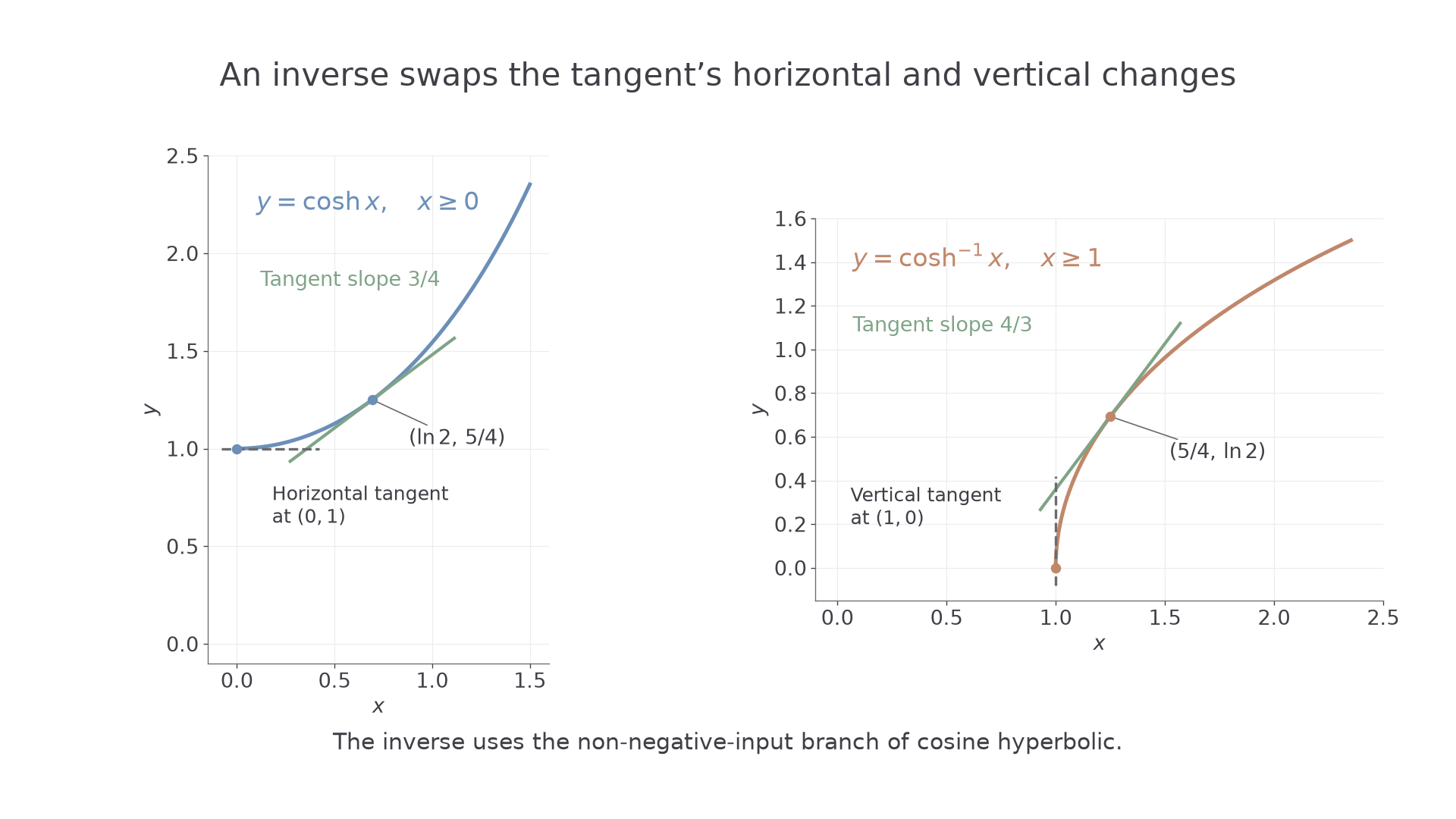
Why does have a vertical tangent at , while has an ordinary finite slope there? Both inverses involve a square root in their logarithmic forms, so the difference needs explaining.
You already know
An inverse swaps the input and output. The branch of used for its inverse has non-negative input. From A-level Maths, use implicit differentiation, the chain rule and the negative reciprocal for a normal gradient.
At , and the original gradient is . Reflection in swaps a tangent's horizontal and vertical changes. The inverse tangent therefore has gradient at . This reciprocal relationship also explains the exceptional case: a horizontal tangent reflects to a vertical one.
[DIAGRAM: asset_name: Reciprocal tangent slopes for an inverse; asset_slug: h245_inverse_cosh_slopes; caption: Reflection swaps the tangent slopes three quarters and four thirds, and sends the horizontal tangent at the vertex to a vertical tangent; description: Two panels on equal scales show the non-negative-input branch of y = cosh x in blue and y = inverse cosh x in clay. The points (ln 2, 5/4) and (5/4, ln 2) have labelled tangent segments of slopes 3/4 and 4/3. The first curve starts at (0, 1) with a horizontal tangent, while the second starts at (1, 0) with a vertical tangent. The corresponding coordinates and non-negative branch are stated on the figure]
To derive rather than quote an inverse derivative, write as , differentiate and eliminate . Where ,
This inverse-derivative relationship is not in the formula booklet; learn the argument. It applies at corresponding points, not at the same numerical input on both curves. For a composite inverse, multiply the resulting derivative by the derivative of its entire inner argument.
Key idea
Differentiate the equation the inverse undoes; the inverse's branch determines the sign when you remove a square root.
Test which point must be paired with the given point before taking a reciprocal.
Derivatives of inverse sine and cosine
Inverse sine and inverse cosine need different branches, which is precisely why one derivative is positive and the other is negative.
For , the principal range is . Inside that range , so
For , use . Here away from the endpoints:
The inverses themselves exist at , but their finite derivatives do not. Do not include these endpoints in a derivative's domain.
Inverse sine and cosine derivatives
For a differentiable with ,
The derivatives for are printed; these composite forms use the chain rule.
In the formula booklet.
Simplify a scaled square root only after applying the rule to the complete inner argument.
Worked example 1: a scaled inverse sine
Question. Differentiate , stating where the derivative is finite.
Plan. Use the inverse sine derivative with inner derivative , then simplify the denominator.
Why this step? The inner derivative cancels a factor from the square root; omitting it would double the answer.
Answer. , for .
Check. At , the gradient is , matching the horizontal stretch by factor .
Change only inverse sine to inverse cosine. The square root and scale stay the same; the direction of change reverses.
Worked example 2: the corresponding inverse cosine
Question. Differentiate , stating where the derivative is finite.
Plan. Use the negative inverse cosine derivative and keep the same inner factor.
Why this step? Inverse cosine decreases on its real domain, so its gradient must be negative.
Answer. , for .
Check. ; differentiating this constant gives two derivatives that cancel.
The check uses the complementary inverse identity, which is not in the formula booklet. The branch derivations above explain it without making it an extra rule to memorise.
Watch out
Wrong: . The minus sign comes from differentiating . Also, is an inverse, not .
Keep the function and change its inner scale once more.
The inverse tangent derivative
Inverse tangent has no square-root sign to choose, because its defining derivative already uses a square.
Let , with . Then
This derivative is positive for every real input. Unlike the inverse sine and cosine derivatives, it stays finite throughout its entire real domain.
Inverse tangent derivative
For a differentiable real ,
The derivative for is printed; the composite form uses the chain rule.
In the formula booklet.
The square in the denominator applies to the whole argument, including its coefficient.
Worked example 3: a linear inner function
Question. Differentiate .
Plan. Divide the inner derivative by one plus the square of the inner function.
Why this step? , so the coefficient is squared in the denominator but differentiated in the numerator.
Answer. , for all real .
Check. At zero the gradient is , matching a horizontal compression by factor .
Now change only the inner power from to . Both the inner derivative and the squared argument must respond to that change.
Worked example 4: a quadratic inner function
Question. Differentiate .
Plan. Treat as one argument and apply the chain rule.
Why this step? The denominator contains , not ; the two operations have different jobs.
Answer. , for all real .
Check. The original function is even, and the derivative is odd. At zero its gradient is zero, as the outer tangent inverse receives a stationary inner function.
Continue this lesson.
You’re previewing NovaLearn without an account. Create a free account to read the rest.
Create free account