4.02q - Rewriting powers of sine and cosine
Rewrite powers of sine and cosine as sums of trigonometric functions with multiple angles. Euler's formula supplies a short route: expand powers of a sum or difference of exponentials, pair opposite powers, and turn the pairs back into real functions.
Sine and cosine as exponential pairs
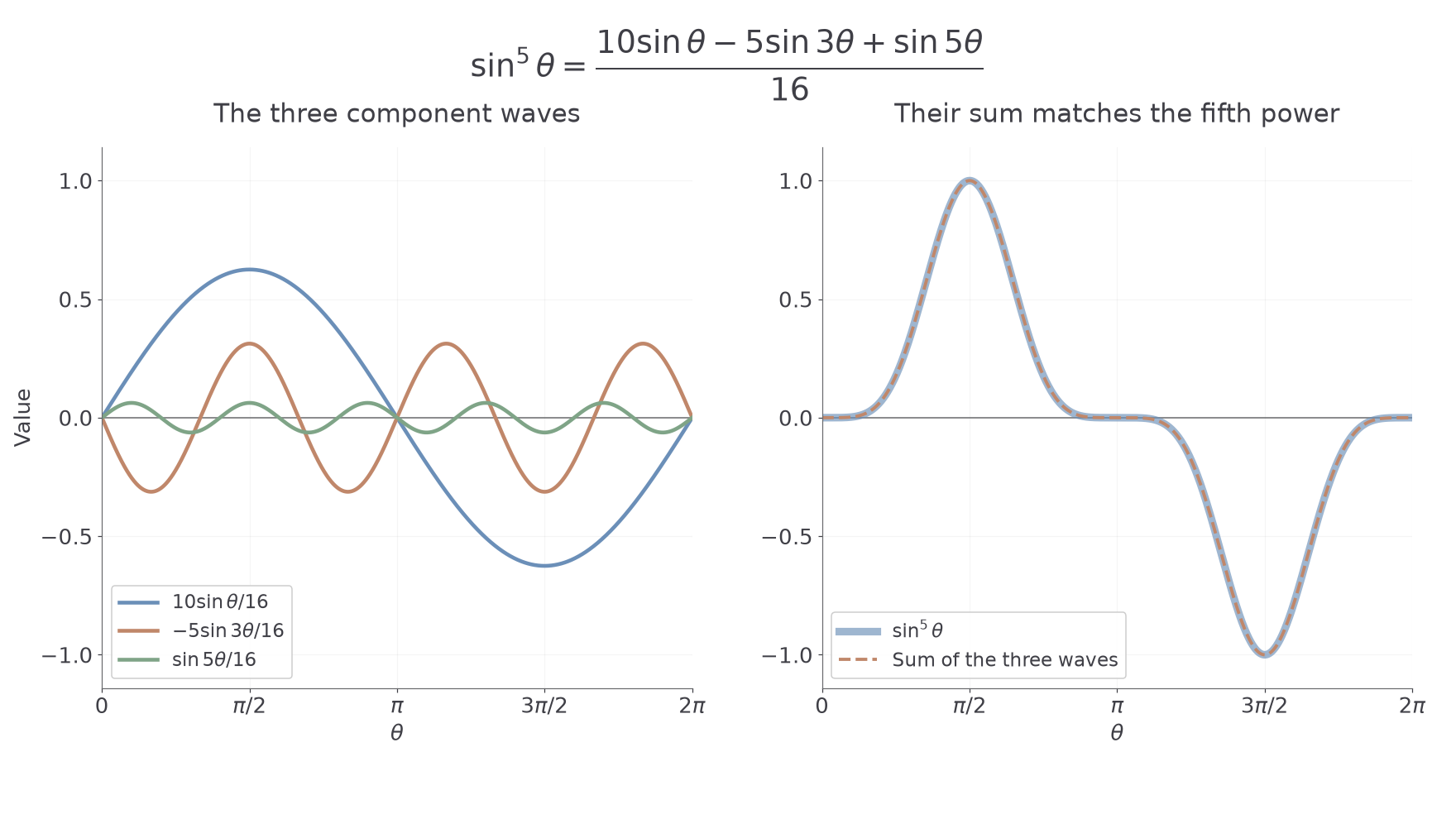
Can the curved shape be made by adding just three sine waves? Raising a function to the fifth power looks quite different from adding waves, but the two descriptions will turn out to be exactly equal.
Start with an easier pair. Euler's formula gives
Adding cancels the imaginary terms; subtracting cancels the real terms. Thus
You already know
De Moivre gives for integer . A-level Maths supplies the binomial theorem and . Keep when raising an entire denominator to a power.
The cancellation isolates each real ratio, with a factor of needed only in the sine expression.
Exponential expressions for sine and cosine
For real ,
Equivalently, for ,
Not in the formula booklet: learn it.
The same pair works at every multiple angle:
These follow from the displayed formulae with in place of , and are not separately printed in the formula booklet.
There are two directions to keep apart. Expanding gives a multiple angle in terms of powers. Expanding or goes the other way: it gives a power in terms of multiple angles.
Key idea
Use sums of opposite powers for cosine and differences of opposite powers for sine; the paired terms remove the complex numbers from the final answer.
Before pairing any powers, calculate the denominator's power: that is where a correct expansion can acquire the wrong sign.
Even powers and cosine multiples
An even power expands into opposite powers with equal coefficients, so the terms pair into cosines, including a constant term.
For the fourth power, the exponents are . They fall by 2 because choosing a instead of a reduces the exponent by 2. The middle term has exponent 0 and equals a real constant; it must not disappear.
Worked example 1: a fourth power of cosine
Question. Use de Moivre's theorem to express as a sum of a constant and cosines of multiple angles.
Plan. Expand , then pair the powers and .
Why this step? The complex terms cancel inside each pair, so no real or imaginary parts need be calculated separately.
Answer. .
Check. At , the right side is , agreeing with .
Worked example 2 changes only cosine to sine. Subtraction changes some binomial signs, and the multiplier on the left is now .
Worked example 2: a fourth power of sine
Question. Use de Moivre's theorem to express as a sum of a constant and cosines of multiple angles.
Plan. Expand , using , then pair equal and opposite exponents.
Why this step? Even powers of sine are even functions of , so cosine terms are expected. The minus signs belong to the binomial coefficients, not to the pairing rule.
Answer. .
Check. At , the right side is , agreeing with .
These fourth-power identities are not in the formula booklet: rebuild them from the exponential expressions. They are useful, for example, before integrating a power, because a sum of cosines is much easier to integrate term by term.
Watch out
Wrong: . The second term in the bracket is , not 1. Right: the exponents are , because .
The expansion is the explanation, so keep the powers visible until the pairing step has done its job.
Exam tip
When asked to use de Moivre's theorem, show the exponential or -pair expansion. Quoting a power-reduction identity and simplifying it does not demonstrate the requested method.
A sixth power introduces the extra pair , and its denominator has a different sign from the fourth power's denominator.
Odd powers and odd multiples
For an odd power the exponents are odd, so there is no constant term; a power of cosine gives cosine multiples, and an odd power of sine gives sine multiples.
The distinction is visible in the signs. The expansion of pairs as sums, while pairs as differences. Each difference contributes a factor of , and the power of on the left decides the final sign.
Worked example 3: an odd power of cosine
Question. Express as a sum of cosines of multiples of , using de Moivre's theorem.
Plan. Expand the cube of and collect the opposite powers as sums.
Why this step? The coefficients of opposite powers match, so pairing gives only cosines and removes completely.
Answer. .
Check. At , .
Worked example 4 changes only cosine to sine. Now the opposite powers have opposite coefficients, so pair differences and keep the sign of .
Worked example 4: an odd power of sine
Question. Express as a sum of sines of multiples of , using de Moivre's theorem.
Plan. Expand the cube of , pair as differences, and divide by .
Why this step? Dividing by , rather than , reverses both signs and makes the result positive near a small positive angle.
Answer. .
Check. At , .
Neither cubic power identity is printed in the formula booklet. Notice that rearranging the last one gives the triple-angle formula from the preceding lesson: the two methods agree.
Three waves make a fifth power
For the fifth power, , and the paired expansion is
So the answer to the opening question is
This identity is not printed in the formula booklet. One powered curve is exactly three waves, with frequencies in the ratio . The negative coefficient means subtracting the middle wave.
[DIAGRAM: asset_name: Three sine waves combine into a fifth power; asset_slug: h245_4_02q_sine_fifth_harmonics; caption: Adding the three labelled sine waves gives sin to the fifth power exactly; description: A white landscape figure shows the three component curves 10 sin(theta)/16, -5 sin(3theta)/16 and sin(5theta)/16 in blue, clay and sage over one full turn. A second panel overlays their sum and sin(theta) to the fifth power, which coincide. Axes are theta and value, with pi-based ticks and generous label space]
Watch out
Wrong: an odd power of sine must contain a constant term because every binomial expansion has a middle term. An odd power has two central terms, with exponents and ; neither has exponent 0. Right: only odd sine multiples occur.
The cosine version has the same odd exponents, but all its binomial coefficients are positive. Its opposite powers therefore pair as sums.
Quick Recap
- Write , so and .
- Expand the whole expression, including when working with sine.
- Pair opposite powers: sums give cosines and differences give sines.
- Even powers contain even multiples and a constant; odd powers contain odd multiples without a constant.
Three sine waves do make the opening curve: .