8.06a - Reduction formulae
A reduction formula turns a difficult integral into simpler members of the same family. You will establish these formulae, keep their boundary terms, and use the right starting value to obtain exact answers without repeatedly finding a new antiderivative.
Reducing an integral to a starting value
Can you find the exact value of without expanding the eighth power?
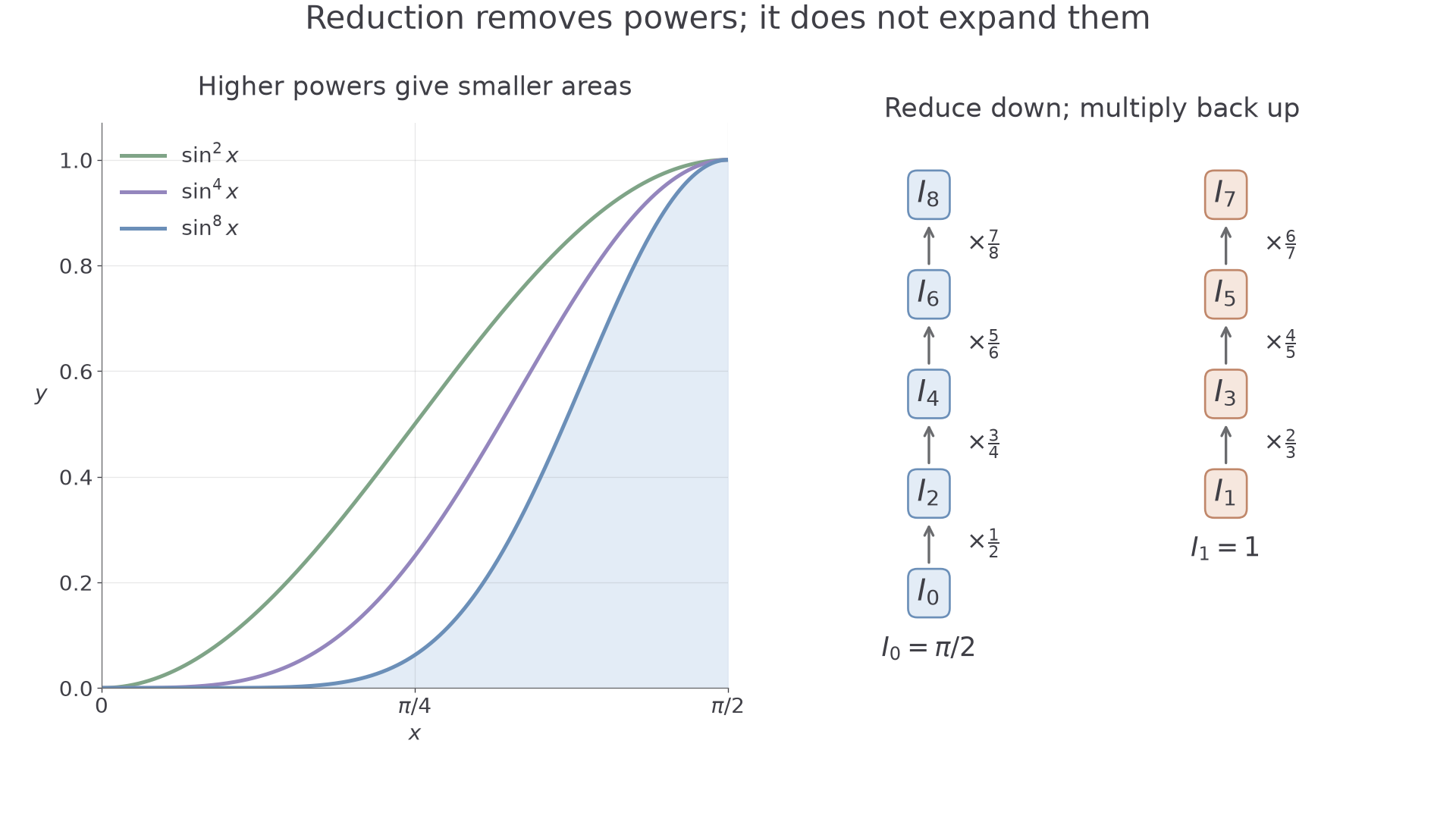
The curves , and enclose successively smaller areas on this interval. Although the powers grow, the integrals can be linked by a very short rule. Each link removes two powers, until an ordinary sine integral or the area of a rectangle remains.
[DIAGRAM: asset_name: Sine powers and two reduction chains; asset_slug: h245_8_06_reduction_chains; caption: Even powers reduce to the integral of 1, while odd powers reduce to the integral of sine; description: Left panel shows sine squared, sine to the fourth and sine to the eighth from zero to pi over two, with the eighth-power area shaded. Right panel shows the chain I8, I6, I4, I2, I0 and a separate I7, I5, I3, I1 chain. Arrows point upwards from each simpler integral to the next, labelled with the multiplication factor. The starting values at the bottoms are I0 equals pi over two and I1 equals one.]
You already know
Integration by parts gives , and its formula is in the booklet. For definite integrals, evaluate the product at both limits. The identities and the standard derivatives are assumed A-level Maths knowledge.
A family needs a precise definition: the same limits and integrand pattern, with an integer index controlling the power.
Reduction formula
A reduction formula relates an integral to one or more integrals of the same family with smaller indices. Repeated use ends at known starting values. For example, a link from to needs separate starting values for the even and odd chains. A relation containing only , with no simpler integral, is not a reduction.
For the sine family, the following rule will be proved later in the lesson. Here the task is to use it accurately.
A sine-power reduction
Define for integers . Then
The reduction is not printed; a question may give it or ask you to establish it. Learn how to use the index and starting values.
Not in the formula booklet: learn it.
Write the index used at each stage. The rule changes its coefficient every time the index falls.
Worked example 1: an even chain
Question. Given the sine-power reduction above, determine the exact value of .
Plan. Reduce the index by two at each stage, ending at .
Why this step? An even index stays even when two is subtracted, so cannot be the starting value for this chain.
Answer. .
Check. , as expected because . Numerically the answer is about , smaller than .
Change only the parity of the requested power. The recurrence is unchanged, but the chain now ends at .
Worked example 2: an odd chain
Question. Given the same reduction formula, determine the exact value of .
Plan. Follow the odd indices down to , then multiply the rational factors.
Why this step? ; inserting here would use the wrong base integral.
Answer. .
Check. , agreeing with the ordering of the integrands.
Every odd-power integral in this family is rational, while every even-power integral is a rational multiple of . The same rational reduction factors lead to two different kinds of answer because their starting values differ.
The smallest admissible index matters as much as the starting value.
Watch out
Wrong: applying the rule with to obtain . The rule was stated only for ; would not even converge on these limits. Right: evaluate directly and stop there.
One more even step answers the opening question.
Establishing a one-step reduction
Integration by parts becomes a reduction method when differentiating one factor lowers the index and integrating the other keeps its form.
Consider . Differentiating gives , and integrating leaves . The remaining integral therefore belongs to the same family. The index is a constant while you integrate with respect to .
The integration-by-parts rule is in the booklet; no reduction formula for this family is printed. Establish the relation from the definition, rather than quoting a memorised formula for a different family.
Worked example 3: lowering a polynomial power
Question. For integers , let . Show that for . Hence determine .
Plan. Take and , retain the boundary product, then start the recursion at .
Why this step? The remaining power is exactly , so its integral is , including the same limits. It is not .
Answer. for , and .
Check. The integrand for is positive and less than the integrand for on . Indeed, .
Change only the exponential from to . Its antiderivative introduces a factor of in both terms of the recurrence.
Worked example 4: an inner exponential scale
Question. Define for integers . Establish a reduction formula for when , and hence determine .
Plan. Differentiate , integrate , and retain the resulting half throughout.
Why this step? Integrating changes the product term and the remaining integral by the same factor. Changing just one would break integration by parts.
Answer. , for , and .
Check. , since for .
A boundary product is a value to calculate, not a piece of notation to discard.
Watch out
Wrong: , omitting . This would make positive integrals alternate in sign. Right: the product is for , so . At , evaluate the integral directly instead of using this boundary argument.
Show the choice of parts and the evaluation of the product when establishing a given result. Those steps make the recurrence a proof.
Continue this lesson.
You’re previewing NovaLearn without an account. Create a free account to read the rest.
Create free account