6.05f - Leaving a circular path
A circular path lasts only while the constraint can supply the force that it needs. Learn to find when a particle leaves the outside of a smooth circular surface or a string goes slack, then carry the correct position and tangential velocity into free fall. You will also determine the limiting speed for a complete vertical circle on a string.
When the circular model ends
A particle slides over the outside of a smooth hemisphere. Does it leave the surface when its speed becomes zero, when its weight vanishes, or when something else happens? Neither of those is the right condition. The surface stops controlling the motion when the required normal contact force reaches zero and would need to reverse direction to preserve the circle.
You already know
On a vertical circular path, energy gives the speed and the radial equation gives the constraint force. Radial acceleration is towards the centre. A projectile under gravity alone has constant horizontal velocity and vertical acceleration when upwards is positive.
The sign restriction comes from the object providing the force. A smooth external surface pushes the particle away from its centre; it cannot pull the particle in. A light string pulls towards its fixed end; it cannot push away. A rigid rod can do either, so a negative force in an assumed inward direction can mean compression rather than loss of the path.
Loss of a circular constraint
A particle loses contact with a smooth surface when its normal reaction reaches zero and continued circular motion would require the surface to pull. A string goes slack when its tension reaches zero and continued circular motion would require compression. From then until another contact or taut-string event, the particle moves under gravity alone if no other force acts.
Zero force is a boundary condition, not a command to replace every other quantity by zero. At departure the position is continuous and the velocity is unchanged in that instant: it is tangent to the circle. Acceleration becomes the free-fall acceleration. There is no outward kick and no new impulse merely because contact ends.
Key idea
Use circular dynamics up to departure, then use projectile dynamics with the departure position and tangent velocity as the initial conditions.
Check the direction at this handover: confusing velocity with radial acceleration would launch the particle along the wrong line.
Leaving the outside of a surface
For the outside of a sphere or circular arc, choose an angle from the upward vertical. This makes the height and the inward component of weight easy to read.
Let the particle start at the top with horizontal speed , and let increase down the right-hand side of a smooth sphere of radius . Its height above the centre is ; it has fallen . Energy gives
and hence . Meanwhile weight has inward component , but the reaction acts outwards. Thus .
[DIAGRAM: asset_name: Leaving the outside of a smooth sphere; asset_slug: h245_6_05_surface_departure; caption: At departure the outward reaction is zero, and the particle continues with a tangent velocity; description: The upper semicircle of a sphere is drawn with centre O and a departure point P on its upper right side. The radius OP makes angle phi with the upward vertical. Height r cos phi is marked above O. At an earlier point a short outward normal reaction arrow and downward weight arrow illustrate the signs. At P the reaction is labelled zero, a blue tangent velocity points down and right, and a clay projectile trajectory continues outside the circle to a horizontal plane through O. A side panel states mg cos phi - R = mv squared over r and R = 0 at departure]
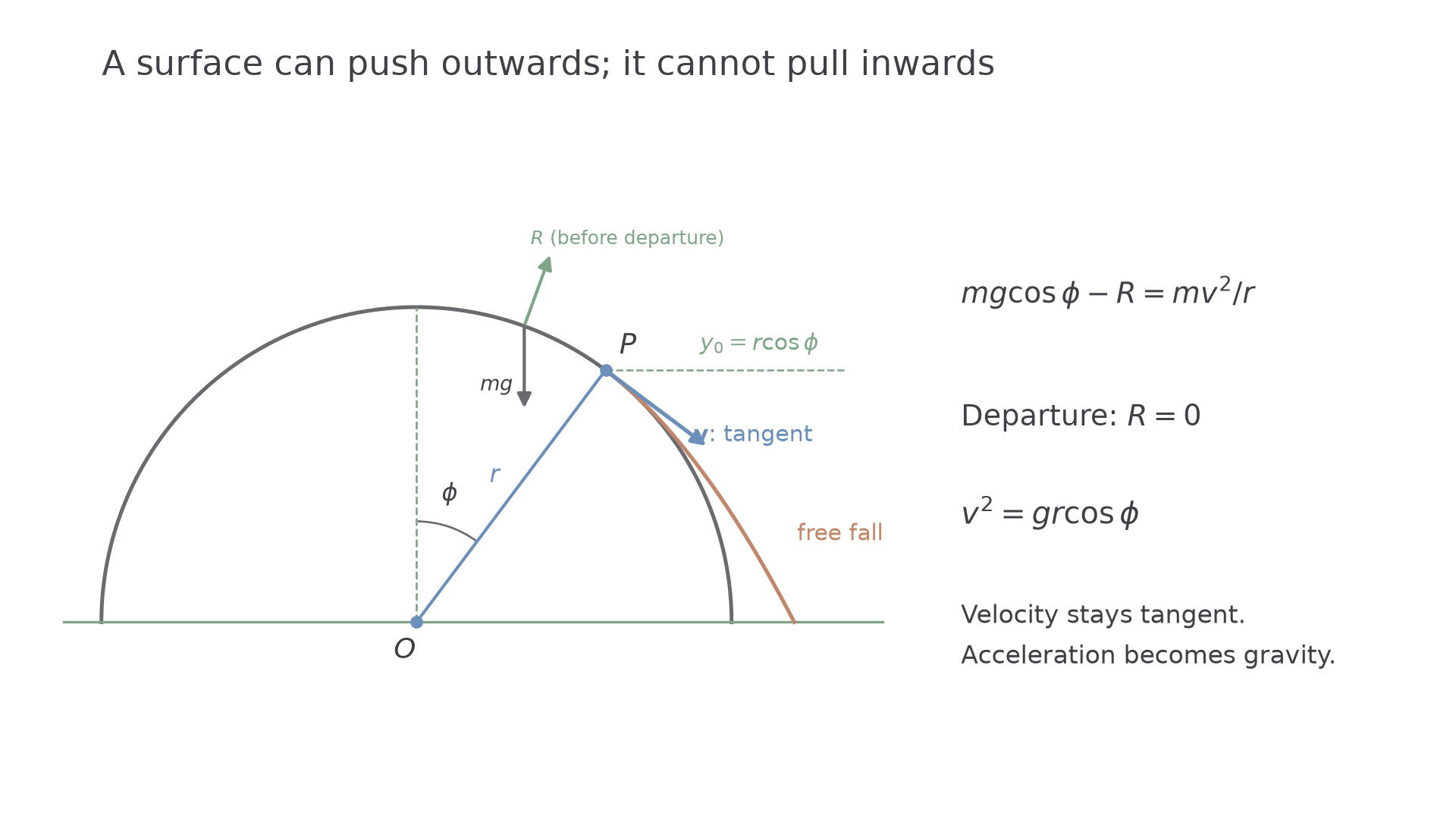
Departure from an external circular surface
While contact is maintained,
At departure, combine with energy:
These forms assume a smooth fixed external surface, launch from its top, gravity alone doing work, and . At , departure is immediate at the top; do not use an impossible cosine as a later contact point.
Not in the formula booklet: learn it.
At the top, contact requires . As the particle descends, its speed increases while the inward component of weight decreases; eventually weight alone is just enough to turn it at that instant. Thereafter the surface would need to pull, and the circular model ends. A particle exactly at rest at the exact highest point is an equilibrium of this ideal model; a slide from near the top can be considered as a limit, but no unmentioned push is needed in the non-zero-speed examples below.
Worked example 1: a non-zero launch from the top
Question. A particle is projected horizontally from the top of a smooth fixed sphere of radius , with . Determine the angle from the upward vertical at which it leaves the sphere and its speed there.
Plan. Combine the energy equation with the inward force equation at zero reaction.
Why set , rather than ? The contact force is the quantity that cannot change to a pulling force; the particle is still moving when contact ends.
Answer. , with speed .
Check. Initially . The reaction falls to zero as decreases to , and the departure speed is greater than the initial speed.
Change only the initial speed to a larger value. Less descent is needed before gravity alone can no longer supply the required inward force.
Worked example 2: a faster launch leaves sooner
Question. In the same sphere model, the initial speed instead satisfies . Determine the departure angle and speed.
Plan. Use the same zero-reaction and energy equations with the new initial kinetic energy.
Why is the angle smaller? , so departure occurs closer to the top.
Answer. , with speed .
Check. Initial reaction is , smaller than before, consistent with the earlier departure.
After departure, the value is no longer a required radial acceleration for the particle: it is no longer following that circle. Carry the launch velocity into a new free-fall model.
Watch out
Wrong: for a particle on the outside. Right: the reaction points away from the centre, so . Draw its direction before choosing its sign.
Change the launch speed once more and keep both equations visible.
Slack strings and complete circles
For a string, measure from the downward vertical as in the preceding lesson. The force that can fail is inward tension, so the radial equation has the opposite constraint-force direction from the external-surface example.
For initial speed at the bottom and string length , energy and radial dynamics give
Combining them gives . On the first ascent, tension decreases as increases. To locate slackening, solve and check that the speed is real and the point is reached before a reversal.
[DIAGRAM: asset_name: A string reaches zero tension above the centre; asset_slug: h245_6_05_string_slack; caption: At the first slackening point the tangent velocity is still non-zero, and gravity alone provides the instantaneous inward acceleration; description: A vertical circle of radius r with centre O and a point P in the upper right quadrant at theta = 120 degrees from the downward vertical. The string OP is blue and its tension at P is labelled T = 0. A tangent velocity arrow points up and left. A downward weight arrow from P is resolved conceptually into an inward component and a down-tangent component. A short dashed projectile curve bends inside the former circle after P. Text gives cos theta = -1/2 and v squared = gr/2 for the check example, with the circular arc beyond P greyed and labelled no longer the path]
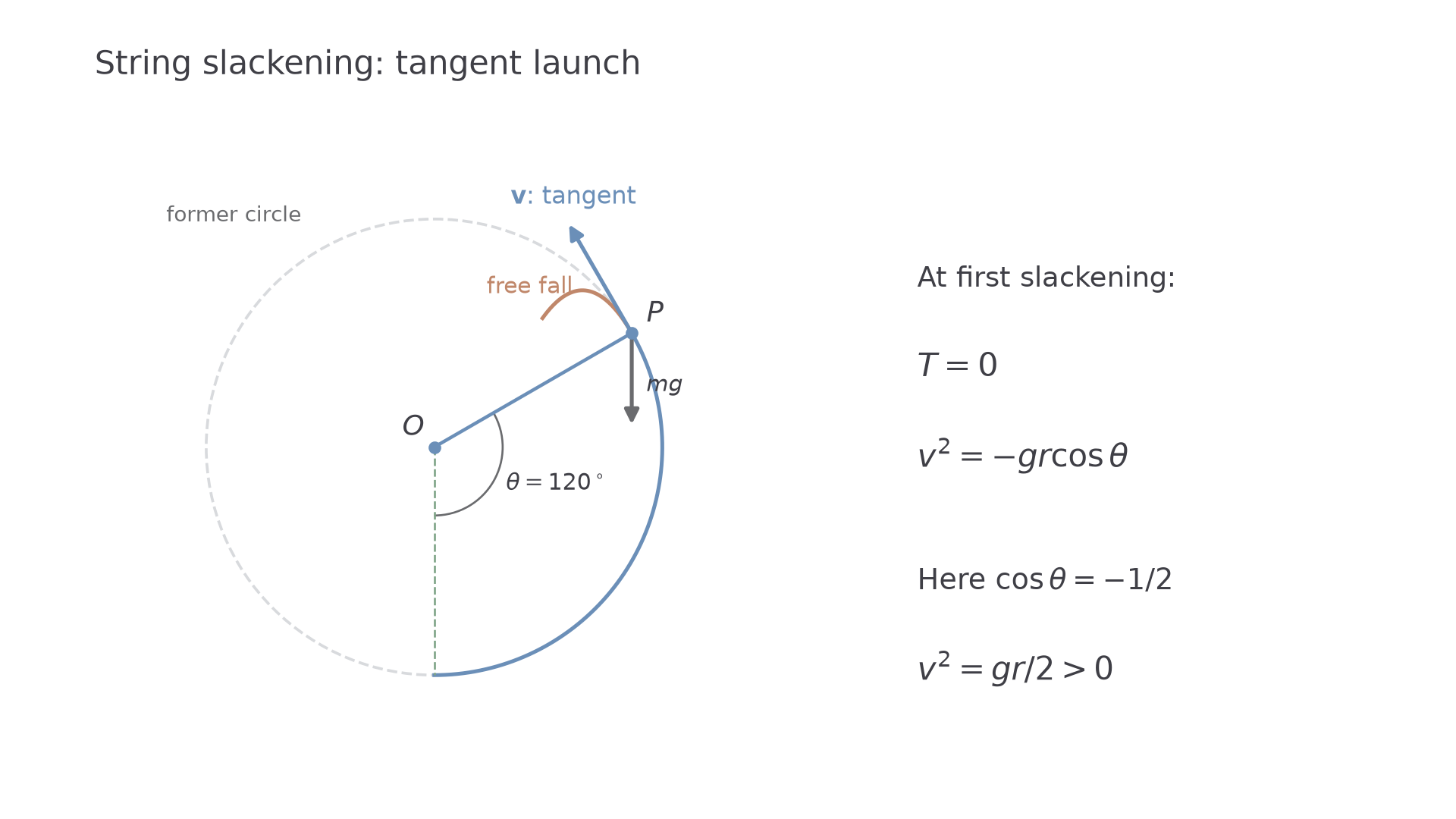
String boundaries
For , the first slackening point on the ascent satisfies
For a complete vertical circle, the limiting bottom speed satisfies
The equality is the limiting case with zero tension at the top; strictly positive tension everywhere requires .
Not in the formula booklet: learn it.
Continue this lesson.
You’re previewing NovaLearn without an account. Create a free account to read the rest.
Create free account