4.02n - Euler's formula
Use Euler's formula to connect the complex exponential with cosine and sine. You will interpret an imaginary exponent as an angle on the unit circle, calculate exact values, and solve equations by identifying a direction and its full turns.
Imaginary exponentials on the unit circle
What is ? The real exponential is larger than , so an exponent involving might suggest a large answer. Euler's formula instead puts at the ordinary number . The imaginary exponent records a turn, rather than growth along the positive real axis.
You already know
The point has modulus and argument . Multiplying two such numbers adds their angles, by the compound-angle identities. Radians measure a full turn as .
The expression , for real , is the complex exponential on the unit circle. Euler's formula tells you exactly what its two coordinates are. You do not multiply by : the is part of the exponent.
[DIAGRAM: asset_name: Euler's formula on the unit circle; asset_slug: h245_4_02_euler_circle; caption: The real and imaginary parts of an imaginary exponential are cosine and sine; description: Equal-scale Argand axes with a circle of radius 1 and point e to the i theta at theta = pi/3. A blue position vector, dashed coordinate guides, and a labelled angle theta show coordinates cos theta and sin theta. The four axis points are labelled e to the 0 = 1, e to the i pi/2 = i, e to the i pi = -1 and e to the -i pi/2 = -i.]
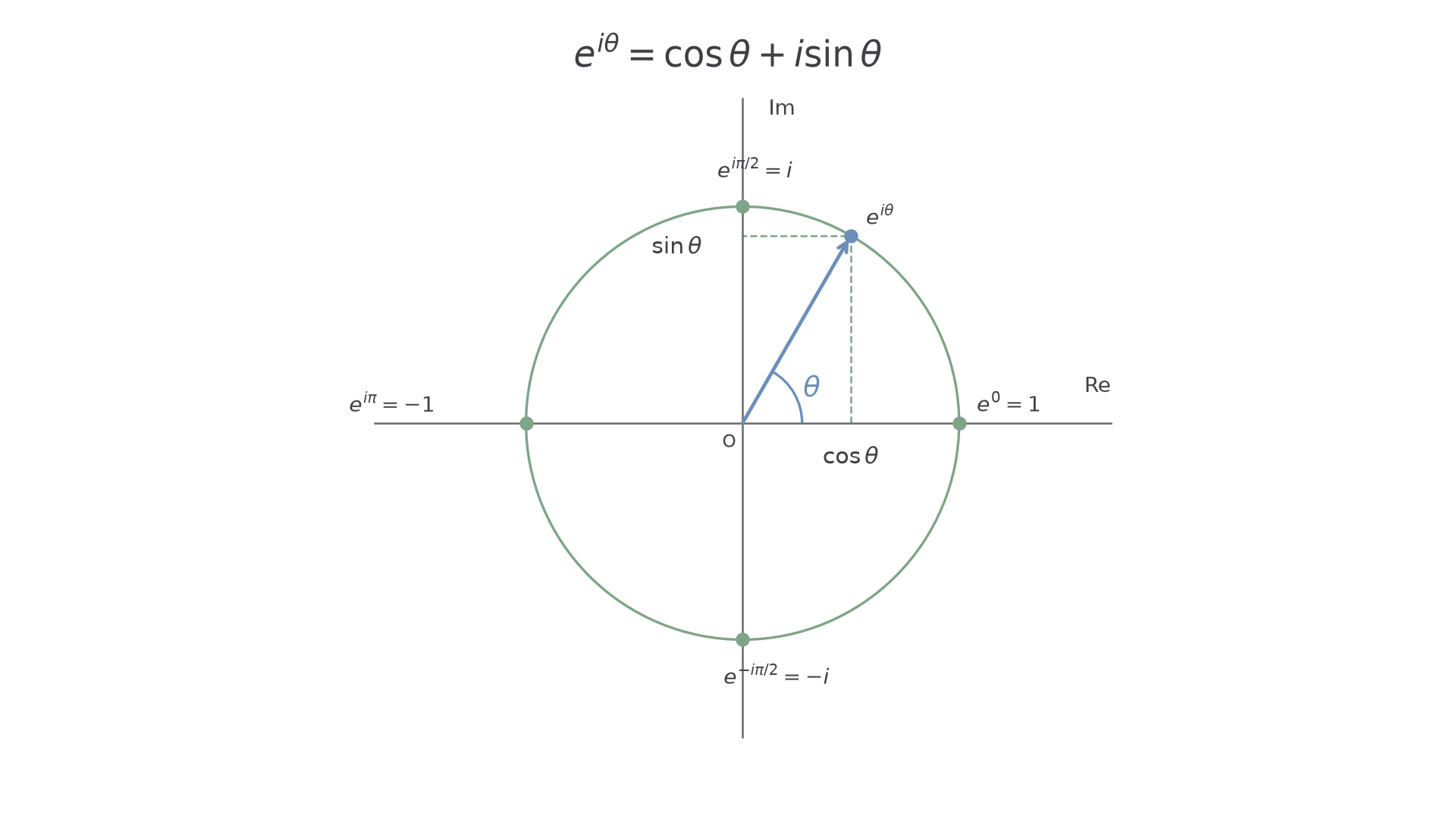
Euler's formula
For real , measured in radians:
Consequently, , , and .
Not in the formula booklet: learn it.
The modulus statement follows from . As increases, the point travels anticlockwise round the circle. A negative travels clockwise. At , ; after a half turn, .
The exponential notation agrees with the angle-addition rule:
The circle's addition of angles is the exponential's addition of exponents.
Here is the exact surprising identity behind the opening question:
The constants , , , and meet in one equation because the exponential describes the geometry of turning.
Key idea
For real , has unit modulus and direction . Its real and imaginary coordinates are cosine and sine.
Explain the two coordinates as well as the length: saying only “it is a rotation” leaves the formula's content unstated.
Exact values from Euler's formula
To evaluate an imaginary exponential, replace it by its cosine and sine, keeping the angle unchanged in both functions. Exact trigonometric values then give cartesian form.
Worked example 1: a positive angle
Question. Express in the form .
Plan. Apply Euler's formula and use exact values at .
Why this step? The exponent's real angle is ; that angle supplies both coordinates.
Answer. .
Check. Its modulus is , and both parts are positive, as expected in the first quadrant.
Change only the sign of the angle. The real part stays the same and the imaginary part changes sign, so the value is the conjugate.
Worked example 2: a negative angle
Question. Express in the form .
Plan. Use Euler's formula with angle , then use the evenness of cosine and oddness of sine.
Why this step? Clockwise and anticlockwise angles reflect the point in the real axis, which reverses only the imaginary coordinate.
Answer. .
Check. Multiplying the two example answers gives , matching .
The conjugation rule follows directly from Euler's formula and is not in the formula booklet: learn it.
Watch out
Wrong: . A negative exponent changes the angle, not the sign of the whole number. Right: .
Use the same method for a different clockwise turn.
Periodicity and equal exponentials
Different imaginary exponents can represent the same point, because a full turn changes neither cosine nor sine. Unlike the real exponential, the imaginary exponential repeats.
For example, and , although . You cannot cancel exponentials and claim their imaginary exponents must be equal.
Equal imaginary exponentials
For real , :
The angles describe the same direction exactly when they differ by a whole number of full turns.
Not in the formula booklet: learn it.
When solving for an angle, first identify one direction, then include the full turns, then apply any interval restriction.
Worked example 3: all angles for one point
Question. Determine all real such that .
Plan. Locate on the unit circle and add integer multiples of .
Why this step? A single principal argument supplies one solution; “all real” requires every full-turn equivalent too.
Answer. , .
Check. Adding leaves cosine and sine .
Change only the point from to . The direction reverses, while the full-turn spacing remains .
Worked example 4: the opposite imaginary point
Question. Determine all real such that , and identify the solution in .
Plan. Use a clockwise quarter turn, add full turns, then select the required interval.
Why this step? The principal interval selects a representative; it does not change the set of directions represented by the exponential.
Answer. All solutions are ; the one in is .
Check. , , giving .
This periodicity explains why the opening answer is compatible with a whole family: for every integer .
Watch out
Wrong: from , concluding . Right: the angles can differ by . For example, .
Make the interval restriction your last step.
Quick Recap
- Euler's formula is , with in radians.
- The point has modulus , real part , and imaginary part .
- Reversing the angle takes the conjugate: .
- Equal imaginary exponentials have angles differing by ; apply the requested interval at the end.
The opening value is exactly , the point reached after a half turn round the unit circle.