4.02a–4.02c - The language of complex numbers
Meet , the number whose square is , and the words and symbols used for every complex number: real part, imaginary part, conjugate, modulus and argument. You will write a complex number in cartesian form and in modulus-argument form , picture it as a point, and give its principal argument in the interval an exam question asks for.
The imaginary unit
Multiplying by turns the number line through half a turn about 0: it swaps with , with , and every number with its negative.
So here is the question this lesson answers: is there a number that turns the number line through a quarter turn, so that doing it twice is the same as multiplying by ? Such a number would have square , and no number on the number line does: positive and negative numbers both have positive squares, and . If it exists, it must live somewhere off the line. By the end of this lesson you will be able to say exactly where.
A number whose square is minus one
Start with a case you know. The equation has two roots, and . The equation has no real roots, because the square of any real number is positive or zero.
Now suppose there is a number whose square is . Then
and as well, so has the two roots and .
Imaginary unit
The imaginary unit is a number with . For a positive real number , . For example, and . Not an example: is not , because .
Write a surd before the with a clear gap, as in , or write , so that nobody reads it as .
Powers of the imaginary unit
Powers of repeat in a cycle of four, because .
| 1 | 2 | 3 | 4 | 5 | 6 | 7 | 8 | |
|---|---|---|---|---|---|---|---|---|
To find a high power, divide the power by 4 and keep the remainder: , so . The quotient 5 does not matter, because .
Watch out
Wrong: . The rule can fail when and are both negative. Right: turn each root into a multiple of first, so .
With available, every negative number has square roots, and calculations with follow the ordinary rules of algebra, with replaced by wherever it appears.
Key idea
is a new number with . Write the square root of a negative number as a real multiple of before doing anything else with it, and reduce powers of using .
Cartesian form and the conjugate
Adding a real number to a real multiple of gives a complex number, and every complex number is described by two real numbers: its real part and its imaginary part.
Complex number
A complex number is a number , where and are real; written this way, is in cartesian form. The real part is and the imaginary part is . The set of all complex numbers is . For example, has and . Not an example of cartesian form: is a complex number, but you cannot read off its parts until it is rewritten as .
Every real number is a complex number whose imaginary part is 0, so . A number such as , whose real part is 0 and whose imaginary part is not, is called purely imaginary. So is real exactly when , and purely imaginary when and . Exam questions write complex numbers either as or as ; both mean the same thing.
When a complex number is zero
A complex number is zero only when both of its parts are zero. Try to break this rule and see what goes wrong: suppose , with and real and . Then , so , which is a real number. But no real number squares to , so this is impossible. Therefore , and then as well.
A complex number equal to zero
If and are real, then
Not in the formula booklet: learn it.
The condition that and are real matters. For example, , yet neither 1 nor the "imaginary part" is zero, because is not a real number.
The complex conjugate
Changing the sign of the imaginary part gives a partner number that you will use in almost every complex calculation.
Complex conjugate
The complex conjugate of is : the imaginary part changes sign and the real part stays the same. For example, , and . Not an example: the conjugate of is not .
To use any of these words, first get the number into cartesian form: then the real part, the imaginary part and the conjugate can all be read straight off.
Worked example 1: writing a number in cartesian form
Question. Write in the form . Hence write down , and .
Plan. Reduce each power of using , write the square root as a multiple of , then collect the real and imaginary parts.
Why this step? Only when every term is a real number or a real multiple of can you see which terms make up the real part and which make up the imaginary part.
Answer. , so , and .
Check. , so
Worked example 2 changes one thing: the parts now contain an unknown real number, and you are told that the whole complex number is zero. That matters because one complex condition becomes two real equations, and the answer must satisfy both.
Worked example 2: an unknown that makes z zero
Question. The complex number is given by , where is real. Given that , find the value of .
Plan. Since is real, both brackets are real, so set the real part and the imaginary part equal to zero and find the value of that satisfies both equations.
Why this step? Each equation on its own allows two values of , but needs both parts to be zero at the same time, so only the common value works.
Answer.
Check. With , . With , , which is not zero.
Watch out
Wrong: . The imaginary part is the real number that multiplies , so it never contains . Right: , and then with both parts real.
In the next lesson the same idea, applied to two complex numbers that are equal, is how you solve equations in and .
Modulus and argument
A complex number is fixed by two real numbers, so you can draw it as the point , and that picture gives every complex number a size and a direction.
The picture has a surprising history. In 1797 the Norwegian-born surveyor Caspar Wessel, who worked on the mapping of Denmark, presented a paper to the Royal Danish Academy of Sciences on describing directions with numbers. He drew complex numbers as arrows from a fixed point and calculated with their lengths and angles. Almost nobody noticed, and the paper was only rediscovered about a hundred years later. By then the same picture carried the name of Jean-Robert Argand, who published it independently in 1806.
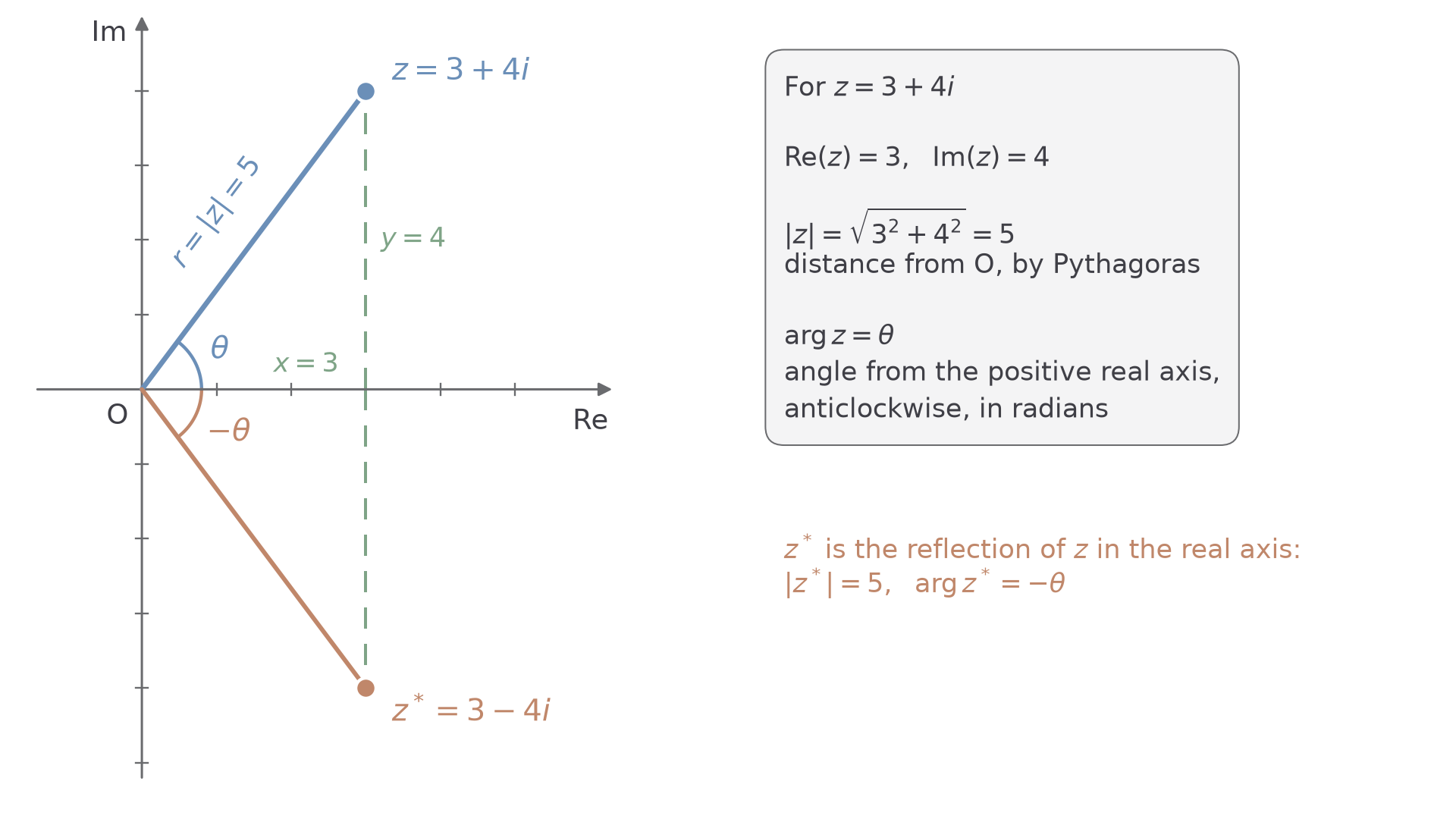
Take . Its point is 3 units to the right of the origin and 4 units up. By Pythagoras its distance from is , and the line from to makes an angle with the positive real axis.
[DIAGRAM: asset_name: The complex number 3 + 4i as a point; asset_slug: h245_4_02_complex_number_point; caption: The point z = 3 + 4i is 5 units from O at angle theta to the positive real axis, and its conjugate 3 - 4i is its reflection in the real axis; description: Axes labelled Re and Im with origin O. A blue line runs from O to the point z = 3 + 4i and is labelled r = |z| = 5. Dashed green lines mark x = 3 and y = 4, and a blue arc at O marks the angle theta. A clay line runs from O to the conjugate z* = 3 - 4i, with the angle -theta marked below the real axis. A side panel gives Re(z) = 3, Im(z) = 4 and |z| = root(3 squared + 4 squared) = 5 as the distance from O by Pythagoras, and says arg z = theta is measured anticlockwise from the positive real axis in radians. A note says z* is the reflection of z in the real axis, with |z*| = 5 and arg z* = -theta]
You already know
Angles in radians: a full turn is , a half turn is and a quarter turn is . So , and .
The distance and the angle have names.
Modulus
The modulus of is , the distance of the point from . It is a real number and never negative. For example, , and . Not an example: is not .
For a real number the modulus is the absolute value you already know, and only has modulus 0.
Argument
An argument of a non-zero complex number , written , is the angle between the positive real axis and the line from to , measured in radians: anticlockwise angles are positive and clockwise angles are negative. For example, has argument and has argument . Not an example: 0 has no argument, because there is no line from to itself.
For a number on one of the axes you can read the argument straight from the picture.
| Number | Where it is | Modulus | An argument |
|---|---|---|---|
| positive real axis | |||
| positive imaginary axis | |||
| negative real axis | |||
| negative imaginary axis | , turning clockwise |
For other numbers the quadrant tells you roughly where the argument is. A number with positive real and imaginary parts, such as , has an argument between 0 and . A number with negative real part and positive imaginary part has an argument between and . Working out the exact argument of a number such as is part of converting between forms, which has its own lesson, as does drawing Argand diagrams.
One point has many arguments. A further full turn of brings you back to the same direction, so also has arguments and . The last part of this lesson shows how to choose one.
The conjugate is the point , the reflection of in the real axis. Reflection keeps the distance from and reverses the angle, so , and if has argument then has argument . In the picture, also has modulus 5.
Key idea
The modulus says how far is from ; the argument says in which direction, as an angle from the positive real axis. Together they fix the point just as well as and do.
Modulus-argument form
Because the modulus and the argument fix a point, you can write any complex number using them instead of its real and imaginary parts.
Look again at the point at distance from with argument . The right-angled triangle in the picture has hypotenuse , so its horizontal side is and its vertical side is . These are the definitions of cosine and sine on a circle of radius , so they hold in every quadrant, not just the first. Substituting,
Modulus-argument form
A complex number with modulus and argument is
where and is an argument of , measured in radians.
Not in the formula booklet: learn it.
A number is in modulus-argument form only when it matches this pattern exactly: a number that is not negative in front, then with the cosine first, a plus sign, and the same angle in both places. Then you can read off the modulus and an argument with no working.
| Expression | In modulus-argument form? | What to do |
|---|---|---|
| Yes | read off , | |
| Yes | read off , | |
| No: a minus sign | rewrite first | |
| No: sine and cosine swapped | rewrite first | |
| No: a negative number in front | rewrite first |
You already know
From the unit circle: and . Complementary angles: and . A half turn: and .
Each pair of identities repairs one of the faulty forms without changing the value of the number.
Worked example 3: a minus sign inside the bracket
Question. Write in modulus-argument form, and state and an argument of .
Plan. The bracket has a minus sign, so use and to move the minus sign into the angle.
Why this step? The two terms must have the same angle and be joined by a plus sign; changing the angle to achieves that without changing the value of either term.
Answer. , so and an argument of is .
Check. The minus sign changes only the sign of the imaginary part, so is the conjugate of : its reflection in the real axis, with the opposite argument
Worked example 4 changes one thing: the sine and cosine are the wrong way round. That matters because examiners report candidates treating as if it were , which gives the wrong argument.
Worked example 4: sine and cosine swapped
Question. Write in modulus-argument form, and state and an argument of .
Plan. Turn the sine into a cosine and the cosine into a sine using the complementary angle .
Why this step? The same complementary angle appears in both terms, because is used for both, so the bracket now matches the pattern exactly.
Answer. , so and an argument of is .
Check. and ; and
Watch out
Wrong: has modulus and argument . A modulus is a distance, so it is never negative. Right: multiplying by is a half turn, so use and . The number is , with modulus 3 and argument .
So every faulty form has a repair: move a minus sign into the angle, swap sine and cosine with the complementary angle, or absorb a negative number in front with a half turn.
Exam tip
OCR accepts , and as modulus-argument form, and later the exponential form . Examiners have penalised final answers written as , so keep outside the bracket.
The principal argument
Every non-zero complex number has infinitely many arguments, so to give each number one standard argument you agree on an interval one full turn wide.
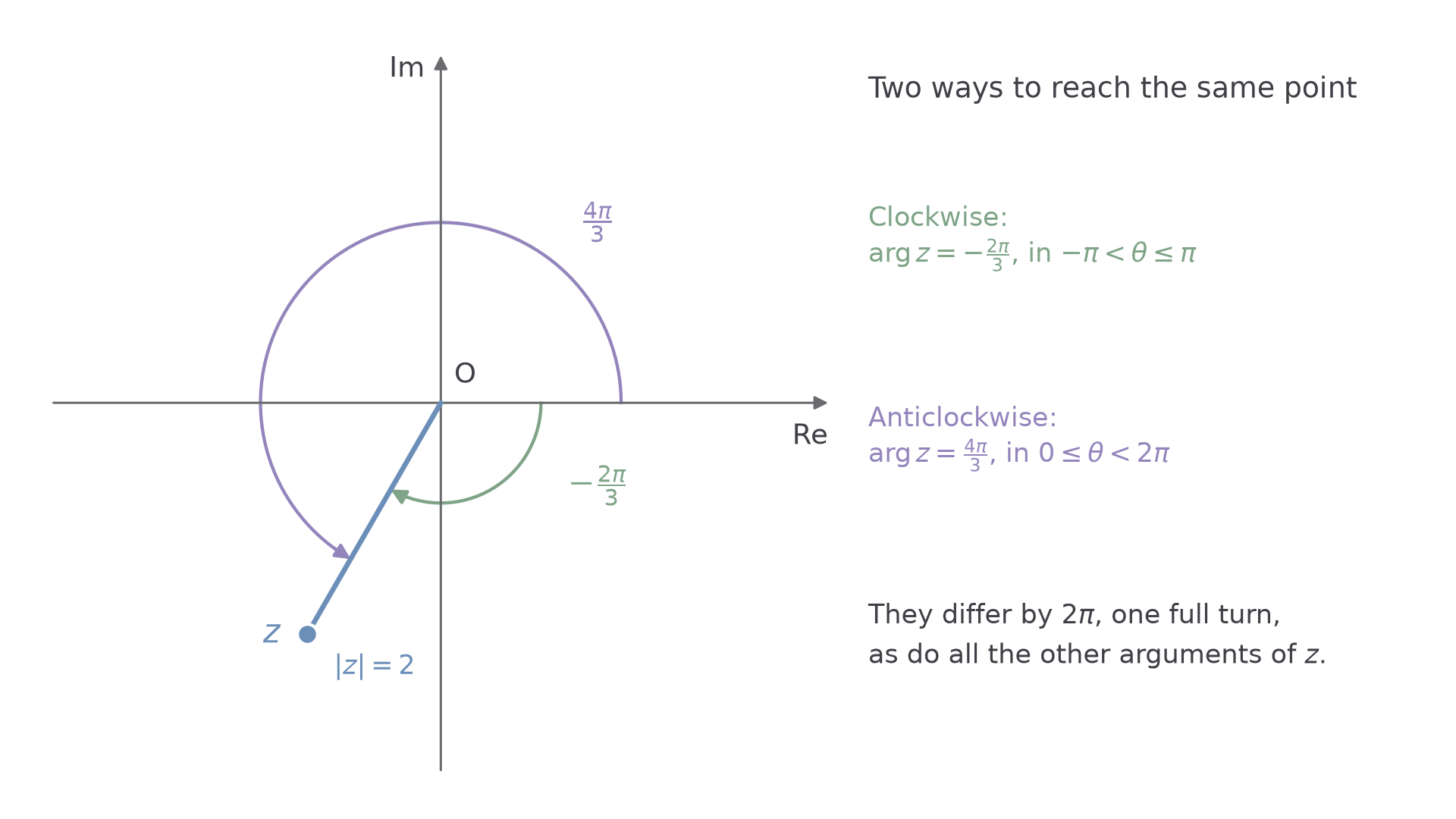
Look at the number with modulus 2 in the picture. Turning clockwise from the positive real axis, you reach it after , so is an argument. Turning anticlockwise, you reach it after . The two angles differ by , and adding or subtracting further full turns gives more arguments still, such as and .
[DIAGRAM: asset_name: One point with two principal arguments; asset_slug: h245_4_02_principal_argument; caption: The point z with modulus 2 is reached by turning 2pi/3 clockwise or 4pi/3 anticlockwise, so its principal argument is -2pi/3 or 4pi/3 depending on the interval used; description: Axes labelled Re and Im with origin O. A blue line of length 2 runs from O to the point z in the third quadrant. A green arc with an arrow turns clockwise from the positive real axis to z and is labelled -2pi/3. A purple arc with an arrow turns anticlockwise from the positive real axis to z and is labelled 4pi/3. Side text says that -2pi/3 is the argument in the interval greater than -pi and up to pi, that 4pi/3 is the argument in the interval from 0 up to but not including 2pi, and that the two values differ by 2pi, one full turn, as do all the other arguments of z]
Principal argument
The principal argument of a non-zero complex number is its one argument in an agreed interval of width . OCR uses either , meaning , or , meaning ; you may use either unless the question says which. For example, the number in the picture has principal argument in and in . Not an example: is never a principal argument in , because that end of the interval is excluded, so a negative real number has principal argument .
From now on means the principal argument. To find it, add or subtract as many times as you need to land in the interval; each is a full turn, so the point does not move. Here is all the notation of this lesson for one number, :
| Notation | Meaning | For |
|---|---|---|
| real part | ||
| imaginary part, a real number | ||
| complex conjugate | ||
| modulus | ||
| principal argument | in , or in |
Worked example 5: finding principal arguments
Question. The complex number is given by . Find the principal argument of in each of the intervals and .
Plan. is an argument but lies outside both intervals, so subtract until it lands in each one.
Why this step? Subtracting is a full turn back, so the point stays where it is. is more than , so the interval needs one more turn.
Answer. in , and in .
Check. The two answers differ by , one full turn
Worked example 6 changes one thing: the number in front is negative, so the number is not yet in modulus-argument form. That matters because the half turn adds to the argument, which often pushes it out of the interval the question fixes.
Worked example 6: a negative number in front
Question. In this question, arguments of complex numbers are in the interval . The complex number is given by . Write in modulus-argument form, and state and .
Plan. Use and to absorb the minus sign, then subtract to reach the interval.
Why this step? is a correct argument, but it is not in , and the question fixes that interval.
Answer. , with and . This is the point in the picture above.
Check. , and
The conjugate is the reflection in the real axis, so in its principal argument is . In the angle is outside the interval, so add a full turn: when is not real.
Watch out
Wrong: , or . The interval excludes , and is the same point. Right: and . The rule needs not to be a negative real number.
The interval matters in the exam as much as the angle does.
Exam tip
When the question fixes the interval, as in "In this question, arguments of complex numbers are in the interval ", give your final argument in that interval. Examiners have withheld the final accuracy mark from answers that were correct in every other way but gave the argument outside the stated interval.
Where the quarter turn lives
You can now answer the question from the start of the lesson. The number is not on the real line: it is the point one unit above , with modulus 1 and argument , so
The powers of from the first part sit where the circle of radius 1 crosses the axes, a quarter turn apart.
[DIAGRAM: asset_name: Powers of i as quarter turns; asset_slug: h245_4_02_powers_of_i; caption: The numbers 1, i, -1 and -i lie on the circle of radius 1 a quarter turn apart, and each multiplication by i moves one to the next; description: Axes labelled Re and Im with origin O and a dashed green circle of radius 1. Blue points mark 1 with argument 0, i with argument pi/2, i squared = -1 with argument pi and i cubed = -i with argument -pi/2, all with modulus 1. Four clay arrows run anticlockwise round the circle from each point to the next, each labelled times i. A side panel says that each multiplication by i keeps the modulus 1 and increases the argument by pi/2, a quarter turn, that two quarter turns give i squared = -1, a half turn, and that four quarter turns give i to the power 4 = 1, back to the start]
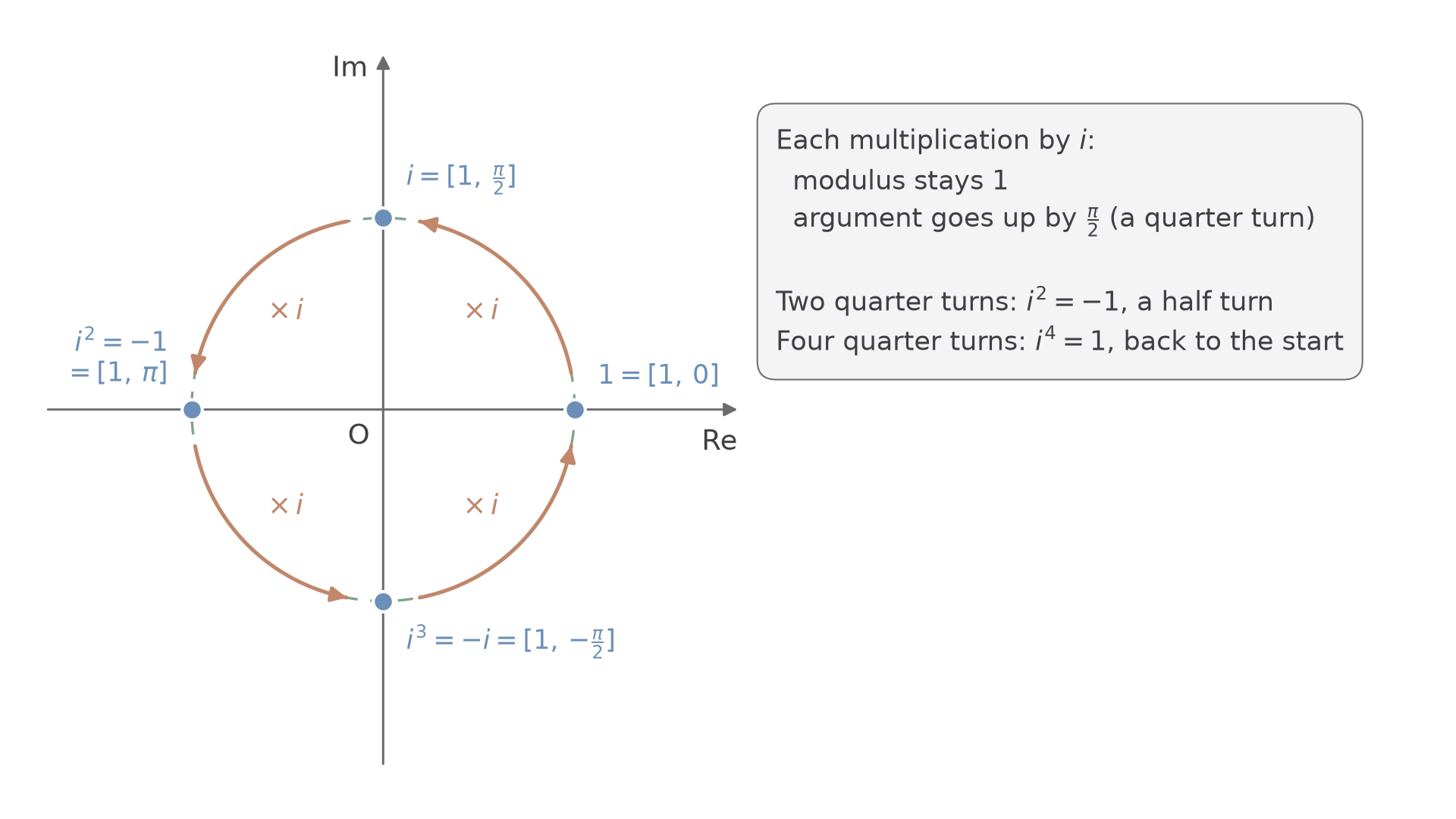
Each multiplication by keeps the modulus 1 and adds to the argument, a quarter turn about . Two quarter turns give , the half turn you started with, and four give , which is why the powers of repeat every four. In the lesson on working in modulus-argument form you will prove that multiplying any complex number by turns it through a quarter turn.
Quick Recap
- , so for , and the powers of repeat every four.
- In cartesian form , and are both real, , and only when and .
- is the distance of from ; is the angle from the positive real axis, in radians; 0 has no argument.
- Modulus-argument form is with ; repair a minus sign, a swapped sine and cosine, or a negative number in front before you read off and .
- The principal argument lies in or ; add or subtract to reach the interval the question asks for.
Where the quarter turn lives: is one unit above , and each multiplication by turns through , so two quarter turns give .