4.08c - Improper integrals
Use limits to evaluate integrals with an infinite range or an undefined integrand. You will decide whether a finite value exists, handle singularities at either endpoint, and split an integral when the difficulty lies inside its interval.
A limit decides whether an integral exists
Can a region stretch infinitely far to the right but still have a finite area?
For , the area from to is ; to it is . Extending the region adds area, but the total approaches . Infinite width alone does not decide the answer.
You already know
For an ordinary definite integral, find an antiderivative and calculate . A limit describes what an expression approaches as its variable approaches an endpoint or grows without bound.
The usual endpoint substitution needs care when an endpoint is infinite, or when the integrand is undefined at a point of the integration interval. Instead, first integrate over a safe finite interval, then examine its limit.
Improper integral
An improper integral has an infinite range of integration, or an integrand that is undefined at a point in the integration interval, including an endpoint. It converges if the required one-sided limits all exist as finite real numbers. Otherwise it diverges and has no finite value.
For example, has an infinite range, while has a finite range but an undefined integrand at . Both are improper and both converge. The ordinary integral is neither of these: its integrand is continuous throughout a finite interval.
[DIAGRAM: asset_name: Two infinite tails behave differently; asset_slug: h245_improper_tails; caption: Both curves tend to zero, but only the area under 1 over x squared from 1 to infinity is finite; description: Side-by-side plots from x equals one to eight, showing y equals one over x squared in blue and y equals one over x in lavender. The shaded finite portions have labels giving their integrals to R, one minus one over R and log R. Arrows show that both regions continue beyond the frame.]
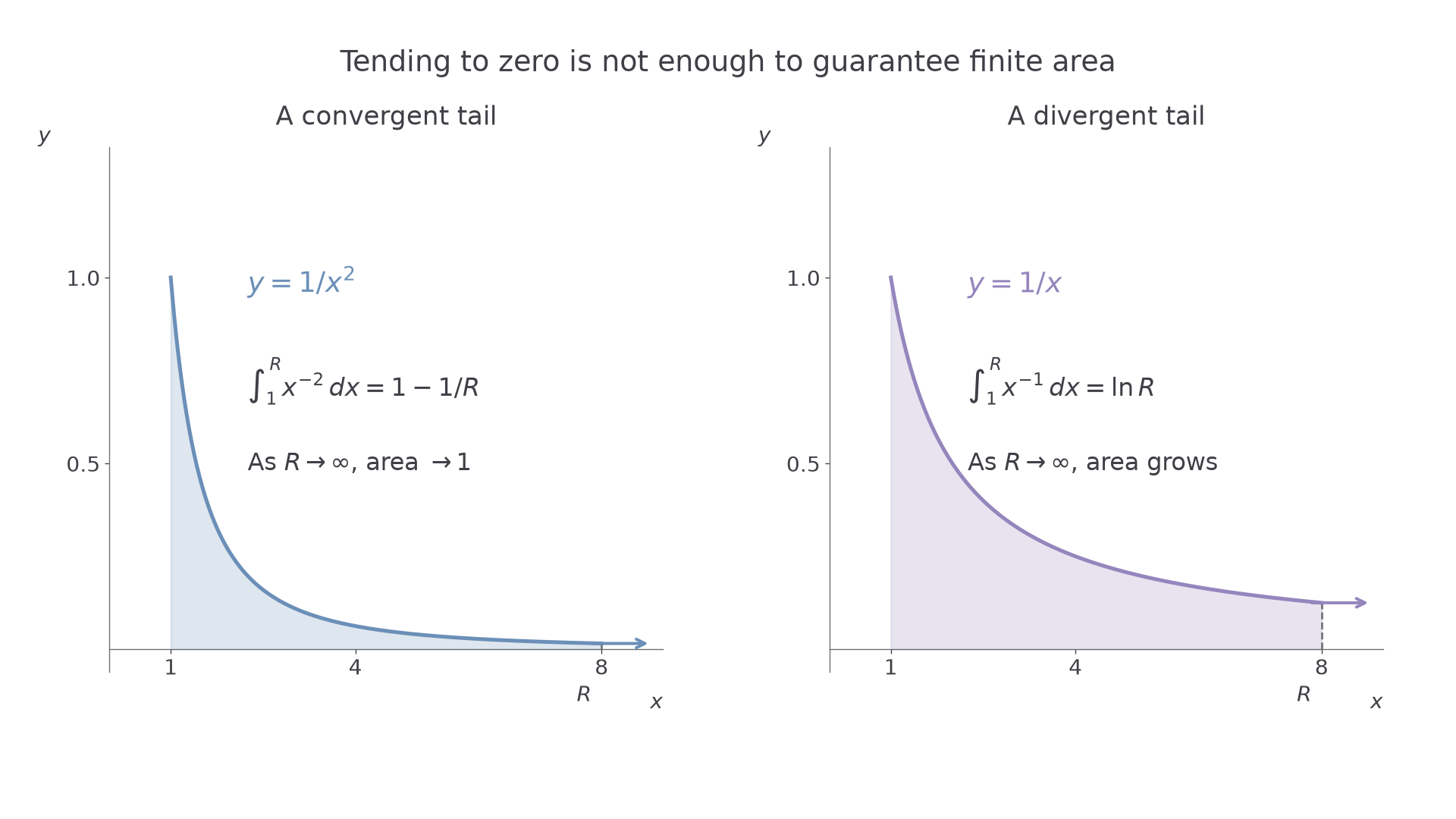
Both curves in the picture tend to , but diverges. A decreasing height is not enough: the accumulated area must approach a finite number.
Key idea
An improper integral is a limit of ordinary integrals; a finite antiderivative expression is not enough until the limit has been checked.
Use that definition to distinguish the source of the difficulty.
Infinite ranges of integration
Replace an infinite endpoint by a finite variable, integrate, and then let that variable tend in the required direction.
An infinite upper limit
If is integrable on every finite interval , define
only when that limit is finite. For an infinite lower endpoint, use .
Not in the formula booklet: learn it.
The finite variable makes every step of the fundamental theorem of calculus legitimate. The limit is a separate, final operation.
Worked example 1: a finite area
Question. Determine the exact value of .
Plan. Integrate to a finite upper limit , then let increase without bound.
Why this step? Infinity is not a number to substitute into ; the limit tells you what the finite-area expression approaches.
Answer. The integral converges and has exact value .
Check. Up to , the area is , and the remaining area is ; together they give .
Change only the exponent, from to . The curve still tends to zero, so the limit must decide whether its area behaves differently.
Worked example 2: a divergent area
Question. Determine whether converges.
Plan. Find the area to and examine its limit.
Why this step? The antiderivative grows without bound, even though the integrand tends to zero.
Answer. The integral diverges; it has no finite value.
Check. Each interval from to contributes . Extending through more such intervals keeps adding the same positive amount.
For a range infinite in both directions, choose any ordinary point and split there: exists only if and both converge separately. For example, . Do not tie the two distant endpoints together to manufacture cancellation.
Watch out
Wrong: , treating infinity as a substituted value. Right: . In detailed reasoning, show the finite endpoint and the limit explicitly.
The same three-stage calculation applies to other functions: finite integral, limit, conclusion about convergence.
Undefined integrands at endpoints
When an integrand is undefined at an endpoint, approach that endpoint from inside the interval.
At a lower endpoint , replace it by and take . At an upper endpoint , replace it by and take the same positive limit. The direction matters because every temporary integration interval must lie in the integrand's real domain.
Continue this lesson.
You’re previewing NovaLearn without an account. Create a free account to read the rest.
Create free account