8.05a–8.05c - Surfaces, sections and contours
Read equations in three variables as surfaces in space. You will connect explicit and implicit equations with their pictures, sketch vertical sections and horizontal contours, and extend the same ideas to surfaces involving trigonometric functions, logarithms and exponentials.
Equations and surfaces
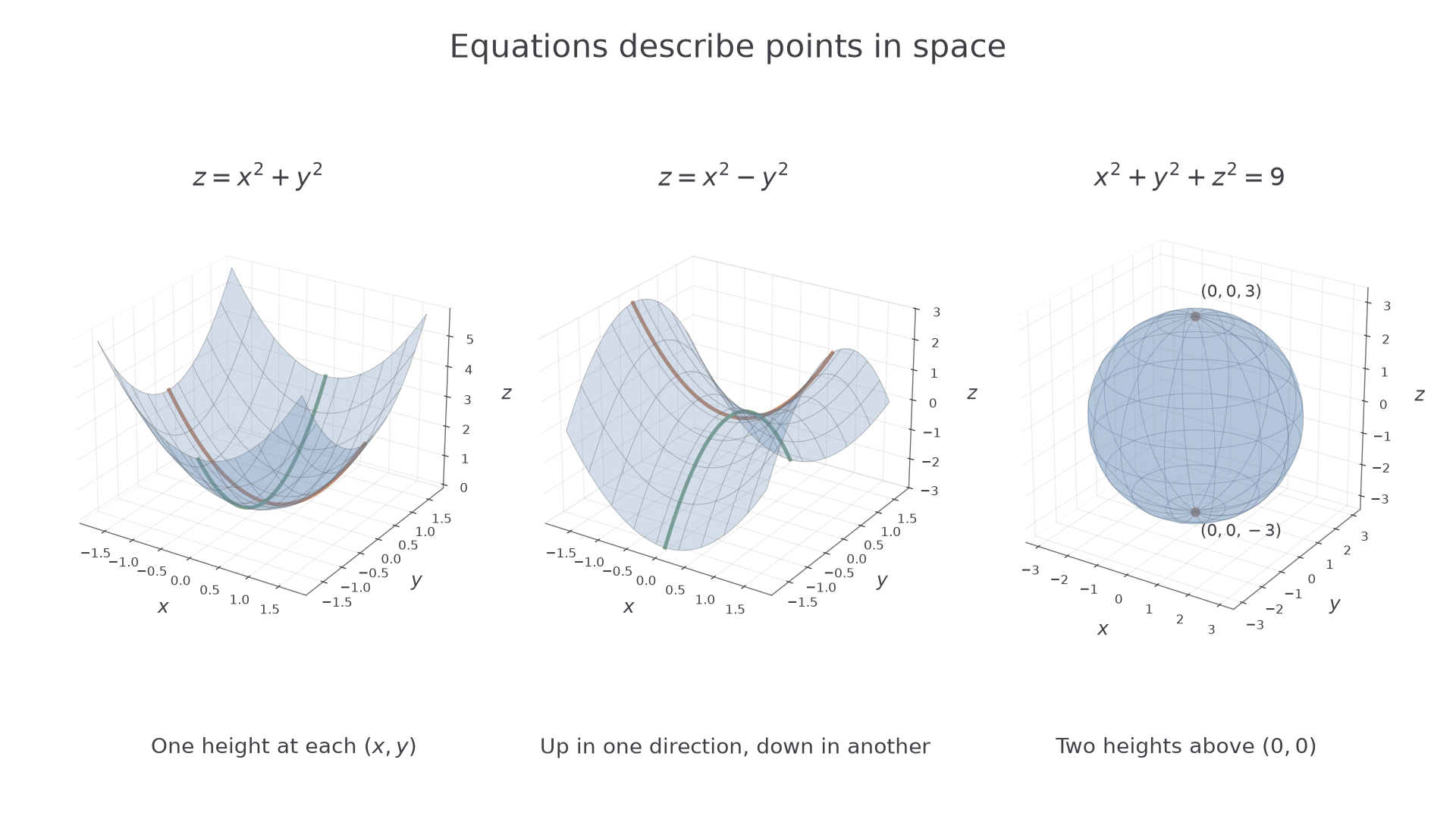
Could a flat map tell you whether you are looking at a bowl or a saddle? The surfaces and both pass through the origin and both contain the parabola when . One view is not enough. Sections and contours will reveal the difference.
You already know
A point in space has coordinates . Fixing , or describes a plane parallel to a coordinate plane. A plane can be written in the cartesian form .
For , choose two coordinates and calculate the third: lies on the surface because . The point does not. Letting and vary produces the whole surface, rather than just one curve.
Explicit and implicit surfaces
An equation gives a surface explicitly: every allowed pair gives exactly one height . An equation gives a surface implicitly: its points are all triples satisfying that equation.
For example, is explicit and is implicit. An implicit surface need not be the graph of one function .
The sphere contains both and : the same horizontal position has two heights. Solving for gives two pieces, and . By contrast, rearranges to the single explicit surface . The equation is another implicit surface: a circular cylinder, because is unrestricted.
[DIAGRAM: asset_name: A bowl, a saddle and a sphere; asset_slug: h245_8_05_surfaces; caption: A bowl has one height above each horizontal position; a sphere can have two. The saddle rises in one coordinate direction and falls in the other.; description: Three exact three-dimensional plots. The left plot is z=x squared+y squared, the middle plot is z=x squared-y squared, and the right plot is the sphere x squared+y squared+z squared=9. Coordinate axes are labelled x, y and z. The bowl and saddle include highlighted coordinate sections. The sphere marks its north and south poles at heights 3 and -3.]
What a partial derivative measures
Imagine walking along the surface while keeping fixed. You follow a curve in a vertical plane. Its gradient measures how the height changes as changes; this is the partial derivative with respect to . Holding fixed instead gives the partial derivative with respect to .
At on the bowl, the section with is , so its gradient at is . The section with is , whose gradient at is . These are two different slopes at the same point. The next lesson develops their notation and calculation.
Some equations simply do not define a point at a proposed position. For , setting is impossible: even when , the original expression is undefined. This is an algebraic restriction, rather than a missing line that you should fill in. The explicit and implicit descriptions, and this interpretation of partial derivatives, are not printed in the formula booklet.
Key idea
The equation specifies the points of a surface. A partial derivative describes the slope of a coordinate section through a point, with the other independent variable held fixed.
The sphere provides a useful test of the difference between an equation in three variables and a function of two.
Vertical sections
Cutting a surface with a vertical coordinate plane turns the equation into an ordinary function of one variable.
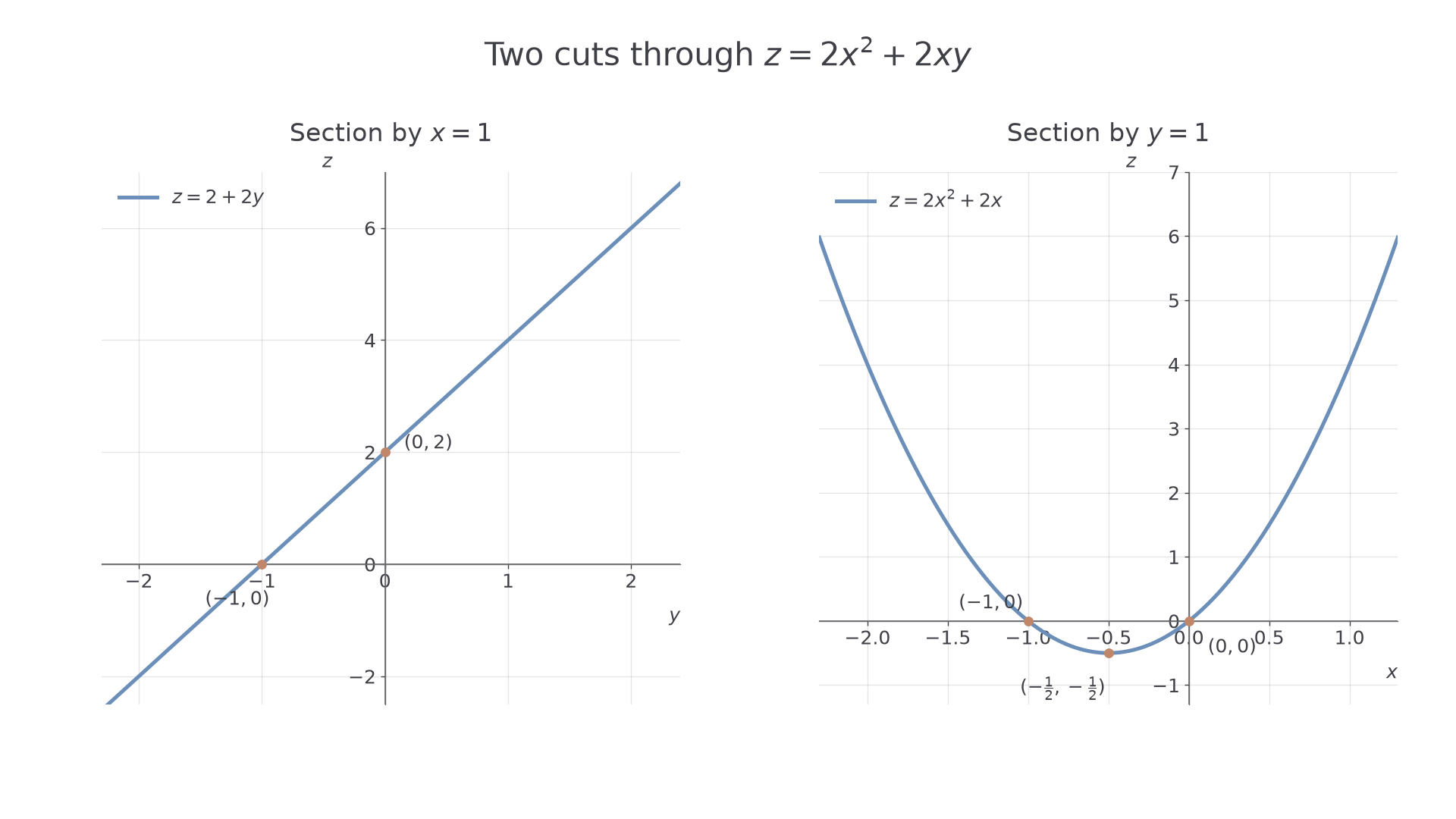
For example, fixing in gives . Sketch it on axes labelled and , because varies and does not. This curve sits in the plane ; it is not in the plane .
Section
A section is the intersection of a surface with a plane. For an explicit surface , the coordinate sections and have equations and , respectively.
Substitution is the whole algebraic method. The geometry comes from naming the correct axes and identifying the remaining curve's intercepts, turning points and shape. These section rules are not in the formula booklet.
Worked example 1: fixing x
Question. The surface has equation . Sketch its section by the plane .
Plan. Substitute , identify the resulting curve in the -plane coordinates, and find its intercepts.
Why this step? The fixed coordinate disappears from the sketch axes. The independent coordinate along this section is , not .
Answer. A straight line of gradient on axes labelled horizontally and vertically, crossing them at and , labelled .
Check. Taking gives the surface point , and the section gives .
The next example changes only which coordinate is fixed. The same surface now produces a parabola rather than a line.
Worked example 2: fixing y
Question. Sketch the section of by the plane .
Plan. Substitute , complete the square and find the intercepts.
Why this step? Completing the square locates the vertex exactly, so the sketch has more information than just an upward-opening shape.
Answer. An upward-opening parabola on - and -axes, with vertex and intercepts and , labelled .
Check. At the vertex, the three-dimensional point is , and .
These two sketches are different cuts through the same object.
[DIAGRAM: asset_name: Two coordinate sections through one surface; asset_slug: h245_8_05_sections; caption: Fixing x gives a straight section; fixing y gives a parabolic section of the same surface.; description: Two side-by-side exact coordinate plots for z=2x squared+2xy. The left has horizontal axis y and vertical axis z, the line z=2+2y, and labelled intercepts (-1,0) and (0,2). The right has horizontal axis x and vertical axis z, the curve z=2x squared+2x, vertex (-1/2,-1/2), and intercepts (-1,0) and (0,0). The titles identify the cutting planes x=1 and y=1.]
Watch out
Wrong: after setting , label the horizontal axis . That coordinate cannot vary along the section. Right: for , use horizontal and vertical ; for , use horizontal and vertical .
For a sketch, show the axes and label the features you calculated; a correct equation alone is not a sketch.
Horizontal contours
A contour joins positions with the same height, so its equation comes from fixing rather than or .
For the bowl , the horizontal cut is a circle of radius at height . Its contour map shows the circle on the -plane and labels it with the height . The map has flattened the location of the circle, while retaining its height as a label.
Contour
For , a contour at height consists of positions satisfying . It is the horizontal section , represented on the -plane and labelled with .
Continue this lesson.
You’re previewing NovaLearn without an account. Create a free account to read the rest.
Create free account