4.03n–4.03q - Finding and using inverse matrices
Find inverses of non-singular matrices of order two and three, by hand and with a calculator. Use inverses to rearrange matrix equations and reverse transformations, keeping the order of multiplication under control.
Undoing a matrix of order two
The matrix sends to . Can one matrix recover every original point, and how should you undo two transformations performed in succession? An inverse answers the first question. Its multiplication order will answer the second.
You already know
The identity matrix leaves vectors unchanged. A square matrix is non-singular exactly when its determinant is non-zero; a singular transformation can send different original points to the same image.
For the opening matrix,
This is more than a lucky recovery of one point. Multiplying that candidate matrix by , in either order, gives the identity, so it reverses for every vector.
Inverse matrix
The inverse of a square matrix is the matrix satisfying . It exists exactly when is non-singular. For example, . Taking the reciprocal of every entry is not a general rule for finding an inverse.
For order two, swapping the diagonal entries and negating the other two gives a matrix whose product with the original is a scalar multiple of the identity:
Dividing by makes that product the identity. If the determinant is zero, this division is impossible; a singular matrix has no inverse.
Inverse of a matrix of order two
For ,
Not in the formula booklet: learn it.
Calculate the determinant first, then change the four entries in the stated positions.
Worked example 1: an integer inverse
Question. Find , where .
Plan. Check that the determinant is non-zero, swap the diagonal entries, negate the other two and divide by the determinant.
Why this step? The factor outside divides every entry. Here the determinant is , so no fractions are needed.
Answer. .
Check. .
Worked example 2 changes only the bottom-right entry. The determinant is now , so the same positional changes must be followed by a genuine division.
Worked example 2: an inverse with fractions
Question. Find , where .
Plan. Find the new determinant, then apply the same inverse rule.
Why this step? The determinant changed even though only one entry changed. Reusing the previous outside factor would give a multiple of the identity rather than the identity itself.
Answer. .
Check. , so multiplying by gives .
On a calculator, store the original matrix with dimensions two by two, then apply the matrix inverse operation to that stored matrix. The resulting matrix must multiply the original to give . In detailed-reasoning questions, show the determinant and the hand method above.
Here is a useful arithmetic surprise: an integer matrix of order two with determinant or has an integer inverse. The formula proves it immediately, since its numerator entries are integers and the denominator is only or .
Watch out
Wrong: . Inversion reverses matrix multiplication; it does not act entry by entry. Right: swap the diagonal entries, negate the other two and divide by .
A fast check is to calculate one diagonal and one off-diagonal entry of the product; a complete identity product verifies the inverse.
Minors, cofactors and an inverse of order three
For a matrix of order three, the same principle works: build a matrix whose product with the original is its determinant times the identity, then divide by the determinant. Minors and cofactors provide that matrix.
For entry , delete row and column and calculate the remaining determinant of order two. That number is the entry's minor. Its cofactor, , is the minor multiplied by the sign in position of
A minor can itself be negative: “minus the minor” can therefore be positive.
Adjugate
The adjugate of a square matrix is the transpose of its cofactor matrix. If the cofactor matrix is , then . Transposing exchanges rows and columns; it does not change the signs.
Cofactor expansion gives . The diagonal entries of this product are determinant expansions. Its off-diagonal entries are expansions with a repeated row, so are zero. This explains both the transpose and the division in the rule.
Inverse using cofactors
For a non-singular matrix ,
Calculate all minors, apply the cofactor signs, transpose, then divide by the non-zero determinant.
Not in the formula booklet: learn it.
Write the four stages separately. A correct set of cofactors can still give a wrong inverse if the transpose is missed.
Worked example 3: constructing all nine cofactors
Question. Find the inverse of without a calculator.
Plan. Find the determinant, calculate the nine minors, apply their signs, transpose and divide.
First,
For example, deleting row and column leaves , so that minor is , and its cofactor is . Doing this for every entry gives
Why this step? Cofactors first belong in their original positions. Only after that do you transpose the whole matrix.
Answer.
Check. Multiplying by the displayed integer matrix gives . For example, the first-row, second-column entry is . Division by gives .
Worked example 4 changes only the bottom-right entry from to . Recalculate the determinant and affected minors; do not change that entry alone in the inverse.
Worked example 4: one entry changes several cofactors
Question. Find the inverse of without a calculator.
Plan. Repeat the four stages with the changed entry included in every relevant minor.
Why this step? The changed entry belongs to four different minors, so changing one original entry can change several entries of the inverse.
Answer.
Check. Multiplying by the integer matrix gives . Its first column, for example, gives .
On a calculator, store the matrix with dimensions three by three, enter its rows, and apply the matrix inverse operation to the stored matrix. Retain exact fractions where possible. Multiply by the original matrix to check the result. A calculator inverse is acceptable in a “Find” question unless analytical working is explicitly required; it is not a substitute for the displayed method in a detailed-reasoning question.
Watch out
Wrong: . This misses the transpose. Right: . A symmetric cofactor matrix can hide this mistake, so check the rule rather than relying on the appearance of one example.
A quick off-diagonal product check is particularly useful for detecting a missed transpose.
Inverse properties and matrix equations
An inverse lets you cancel a matrix, but cancellation must happen on the side where the two inverse factors become adjacent. Matrix multiplication is associative, so you may regroup factors; you may not generally reorder them.
For example, the inverse of a product has its factors reversed:
The reverse product also gives , so this is the inverse of .
Simple inverse properties
For non-singular square matrices and of the same order,
The determinant result follows by taking determinants in .
Not in the formula booklet: learn it.
For , multiply on the left by . For , multiply on the right. This gives or , respectively; these rearrangement rules are not in the formula booklet.
Worked example 5: cancelling on the left
Question. Given and , find such that .
Plan. Find , then multiply both sides on the left by it.
Why this step? Multiplying on the right would create ; the two inverse matrices would be separated by and could not cancel.
Answer. .
Check. .
Worked example 6 changes only which side of the matrix occupies. The answer changes because the cancellation must move to the other side too.
Worked example 6: cancelling on the right
Question. With the same and , find such that .
Plan. Multiply both sides on the right by .
Why this step? The inverse must sit immediately after . That leaves , not , on the other side.
Answer. .
Check. .
The two equations gave different matrices because their cancellation occurred on different sides.
Watch out
Wrong: . Right: . The inside factors must cancel first; keeping the original order generally prevents this.
Use adjacency to inspect a proposed cancellation rather than treating matrices as ordinary fractions.
Reversing successive transformations
An inverse transformation takes each image point back to its object point. If a transformation was assembled from two stages, undo the last stage first.
[DIAGRAM: asset_name: Reversing a stretch followed by a shear; asset_slug: inverse-stretch-shear; caption: The inverse returns the image triangle to the object by undoing the shear before undoing the stretch.; description: A triangle with vertices (0, 0), (2, 1), (0, 2) is mapped to vertices (0, 0), (5, 1), (2, 2) by the matrix with rows (2, 1) and (0, 1), representing a horizontal stretch of factor 2 followed by a horizontal shear of factor 1. The inverse first undoes the shear, then the stretch.]
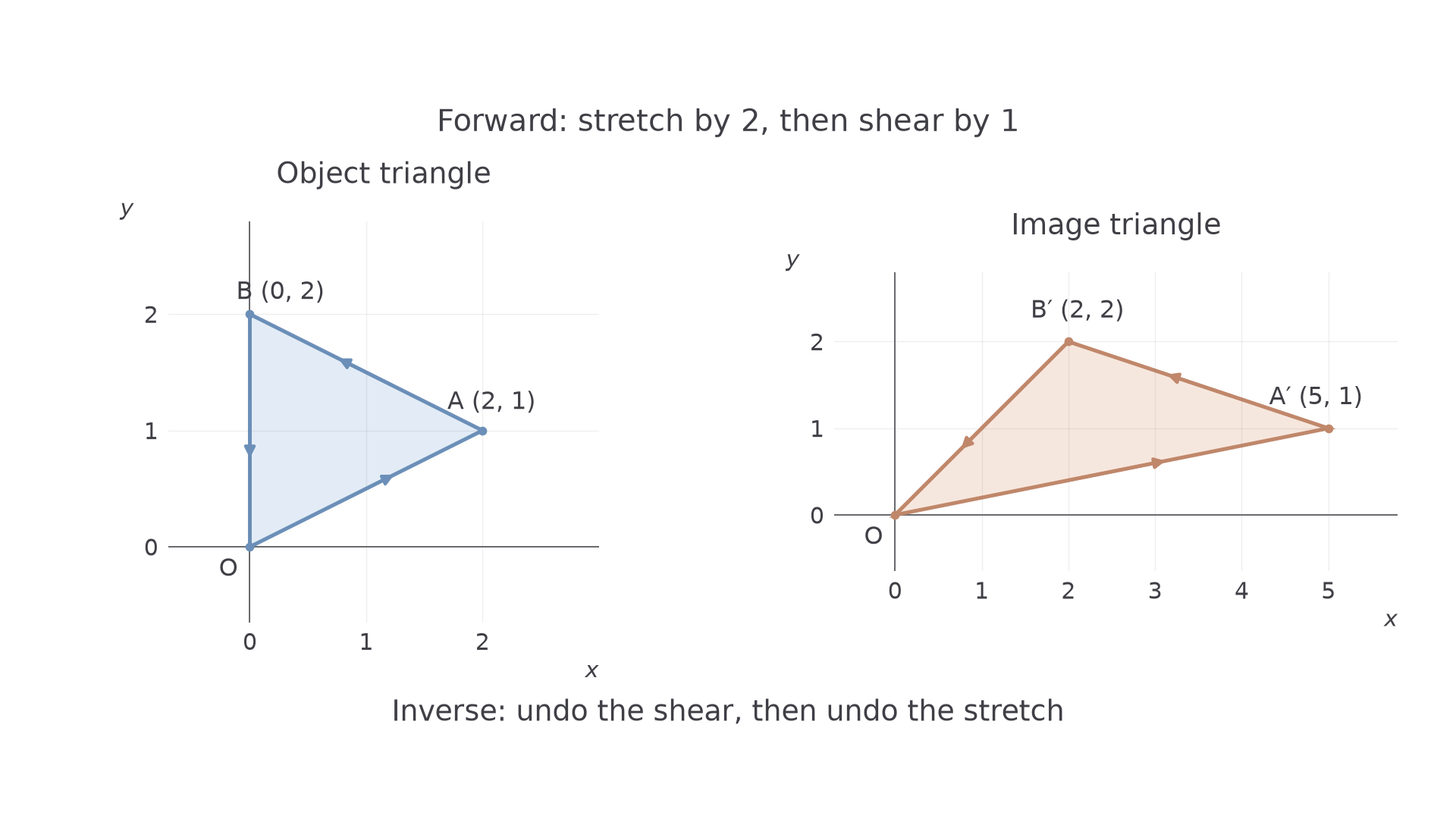
An enlargement is reversed by the reciprocal scale factor. A shear is reversed by the negative shear factor. A rotation is reversed by the opposite angle about the same centre or axis; a reflection in a line or plane reverses itself. These inverse descriptions follow by composing the two transformations and obtaining the identity. They are not listed as inverse rules in the formula booklet; the booklet's rotation matrices can help you write a rotation and its inverse.
For any non-singular matrix , the equations and express forward and inverse transformations. This connection is not in the formula booklet: learn it.
Worked example 7: reversing a stretch then a shear
Question. A stretch parallel to the -axis with factor , represented by , is followed by a shear . Find the inverse matrix and describe its two stages. Recover the object point whose image is .
Plan. The forward matrix is ; reverse the shear first, then the stretch, giving .
Why this step? The rightmost factor acts first. In the inverse product , the shear is undone before the stretch.
Answer. The inverse is . It is a shear parallel to the -axis with factor , followed by a stretch parallel to the -axis with factor . The object point is .
Check. Forward: becomes , then , as required.
Worked example 8 changes only the order of the two original transformations. The inverse stages must change order as well.
Worked example 8: reversing a shear then a stretch
Question. The same shear is now followed by the same stretch . Find the inverse matrix and recover the object point whose image is .
Plan. The forward matrix is now , whose inverse is .
Why this step? The last forward stage is now the stretch. Its inverse acts first, taking to , before the shear is undone.
Answer. The inverse is , representing the stretch with factor followed by the shear with factor . The object point is .
Check. Forward: becomes , then .
For both orders, the inverse acts first on the output of the last forward stage.
Watch out
Wrong: “Reverse each stage in the original order.” Right: reverse each stage in reverse order. This is the transformation meaning of .
The opening matrix has inverse , so every image has one recoverable original. A singular matrix cannot have this property: if two points have the same image, no function can send that one image back to both originals.
Quick Recap
- A square matrix has an inverse exactly when its determinant is non-zero; verify an inverse by obtaining the identity product.
- For order two, swap the diagonal entries, negate the off-diagonal entries and divide by the determinant.
- For order three, calculate minors, apply cofactor signs, transpose and divide by the determinant.
- Cancel inverse factors on the correct side, and reverse the factors in a product: .
- An inverse transformation undoes the last forward stage first.
The opening point is recovered by , and successive transformations are undone in reverse order.