4.01a - Proof by induction
Prove statements about every integer in a specified range, using one starting case and a step that carries truth from one integer to the next. You will use induction for divisibility, matrix powers and inequalities involving exponentials and factorials, with particular care over where each proof starts.
Why induction proves infinitely many cases
Can you prove that is divisible by , without calculating the huge power? The first few cases of are encouraging:
Each is a multiple of . But checking even a million cases would leave the next one unproved. We need a way of reaching every case, however large its index.
Here is a warning with surprisingly good camouflage: is prime for every integer from to . At , however, it equals . Forty successes are evidence for a pattern, not a proof of it.
You already know
A statement about all integers needs an argument that covers all of them. A counterexample disproves such a statement; a collection of successful checks does not prove it. Laws of indices give .
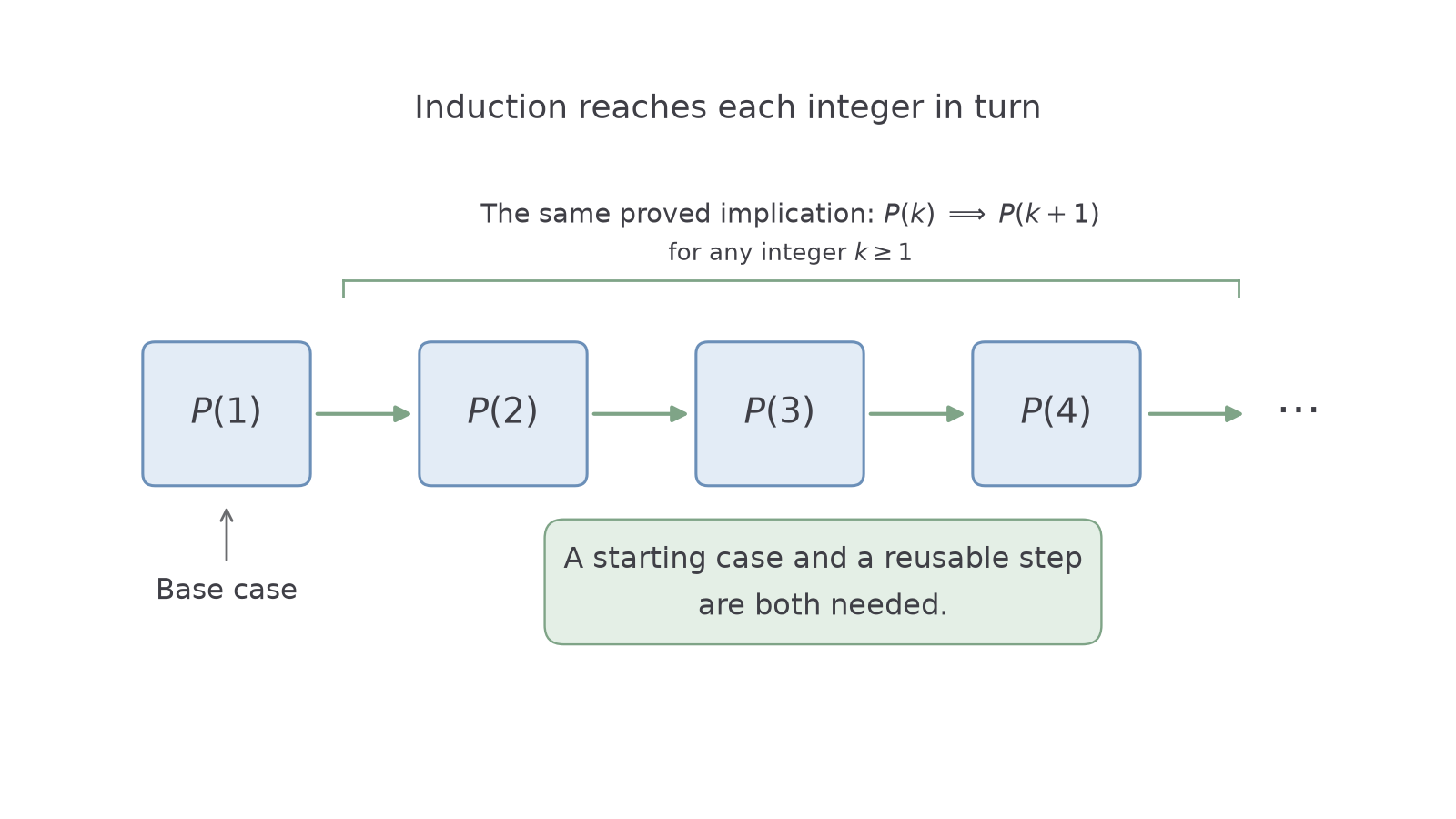
Write for the statement you want to prove at the integer . Induction has two jobs: establish a starting point, then prove a rule that takes you from any allowed case to the next.
[DIAGRAM: asset_name: A starting case and a reusable implication; asset_slug: h245_4_01_induction_chain; caption: The base case starts the chain; the same proved implication carries truth from each integer to its successor; description: Four blue rounded boxes labelled P(1), P(2), P(3), P(4) and an ellipsis are joined by sage right arrows. The first box is marked base case. Above the arrows a bracket says the same implication P(k) implies P(k+1), for any integer k at least 1. Below, a separate statement says the starting case and the reusable step are both needed.]
Proof by induction
A proof by mathematical induction establishes a statement for every integer by proving the base case , then showing that, for an arbitrary integer , the assumption implies . For example, a proof starting at reaches . It does not establish the cases and .
You are allowed to assume one unspecified case while proving the implication. That is not assuming the final answer: you still have to show that this one case forces the next. The base case then starts the chain: gives , which gives , and so on. Every integer in the range is reached after finitely many steps.
The induction principle
For an integer , if
and, for every integer ,
then is true for every integer .
Not in the formula booklet: learn it.
The conclusion must connect these two jobs. A useful full sentence is: “The result is true for , and truth for implies truth for ; therefore it is true for every integer , by induction.” Replace by the actual starting integer.
Key idea
The assumption is the input to an implication, not permission to assume every case. Prove the starting case and the reusable step separately.
The following attempted proof has a circular argument hidden inside otherwise familiar wording.
Divisibility and the inductive assumption
To prove divisibility, turn the assumed statement into a multiple of the required divisor, then make that multiple appear inside the next case.
Divisible by an integer
For integers and , with , is divisible by if for some integer . For example, is divisible by . An expression with integer is not divisible by .
The integer condition matters. Writing an expression as times an unspecified real number says nothing about divisibility. In an induction proof, introduce an integer in the assumption and keep the final bracket integer-valued.
Worked example 1: a power minus one
Question. Prove by induction that is divisible by for every integer .
Plan. Start at , assume , then separate off a multiple of this assumed expression.
Assume for some integer , where is an arbitrary integer. Then
Why this step? Multiplying the whole assumed expression by nearly produces the next case; the correction is another multiple of .
Answer. Since is an integer, truth for implies truth for . The result is true for , so it is true for every integer , by induction.
Check. At , .
Worked example 2 adds a linear correction, , to the expression. That correction makes a stronger divisibility statement possible; track it as carefully as the power.
Worked example 2: the corrected power
Question. Prove by induction that is divisible by for every integer .
Plan. Assume the corrected expression equals , then compare the next case with five times the assumed case.
Assume for an integer , where . Then
Why this step? The correction is exactly the difference between the next expression and five times the previous expression. Expanding both sides checks the regrouping.
Answer. Truth for implies truth for . As the result is true for , it is true for every integer , by induction.
Check. At , . Expanding the regrouped line gives , equal to the required expression.
These divisibility results are not in the formula booklet: derive them when asked. The opening puzzle is now solved: , so is divisible by .
Watch out
Wrong: assume . The quotient need not equal the index. Right: write , where is an integer, then show the next expression is times an integer too.
A complete proof has a starting case, an actual use of the assumption and a conclusion about the entire stated range.
Exam tip
If OCR asks for all integers , check . Starting at leaves a case unproved. The conclusion must say that truth for implies truth for , and connect this to the base case.
The next question changes the power's base from to . Comparing the next expression with nine times the assumed expression produces the useful correction term.
Proving a matrix-power formula
A matrix-power formula predicts every entry after repeated multiplication, so induction tests the whole prediction with one further matrix multiplication.
You already know
means repeated factors of a square matrix. Multiply rows by columns, and keep the order: . A matrix power is not obtained by raising each entry to that power.
For , direct multiplication gives and . The top-right entry appears to increase by each time. Induction proves that it always does.
Worked example 3: an entry growing linearly
Question. Prove that, for every positive integer ,
Plan. Verify , assume the full matrix formula for , then multiply on the right by one more copy of the matrix.
Assume , where . Then
Why this step? Multiplying by the original matrix adds exactly to the changing entry while keeping the other three entries fixed.
Answer. Truth for implies truth for . The result is true for , so it is true for all positive integers , by induction.
Check. At , row-by-column multiplication gives top-right entry , as predicted.
Worked example 4 changes only the common scale of the matrix: every entry is doubled. Each multiplication brings in another factor of , as well as changing the top-right entry.
Worked example 4: a scale factor in every power
Question. Prove that, for and every positive integer ,
Plan. Check the factor at , then retain it outside the matrix during the inductive multiplication.
Assume , where . Then
Why this step? Leaving outside avoids unnecessary expansion. The next multiplication supplies the additional factor needed for .
Answer. Truth for implies truth for . The result is true for , so it is true for all positive integers , by induction.
Check. , as predicted.
Neither matrix-power result is in the formula booklet: derive it when asked. A formula may be supplied in the question precisely because the task is to prove it.
Watch out
Wrong: , obtained by squaring each entry. Right: row-by-column multiplication gives . Raising a matrix to a power means multiplying matrices, not entries.
Writing the intended form in advance is useful as a target. Obtain it from the assumed formula, rather than assuming that target as another equality.
Induction with strict inequalities
An inequality proof needs a chain of justified comparisons that reaches the next target; replacing an inequality by an equality throws away the assumption's meaning.
For example, . Doubling the left side at the next step gives , whereas the target only increases to . Induction captures this difference in growth without checking each integer.
You already know
Multiplying an inequality by a positive number preserves its direction; multiplying by a negative number reverses it. A chain proves . The equality case in one link does not remove a strict inequality in another link.
For each proof, write the next target first in your rough work. You then know what the bound supplied by the assumption still has to beat.
Worked example 5: an exponential beats a linear expression
Question. Prove by induction that for all integers .
Plan. Check , double the assumed inequality and compare with .
Assume for an arbitrary integer . Then
Why this step? The assumption gives , not the required . The final comparison is the bridge between them.
Answer. Truth for implies truth for . Since the inequality is true for , it is true for every integer , by induction.
Check. At , . The start cannot be , because , not a strict inequality.
Worked example 6 changes the coefficient of from to . Check the starting integer again: the old base case no longer works.
Worked example 6: the same method with a later start
Question. Prove by induction that for all integers .
Plan. Start at , double the assumed bound and show that it exceeds the next linear target.
Assume for an integer . Then
Why this step? Once is proved, the strict inequality from the assumption makes the final result strict too.
Answer. Truth for implies truth for . The inequality is true for , so it is true for all integers , by induction.
Check. At , , explaining the later start. At , .
These particular bounds are not in the formula booklet: derive them when asked. The transferable method is to keep the assumed inequality and explicitly justify the comparison with the next target.
Watch out
Wrong: “Assume , so .” The statement being proved is an inequality. Right: assume , giving , then compare with .
The next question changes the coefficient once more. Its stated domain already supplies a valid base case.
Factorials and changing bases
For a factorial, the next case is obtained by multiplying by , so the new factor must appear explicitly in your inductive step.
Factorial
For a positive integer , ; also . In particular, . For example, ; it is not .
Compare with and . A factorial can sit above one exponential expression and below another. The second comparison has a base that changes with the index, so no claim about fixed-base exponential growth is being made.
Worked example 7: a lower bound for a factorial
Question. Prove by induction that for all positive integers .
Plan. Start at , then use and .
Assume for an integer . Then
Why this step? The factorial gains a factor of at least , exactly what is needed to move the exponential bound from to .
Answer. Truth for implies truth for . The result is true for , so it holds for all positive integers , by induction.
Check. At , both sides equal ; at , . The non-strict sign is necessary at the first two integers.
Worked example 8 changes the comparison to the changing-base power . The next target is , not , and both the base and exponent must advance.
Worked example 8: an upper bound for a factorial
Question. Prove by induction that for all integers .
Plan. Start at , multiply the assumption by , then increase the base of the remaining power from to .
Assume for an integer . Then
Why this step? Multiplication gives . Replacing the smaller positive base by then reaches the exact next target.
Answer. Truth for implies truth for . The inequality is true for , so it is true for every integer , by induction.
Check. At , . At , , so the strict inequality cannot include that case.
The factorial identity and both bounds in this part are not in the formula booklet: learn the identity and derive the bounds when asked. Neither needs a formula for the exact size of .
Watch out
Wrong: , or . Increasing an index does not mean adding one to the value. Right: write the complete next expression first, then use the operation that actually connects the cases.
The huge power from the opening question needed no huge calculation: its divisibility follows from the same base-and-step logic used for matrices and factorials. A proof can be short even when its examples are enormous.
Quick Recap
- Check the first integer in the stated domain, assume one arbitrary case, and use it to prove the next case.
- For divisibility, write the assumption as an integer multiple of the divisor and expose it inside the next expression.
- For matrix powers, multiply the assumed whole matrix by one more copy of the original matrix.
- For inequalities, preserve the correct sign and justify the comparison between your bound and the next target.
- Factorials advance by ; a changing-base power requires both its base and exponent to advance.
The opening number is , so the proved divisibility result makes it a multiple of without calculating the power.