4.05c - Quadratic and improper partial fractions
Extend partial fractions to denominators containing a quadratic such as , and to fractions whose numerator has degree at least as large as the denominator. You will choose the right numerator, extract a polynomial part when needed, and check a decomposition by recombining it.
What the denominator and degrees tell you
Can
be written as a sum of proper fractions alone? Every proper fraction tends to zero as grows in magnitude, but this fraction grows roughly like . Something must be missing. By the end you will find exactly what.
Throughout this lesson, is real.
You already know
For distinct linear factors, use one constant numerator over each factor. A repeated linear factor needs every power: gives terms and . Clear denominators, then substitute convenient values or compare coefficients to find the constants.
There are two decisions before the coefficient arithmetic: whether you need a polynomial part, and which numerator belongs above each factor.
Proper and improper rational functions
A rational function , with polynomial numerator and non-zero polynomial denominator, is proper if . It is improper if . For example, is proper, whereas is improper. Here degree means the highest power with a non-zero coefficient, after collecting terms.
The degree of a product is the sum of the factor degrees. Thus has degree , even before you expand it. Equal numerator and denominator degrees already count as improper.
For , , the quadratic has no real zero and does not split into real linear factors. Its fraction needs a general linear numerator, . If , a quadratic of this form can be factorised over the reals and the familiar linear-factor method applies instead. A constant expression with is not a quadratic.
The numerator degree must be smaller than its own denominator degree: constant over a linear factor, linear over a quadratic factor. In particular, a constant over is a possible outcome, but not the most general starting form. The coefficient of may turn out to be zero; do not assume it is zero.
Key idea
Inspect degrees and factor types first. An improper rational function needs a polynomial part; an irreducible quadratic factor needs a numerator of the form .
These two choices are independent: a fraction can be proper and still need a linear numerator above a quadratic. Find the first error in this attempt to decide the form.
A linear numerator over a quadratic
Start with a proper fraction so that the only new feature is the quadratic factor. The coefficient of in its numerator is an unknown to determine, just like the constant.
A linear factor and an irreducible quadratic
If , , and , the appropriate form is
where and , , are constants to be found. The identity applies wherever the original denominator is non-zero.
Not in the formula booklet: learn it.
After clearing denominators, the resulting polynomial identity holds for every . You may substitute a value that made an old denominator zero to find a constant in this identity; that does not make the original fraction defined there.
If the denominator is given expanded, factorise it before choosing the fractions. For example,
so it supplies one linear factor and one irreducible quadratic factor.
Worked example 1: finding all three constants
Question. Express in partial fractions.
Plan. Use a constant over , a linear numerator over , then substitute and compare coefficients.
Why this step? Putting into the polynomial identity removes the whole term, leaving one unknown immediately.
Answer. , for .
Check. The recombined numerator is .
Change the quadratic factor from to . Its leading coefficient now contributes to the coefficient comparison; the numerator still has the same form.
Worked example 2: a non-monic quadratic factor
Question. Express in partial fractions.
Plan. Keep above the quadratic and allow for its coefficient .
Why this step? The coefficient of on the right is , not , because the quadratic factor is not monic.
Answer. , for .
Check. . The unused constant equation also checks: .
The unused coefficient is a useful check, particularly when you found constants by substitution.
Watch out
Wrong: as a general starting form. Right: include . A constant numerator may emerge after solving, but omitting beforehand can make the identity impossible.
In detailed reasoning, show the initial numerator and the identity even if one of its constants eventually vanishes.
Equal degrees need a constant part
An improper fraction must first be separated into a polynomial and a proper remainder. With equal degrees, the polynomial part is a constant: the ratio of the leading coefficients.
Polynomial division makes this precise. Divide by to obtain a quotient and remainder with lower degree than .
Polynomial part and proper remainder
For polynomials , , with non-zero:
Thus, wherever ,
The remainder can be zero. When , is a constant; when , .
Not in the formula booklet: learn it.
You can also put the unknown constant directly into the partial fraction form and solve a single identity. Division first makes the reason for that extra term visible.
Worked example 3: extracting a constant quotient
Question. Express in partial fractions.
Plan. Expand the denominator, subtract twice it from the numerator, then decompose the proper remainder.
Why this step? Proper fractions alone cannot supply a cubic numerator over this cubic denominator. The constant quotient supplies exactly the missing cubic term.
Answer. , for .
Check. The combined numerator is . For large , the result tends to , as the original leading coefficients predict.
Change only the constant polynomial part from to , keeping the proper remainder the same. This also shows that a missing term must be treated as a zero coefficient during subtraction.
Worked example 4: a zero coefficient in the numerator
Question. Express in partial fractions.
Plan. Subtract , lining up the missing square term as , then decompose the remainder.
Why this step? A minus sign outside the bracket changes every term in , including its negative constant.
Answer. , for .
Check. . At , both forms give : .
The coefficient of the leading power is a quick way to spot a missing constant quotient before doing any solving.
Watch out
Wrong: calling equal degrees proper, or stopping division with a remainder of the same degree as the denominator. Right: stop only when the remainder degree is smaller, then decompose that remainder.
You may factor the denominator before or after division. In either case, retain the constant polynomial part in the final answer.
A polynomial part of higher degree
When the numerator degree exceeds the denominator degree, the quotient is itself a polynomial. Repeatedly cancel the highest remaining power, subtract, and continue until the remainder is proper.
For a degree numerator over a degree denominator, expect a linear quotient. For degrees and , expect a quadratic quotient. Its middle or constant coefficient may be zero; the degree prediction does not require every term to appear.
Worked example 5: the opening fraction
Question. Express in partial fractions.
Plan. Divide by , then decompose the proper remainder.
Why this step? After subtracting , the remainder is still cubic. You must divide once more before using proper partial fractions.
Answer. , for .
Check. . As grows in magnitude, the fraction terms tend to zero, so the original expression approaches the line .
This is the surprising information in the decomposition: subtracting leaves a quantity tending to zero. The polynomial part describes the distant behaviour of the whole rational function, not just an administrative step in division.
[DIAGRAM: asset_name: The polynomial part of an improper rational function; asset_slug: h245_4_05c_polynomial_part; caption: The opening rational function approaches the line y = x + 2 as x grows in magnitude, while it is undefined at x = 1; description: Exact graph of the rational function with numerator x to the fourth plus x cubed plus 5x squared plus 6x minus 3 and denominator (x - 1)(x squared + 4), in blue. The clay dashed line is y = x + 2. A dotted vertical line marks x = 1, where the rational function has a vertical asymptote. The blue curve lies below the sloping line to the left of x = 1 and above it to the right, and the separation tends to zero at the distant ends.]
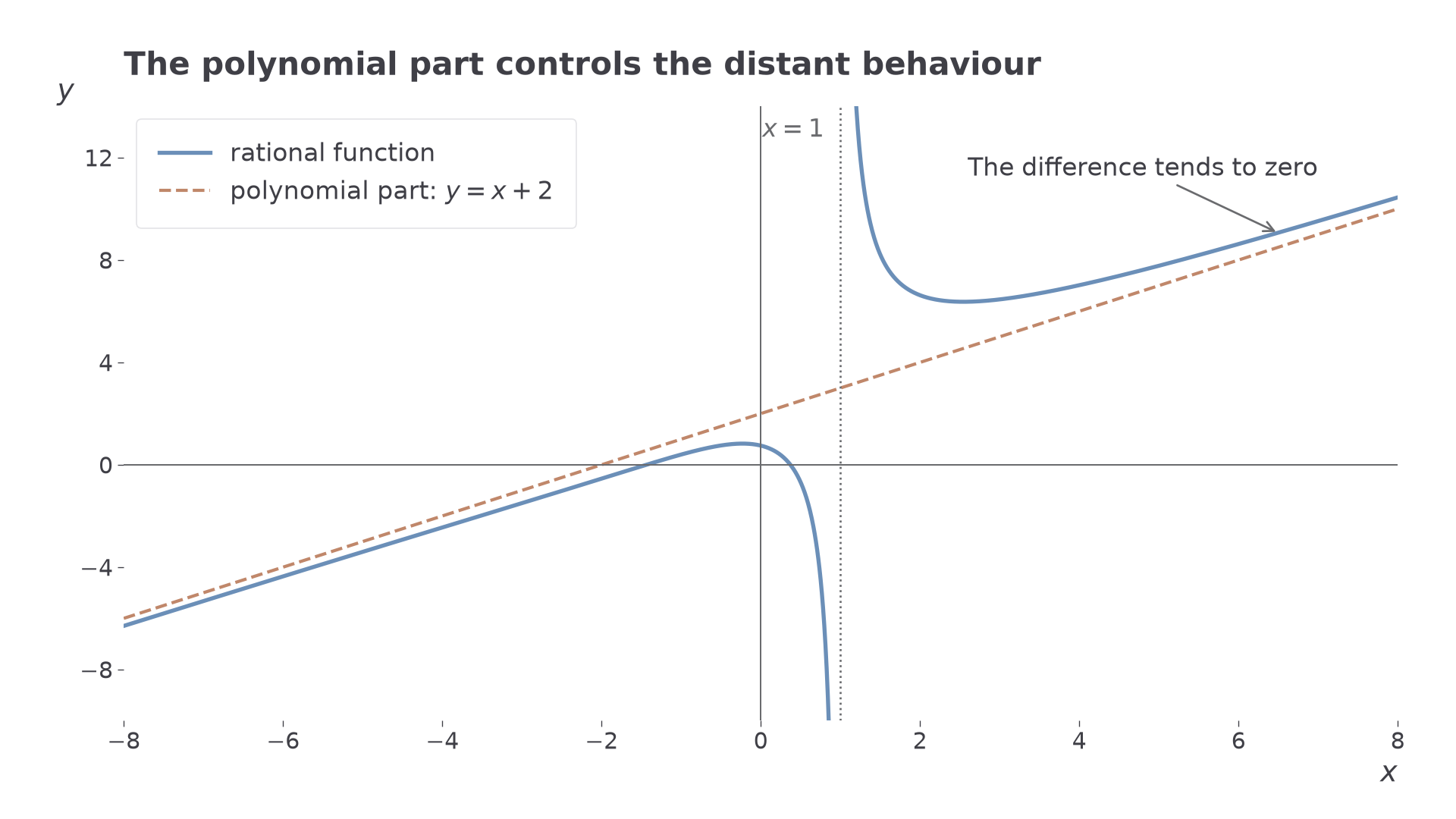
Change the quotient degree from to . The first subtraction now removes two powers at once, and the coefficient of in the quotient is zero.
Worked example 6: a quadratic quotient
Question. Express in partial fractions.
Plan. Begin the quotient with , then inspect the new leading term before continuing.
Why this step? The first remainder has degree , not , so the next quotient term is a constant. Inserting an term just because the quotient is quadratic would be a mistake.
Answer. , for .
Check. . Adding recovers the numerator exactly.
An alternative is to begin with an unknown polynomial of the predicted degree, together with the proper fractions, and compare coefficients in one identity. Division and coefficient comparison are equally valid when carried out fully.
Watch out
Wrong: stopping after . Right: the remainder must have degree below . A remaining cubic over a cubic still contains a constant polynomial part.
The opening question now has its answer: proper fractions alone cannot describe the growth. The missing part is . You will later use such decompositions to integrate rational functions.
Quick Recap
- A rational function is proper only when the numerator degree is strictly smaller than the denominator degree.
- Use above an irreducible quadratic factor such as , with , .
- Divide an improper fraction until its remainder is proper; retain the full polynomial quotient.
- Clear denominators to find the constants, then recombine to check every coefficient and retain the original domain exclusions.
The opening fraction is ; its polynomial part explains why it grows rather than tending to zero.