4.09b - Sketching polar curves
Build a polar sketch from the rays the curve occupies, its symmetry, its visits to the pole and its least and greatest distances from the pole. You will use trigonometric values and differentiation to justify the shape, including curves whose largest radius is not obvious.
Rays, ranges and loops
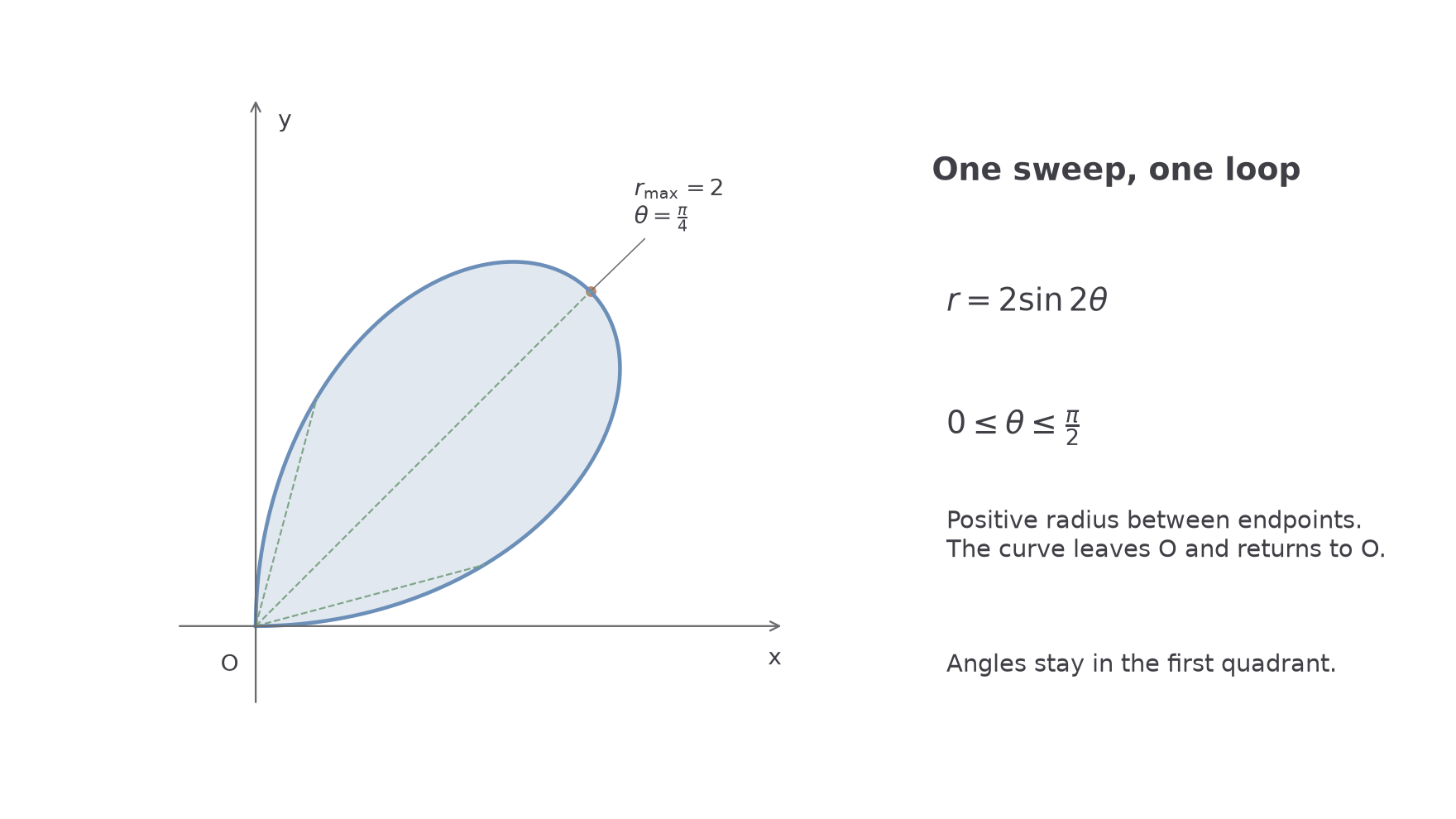
How can , for , leave the pole, make one loop and return to the pole? The expression is a distance along a turning ray: first the distance grows, then it shrinks, while the ray keeps turning through the first quadrant.
At , . At , . At , again. Between the endpoints, , so . Each intermediate ray meets one point of the curve.
[DIAGRAM: asset_name: A single polar loop in the first quadrant; asset_slug: h245_polar_single_loop; caption: The ray turns through the first quadrant while r grows from zero to 2 and returns to zero; description: Equal-scale axes show the single blue loop r = 2 sin 2 theta for theta from zero to pi over 2. Dashed sage rays mark three intermediate angles. The point [2, pi over 4] is marked as the greatest radius. A side panel states positivity between endpoints, a single departure and return to O, and first-quadrant angles]
You already know
A polar point has cartesian coordinates , with . An angle range tells you which directions the curve can occupy; gives the pole.
A table helps you place points, but an explanation of the range tells you what lies between them.
Polar curve
A polar curve consists of the points at distance along the permitted rays. Only angles in the stated domain for which supply points. A loop leaves a point and returns to it; here the only repeated point is the pole at the two endpoints.
The same expression is negative for . Under our convention, those angles supply no points; do not turn a negative answer into a positive radius in the opposite direction. That would introduce a different convention and a different curve.
For this loop, there is also a precise reason it cannot cross itself away from : two distinct angles between 0 and give distinct rays, and each ray has only one positive radius.
Key idea
Justify a loop by locating its zero radii, showing positivity between them and using the angle range to locate it. A table alone does not establish those facts.
That reasoning answers the opening question: one sweep through the first quadrant produces exactly one departure from and return to the pole.
Symmetry and key points
Test a symmetry by asking whether a reflection or half-turn preserves both the radius and the allowed directions.
A point reflects in the initial line to , and in the vertical line through the pole to . A half-turn gives . For a complete turn, equivalent angle representatives can be chosen modulo . For a restricted interval, check that the transformed ray is actually present.
Useful polar symmetry tests
For a curve whose domain is preserved by the indicated angle change, the following equalities are sufficient:
For a full-turn domain, compare equivalent angles modulo .
Not in the formula booklet: learn it.
After finding symmetry, calculate radii on the axes and any other helpful rays. Join points as increases, respecting that symmetry.
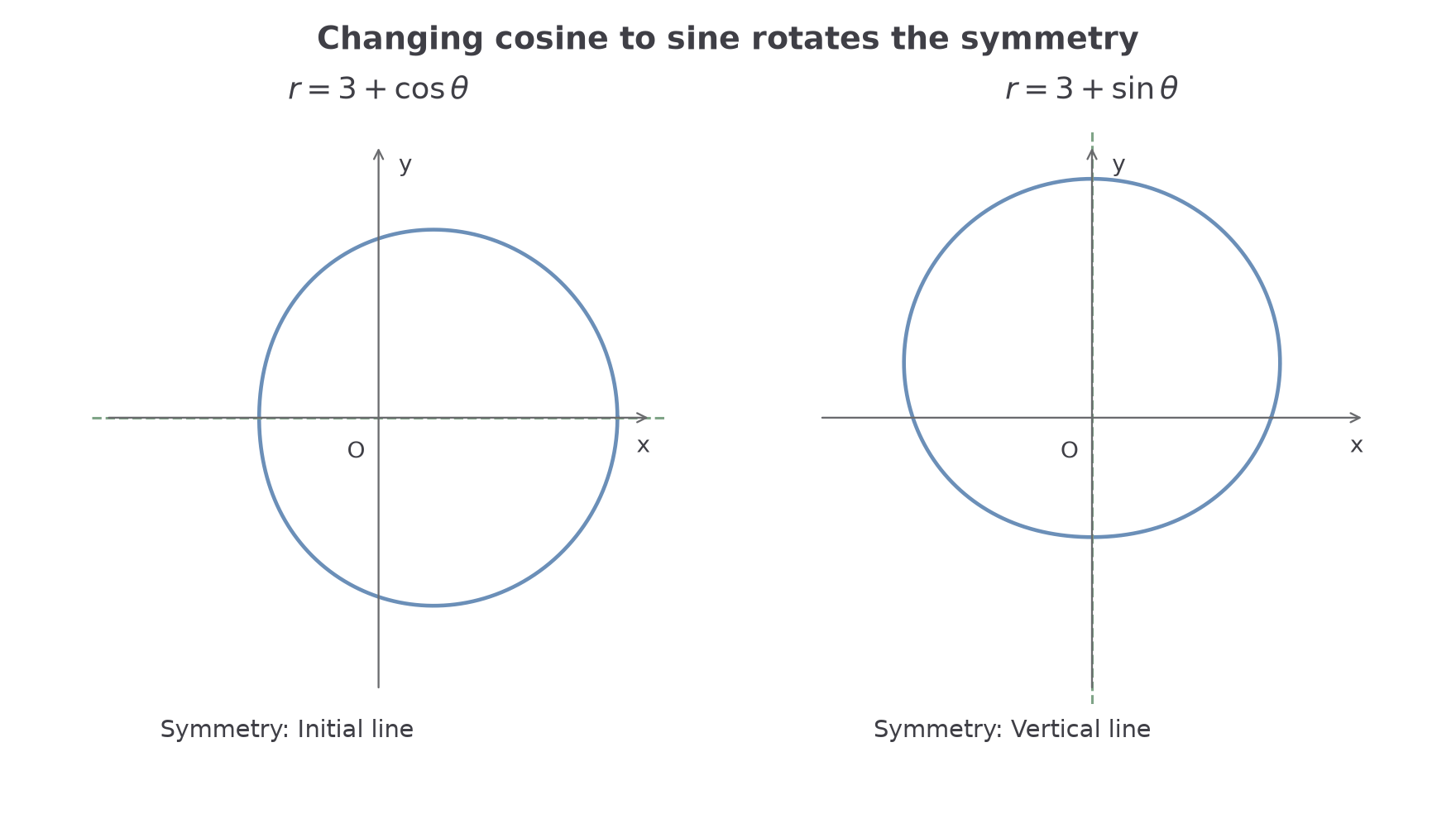
[DIAGRAM: asset_name: Cosine and sine curves with different symmetry lines; asset_slug: h245_polar_symmetry; caption: Cosine gives reflection symmetry in the initial line, while sine gives reflection symmetry in the vertical line through the pole; description: Two equal-scale plots show r = 3 + cos theta and r = 3 + sin theta over a complete turn. The blue curves are identical shapes rotated through a right angle. The cosine plot has a dashed sage horizontal symmetry line, and the sine plot has a dashed sage vertical symmetry line. Each plot is labelled with its equation and symmetry line]
Worked example 1: symmetry in the initial line
Question. Describe the symmetry and axis points of , .
Plan. Test reflection in the initial line, then calculate the radii in the four axis directions.
Why this step? Reflection changes the direction but keeps the distance; equality of the two radius expressions proves that the reflected point lies on the curve.
Answer. The curve is symmetric in the initial line. Its axis points are , , and . It never reaches the pole, since .
Check. The vertical axis points are reflections of one another, while the unequal left and right radii rule out vertical-line and half-turn symmetry.
Worked example 2 changes only cosine to sine. Use the corresponding reflection identity instead of assuming that every trigonometric curve has the same symmetry.
Worked example 2: symmetry in the vertical line
Question. Describe the symmetry and axis points of , .
Plan. Replace by , then calculate the axis radii.
Why this step? The identity pairs rays on opposite sides of the vertical line.
Answer. The curve is symmetric in the vertical line through the pole. Its axis points are , , and . It does not pass through the pole.
Check. The horizontal axis points are reflections in the vertical line; the unequal top and bottom radii rule out reflection in the initial line.
A curve can have more than one symmetry. For instance, is preserved by , and , so it has both axis symmetries and half-turn symmetry.
Watch out
Wrong: a curve is symmetric because two selected radii happen to match. That checks only two points. Right: use an identity that pairs all relevant rays, and check the domain as well.
The next curve has the same angular dependence as the second example, with its constant increased.
Least and greatest radii
The least and greatest values of tell you how near and far the curve gets from the pole, and often determine its overall shape.
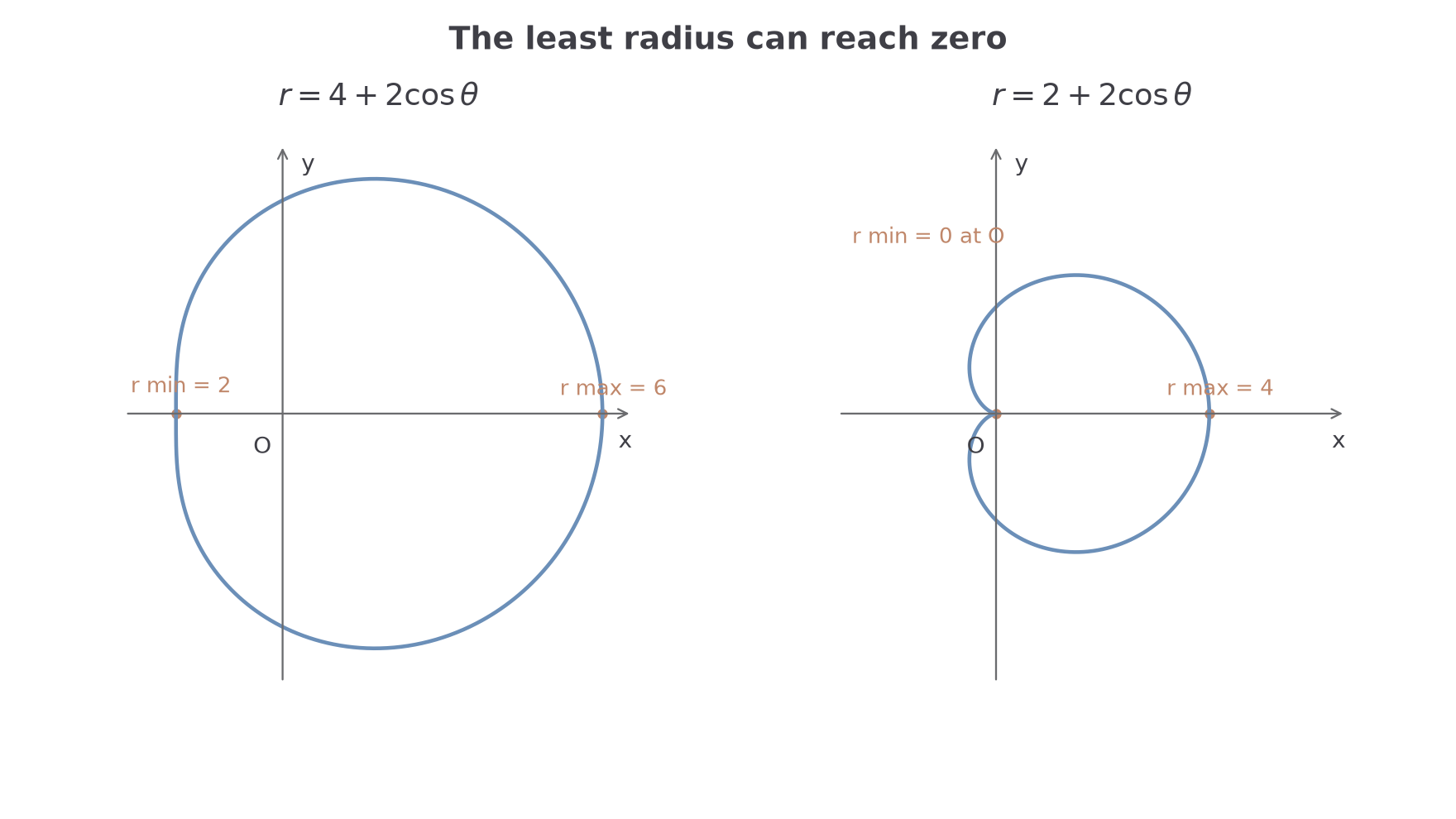
For a complete-turn curve of the form , with , use . The nearest point lies in the direction , and the furthest lies in the direction . A least radius of zero means the curve reaches the pole; a positive least radius means it stays away.
Radii of a cosine curve
For , , where ,
These are distances from the pole, not maximum or minimum cartesian coordinates.
Not in the formula booklet: learn it.
Use the extremes together with axis points and symmetry; the two extreme radii alone do not specify an entire sketch.
[DIAGRAM: asset_name: A positive minimum and a zero minimum; asset_slug: h245_polar_extreme_radii; caption: Reducing the constant term makes the nearest point reach the pole while the radii stay non-negative; description: Two equal-scale plots show r = 4 + 2 cos theta and r = 2 + 2 cos theta. The first curve has least radius 2 at its leftmost axis point and greatest radius 6 at its rightmost axis point. The second is a cardioid with least radius zero at O and greatest radius 4. Clay dots and labels mark these radii]
Continue this lesson.
You’re previewing NovaLearn without an account. Create a free account to read the rest.
Create free account