6.04d - Centres of mass by integration
Build a centre-of-mass calculation from a thin strip or disc. Find both coordinates of a uniform lamina, including a region between curves, and the axial centre of a uniform solid of revolution. Explain why the mass element changes when the same profile is turned into a solid.
A lamina as a sum of strips
A sheet has the profile , between and , above the horizontal axis. Turn that profile into a solid by rotating it about the axis. Will the sheet and the solid have the same horizontal centre of mass?
Near the wide end, the solid gains mass faster than the sheet does: a strip's area is proportional to its height, but a disc's area is proportional to the square of its radius. We will calculate both centres and measure that difference.
You already know
For components, and . Uniform sheet mass is proportional to area. Definite integration adds the contributions of thin elements; integration by parts handles a product such as .
A vertical strip under , of width , has approximate area . Its own centre is approximately . To get a first moment, multiply the strip's mass by the coordinate of this centre, then add the moments.
[DIAGRAM: asset_name: Strip mass and strip centre; asset_slug: h245_lamina_vertical_strip; caption: The strip's centre is halfway up its height, while its mass is proportional to its full height; description: A coordinate diagram shades the region under y equals x squared from zero to two. A narrow vertical strip at x equals 1.3 has height f(x), width dx and midpoint at height f(x) divided by two. The strip midpoint and the complete lamina centre at (1.5,1.2) are separately labelled.]
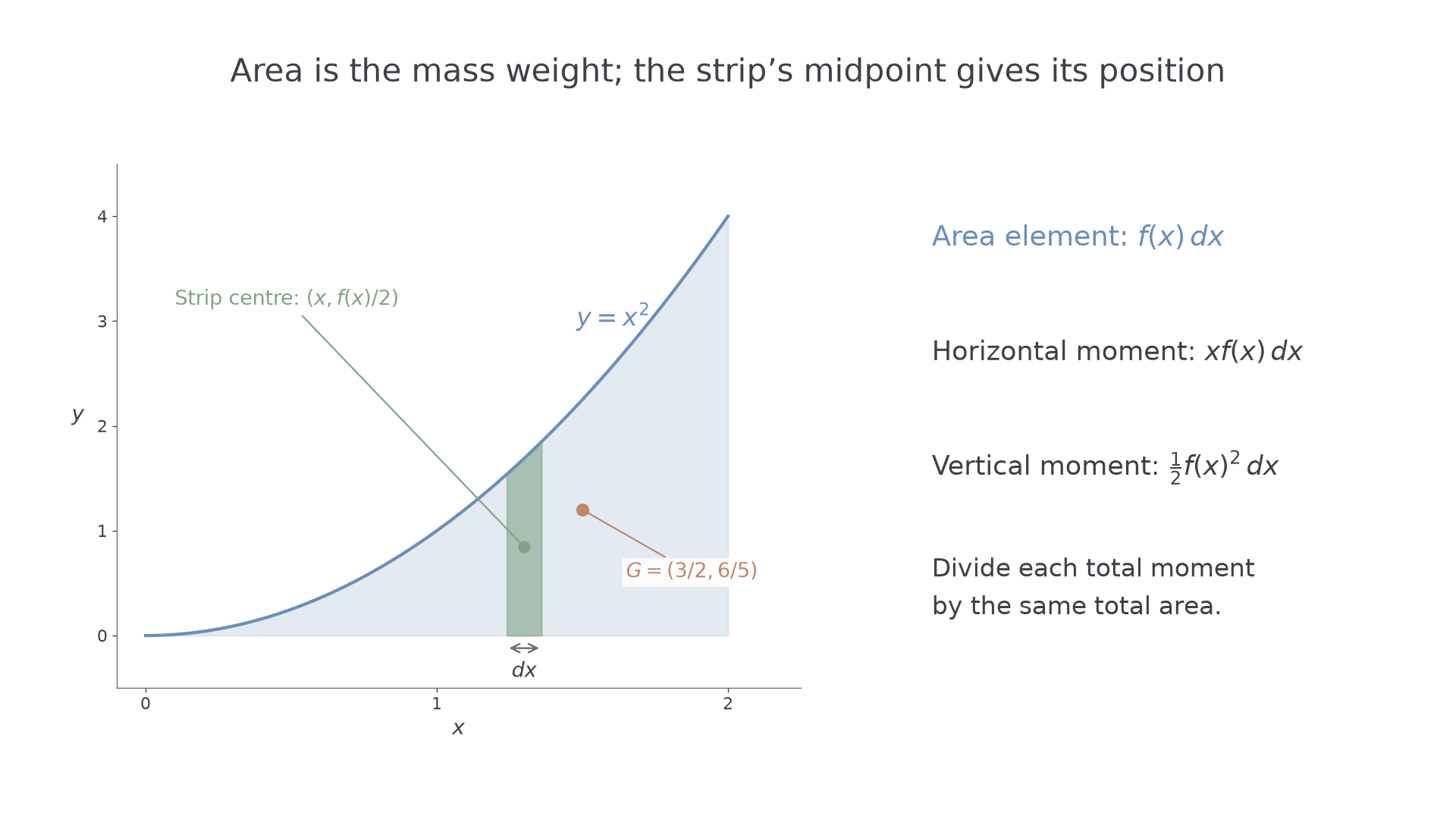
If the constant mass per unit area is , the strip contributes approximately to the mass and to the horizontal first moment. For the vertical first moment it contributes . Taking the thin-strip limit and cancelling gives the following result.
A uniform lamina above the horizontal axis
For the region , , with , finite integrals and positive area ,
Not in the formula booklet: learn it.
The factor belongs to the strip's centroid height; it does not belong in the area or horizontal first moment.
Worked example 1: a parabolic lamina
Question. A uniform lamina occupies the region bounded by , the -axis and . Determine its centre of mass.
Plan. Find the area, then the horizontal and vertical first moments using vertical strips.
Why this step? The lamina's height varies, so averaging the heights of the endpoints would not average the mass. Each strip's contribution must carry its own area.
Answer. .
Check. The centre is to the right of , where the taller strips put more mass, and lies inside the region since .
Change only the profile's power from to , keeping the same interval. The right-hand strips become relatively more important.
Worked example 2: a cubic profile
Question. A uniform lamina occupies , . Determine its centre of mass.
Plan. Use the new height in the area and both first moments.
Why this step? The vertical moment squares the complete height , producing ; it does not merely increase its power by one.
Answer. .
Check. The horizontal centre moves from to , towards the end containing relatively more mass. Also .
For an exponential profile, the setup is unchanged; only the antiderivative changes. Keep the area visible as a separate quantity so you can divide both moments by the same value.
Watch out
Wrong: . That integral is the area, not its first moment. Right: multiply the strip area by its centre height , giving .
Try another power, with a shorter interval.
Exponential profiles and integration by parts
A curved sign can have an exponential upper edge rather than a polynomial one. Its centre still comes from area and first moments; the horizontal moment now calls for integration by parts.
For the profile , a vertical strip has area . Its horizontal first moment is . Choose the factor to differentiate, because one differentiation removes it:
Integration by parts is in the formula booklet; this particular antiderivative is not listed separately. The centre-of-mass strip formulas from the previous part are not in the booklet. Writing the limits in the moment integral makes the coordinate system and the piece of material unambiguous.
Worked example 3: an exponential sign
Question. A uniform lamina occupies , . Determine its centre of mass, giving exact coordinates.
Plan. Integrate for the area, use parts for the horizontal moment, and square the height for the vertical moment.
Why this step? At the lower limit , , so subtracting the lower value adds ; dropping it moves the predicted centre.
Answer. .
Check. The horizontal coordinate is approximately , between and , and to the right of the interval midpoint, as expected for increasing strip heights.
Change only the right-hand boundary from to . The antiderivatives stay the same, but the new end contributes taller strips.
Worked example 4: extending the same sign
Question. A uniform lamina occupies , . Determine its centre of mass, giving exact coordinates.
Plan. Evaluate the same area and moment integrals at the new upper limit.
Why this step? Extending the lamina changes the denominator as well as the moment; reusing the old area would not describe the new body.
Answer. .
Check. Its horizontal centre is approximately , farther right than before, and its height has increased from to as material was added towards the tall end.
Even when a calculator can evaluate the integral, “Show that” requires the link between the mass model, the integral and the exact answer.
Exam tip
Keep the area, moment integral and substituted endpoint values visible. In a given-answer calculation, writing only the required expression for does not establish it.
Extend the same profile once more, using the lower endpoint as carefully as the upper one.
A lamina between two curves
When a strip begins above the axis, its centre is no longer halfway up its height measured from the axis. Locate its two endpoints before forming either moment.
Suppose the upper curve is and the lower is . The strip height is , while its midpoint height is . Their product is , so the vertical first moment subtracts squares of heights. It does not square their difference.
Continue this lesson.
You’re previewing NovaLearn without an account. Create a free account to read the rest.
Create free account