4.10h - Coupled first-order systems
Model two quantities whose rates depend on each other, then solve their coupled first-order equations by elimination. You will recover both variables, translate initial conditions correctly, and interpret the solution in its original setting.
Building coupled models
Two tanks exchange liquid. Can their individual salt quantities change even when their total salt stays fixed? Yes: internal transfers change the distribution while cancelling from the total. Writing both balance equations makes that cancellation visible.
Imagine two perfectly mixed tanks, each containing . They exchange liquid at in each direction. Each also receives from an external supply and drains to waste. Thus both volumes stay constant. Let and be the salt quantities in grams, with measured in minutes.
A tank containing grams has concentration . Each outgoing stream therefore carries salt at rate . There are two outgoing streams from each tank, explaining a loss term or .
Coupled first-order system
A coupled system consists of differential equations in which the dependent variables affect each other's rates. The linear systems considered here have one independent variable, usually time, and the form
where are constants. For example, , is coupled. The pair , is independent, because neither rate depends on the other variable.
In a mixing model, “perfectly mixed” means every outgoing stream has the current concentration of its tank. Salt is conserved in a transfer; no salt is produced or destroyed inside either tank. The balance principle, rate of change rate in rate out, is not a formula-booklet entry: learn how to apply it to each quantity.
[DIAGRAM: asset_name: Two-tank salt balance; asset_slug: h245_4_10_coupled_tanks; caption: Each 10 litre tank receives an external supply, exchanges liquid with the other tank, and drains to waste, with every flow 10 litres per minute; description: Two pale blue rectangular tanks labelled tank X, salt x grams, concentration x/10 grams per litre and tank Y, salt y grams, concentration y/10 grams per litre. Distinct separated horizontal arrows show transfer X to Y carrying x grams per minute and transfer Y to X carrying y grams per minute. External downward arrows show input salt rates f(t) and g(t) grams per minute, while outward lower arrows show drain salt rates x and y grams per minute. A footer states both volumes remain 10 litres and all liquid flow rates are 10 litres per minute]
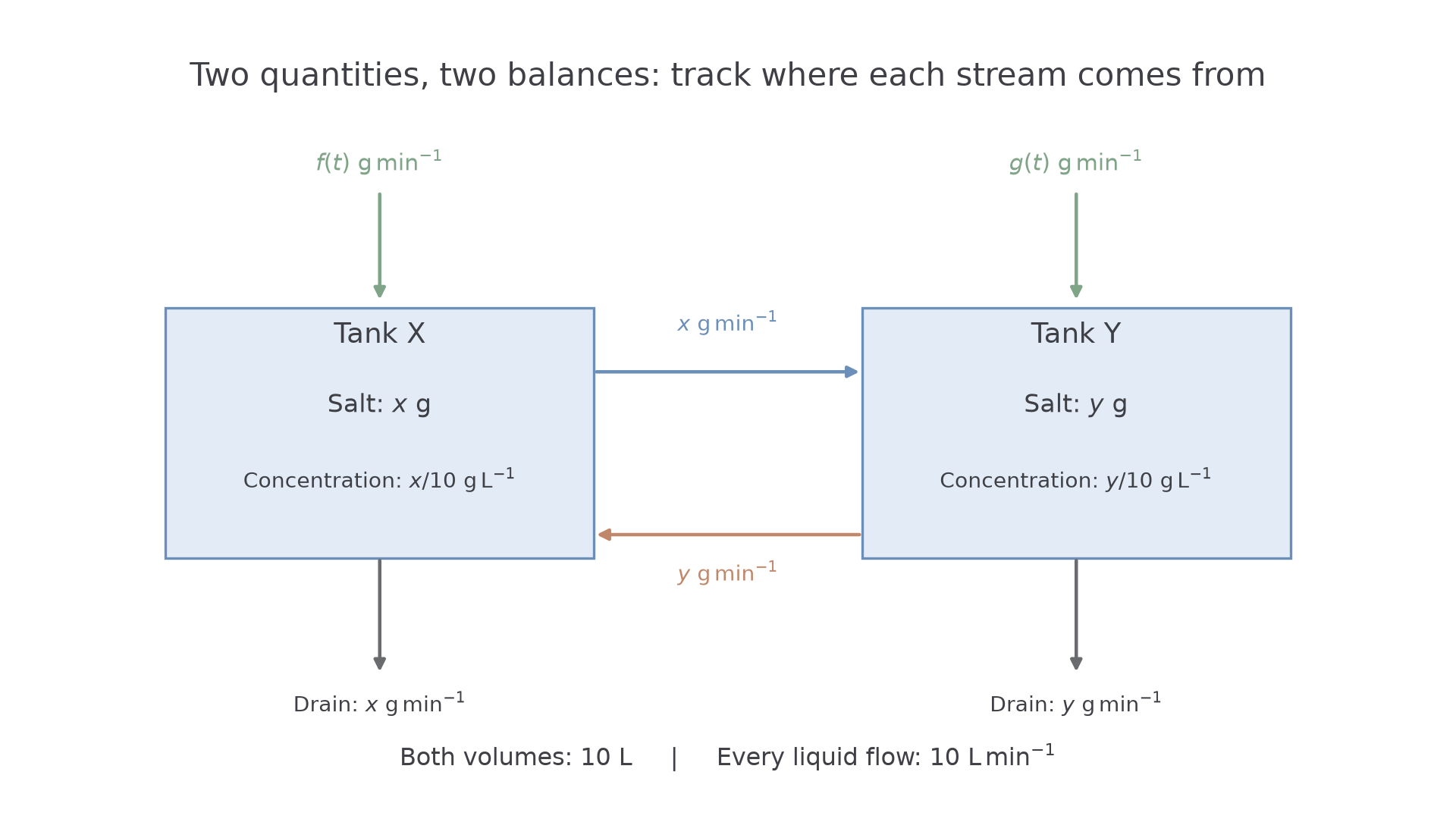
The external salt rates can be constants or functions of time; changing one supply changes only the corresponding balance equation.
Worked example 1: one salty supply
Question. In the two-tank system above, the external supply to tank X has concentration ; tank Y receives pure water. Form differential equations for and .
Plan. Convert supply concentrations to salt rates, then write a separate balance for each tank.
Why does the transfer into X involve ? The liquid comes from tank Y, so it carries Y's concentration, not X's.
Answer. , .
Check. Adding gives : internal transfers cancel, leaving only the external salt input and drains.
Change only the external supply to tank Y, from pure water to concentration . Its balance gains one constant term.
Worked example 2: a second salty supply
Question. Tank X still receives concentration , while tank Y now receives concentration . Form the new equations.
Plan. Keep the existing transfer and drain terms and recalculate only the changed external input.
Why not add directly to both equations? The new salt enters Y first; its later effect on X is carried by the coupling term .
Answer. , .
Check. The total balance is , matching the combined external input .
With both external salt inputs and drains removed, only the exchange terms remain: , , so . This proves the opening claim about redistribution at fixed total.
Watch out
Wrong: a tank's salt outflow equals its salt quantity. Right: outflow rate is liquid flow rate times concentration. It happens to have the same numerical value here because is divided by a volume; the units are still different.
Keep the same apparatus and change one supply concentration once more.
Eliminating and recovering a variable
Differentiate one equation, substitute the other equation for the unwanted derivative, and then eliminate the unwanted variable itself.
You already know
A second order equation needs two independent conditions. When the original data give and , substitute them into the original equation for to obtain the derivative condition for the eliminated equation.
For , , differentiating the first gives . Replacing introduces , which is then replaced using . This produces .
Worked example 3: homogeneous coupling
Question. Solve , , given , .
Plan. Eliminate , translate the initial data, solve for , then recover from the original first equation.
Why recover from rather than solve another second order equation? The original coupling fixes the relationship between their constants; introducing a fresh independent pair would lose that relationship.
Answer. , .
Check. Both initial values hold. Also , verifying the equation not used for recovery.
Continue this lesson.
You’re previewing NovaLearn without an account. Create a free account to read the rest.
Create free account