6.03e–6.03h - Impulse and change in momentum
Calculate the impulse in a sudden change of motion, using signed velocities in a line and vectors in a plane. You will include impulsive tension in an inelastic string, distinguish impulse from force, and calculate the impulse of a constant force or a one-dimensional variable force acting over time.
Impulse changes momentum
A ball of mass arrives at a bat at and leaves in the opposite direction at . What can you calculate without knowing how long bat and ball touch? The answer is impulse, even when the contact force itself is unknown.
You already know
Momentum is mass times velocity, including its direction. Equal and opposite forces act on the two bodies in an interaction. Keep the same positive direction before and after a collision.
A collision lasts a short but non-zero time. The instantaneous-impact model replaces that short interval by a sudden velocity change, with negligible displacement during impact. Ordinary finite forces such as weight then have negligible impulse compared with the very large contact force. The contact force is impulsive; its accumulated effect need not be small.
Impulse
The impulse imparted by a force is its accumulated effect over the time for which it acts. It is a vector. The resultant impulse on a constant-mass particle equals the change in that particle's momentum. Its SI unit is , equivalent to .
“Change” always means final minus initial, not the change in speed.
Impulse–momentum principle in one dimension
For a constant-mass particle whose signed velocity changes instantaneously from to , the resultant impulse is
Use the same positive direction for , and . Impulses exerted by two bodies on one another are equal and opposite.
Not in the formula booklet: learn it.
In a collision on a smooth horizontal surface, the contact impulse is the resultant horizontal impulse.
Worked example 1: slowing without reversing
Question. Right is positive. A ball of mass has velocity immediately before contact with a bat and immediately after it. Find the impulse of the bat on the ball.
Plan. Subtract initial momentum from final momentum.
Why this step? The ball slows while still moving right, so its momentum decreases and the impulse points left.
Answer. to the left.
Check. Initial momentum plus impulse gives final momentum , in SI units.
Change only the final direction. Reversal changes the momentum by more than merely slowing to the same final speed.
Worked example 2: the ball rebounds
Question. The same ball arrives moving right at , but leaves moving left at . Find the impulse of the bat on the ball.
Plan. Use and with right positive.
Why this step? The impulse first removes the rightward momentum and then supplies leftward momentum; the two magnitudes add.
Answer. to the left, answering the opening question. The ball exerts an impulse of to the right on the bat.
Check. , the correct final momentum.
When several collisions occur, label each interval separately and carry the final velocity of one event into the next. Suppose is to the left of , and afterwards both move freely with constant velocities. Their gap changes at rate . A later collision occurs exactly when : the left particle is catching the right one. Equality keeps their gap fixed; increases it. This criterion is not in the formula booklet. A wall collision can change the comparison, so reassess it after every event.
Watch out
Wrong for a rebound: . That uses speeds and the wrong subtraction. Right: . State which body receives the impulse before choosing its direction.
Use a different rebound to make the direction automatic.
Impulse in two dimensions
An oblique impact can change both velocity components, so subtract vectors before taking a magnitude.
Vector impulse–momentum principle
For a constant-mass particle,
Here is the resultant impulse on that particle. Resolve every impulse and velocity in the same fixed axes.
Not in the formula booklet: learn it.
This equation applies to an impact with a fixed plane surface and to an impact between two smooth spheres. The contact direction is constrained by smoothness; when the velocities are already supplied, the change in momentum gives the impulse directly. Predicting the velocities also needs the impact law taught next.
Worked example 3: the impulse on one sphere
Question. A sphere of mass has velocity before an impact and afterwards. Find the contact impulse on and its magnitude. Other impulses are negligible.
Plan. Subtract the initial vector from the final vector, then multiply by mass.
Why this step? A change in speed alone would miss the change in direction; both components contribute to impulse.
Answer. , with magnitude .
Check. Initial momentum plus impulse is , the final momentum.
Change only the focus to the other sphere in the same interaction. It receives the opposite contact impulse.
Worked example 4: the other sphere's velocity
Question. In Worked example 3, collides with a smooth sphere of mass , whose initial velocity is . Find the final velocity of , given that no other impulses act.
Plan. Reverse the contact impulse, then apply impulse–momentum to .
Why this step? Newton's third law relates the impulses, not the velocity changes. Different masses generally undergo different velocity changes.
Answer. .
Check. Total initial momentum is ; the final total is .
For a fixed wall, the wall receives the opposite impulse too, but the support prevents the wall from acquiring a measurable velocity. For example, a sphere with velocity changing from to receives impulse . A smooth fixed wall parallel to can supply exactly this normal impulse; its impulse has no tangential component. Do not impose conservation on the sphere alone.
Watch out
Wrong: the sphere's impulse is . That is the negative of the impulse on the sphere. Right: write the recipient's name first, then .
A vector answer and a magnitude are different requests.
Impulsive tension in a string
An inelastic string can transmit a large tension impulse while preventing motion away from its fixed end.
Here “inelastic string” means its length does not increase under tension. When a previously slack string becomes taut, an outward component of velocity may be removed instantaneously. For a taut string fixed at , write along the string away from , and perpendicular to it. The string's tension impulse is towards , so write it as with .
If the string remains taut, the immediate velocity has zero component along the string: it is perpendicular to the string, or zero. Tension cannot push. If a calculation requires , the assumed taut-string model is not admissible: the string goes slack instead. No restitution coefficient is used for this constraint.
[DIAGRAM: asset_name: Resolving an impulse at a taut string; asset_slug: h245_6_03_string_impulse; caption: The string removes outward motion while leaving the perpendicular impulse to change the velocity; description: A fixed point O is left of particle P on a horizontal taut string. The positive i direction points right away from O and j points upward. An applied impulse 6i + 8j is shown obliquely from P, with its horizontal and vertical components. A separate clay arrow from P points left and is labelled tension impulse -6i. The resulting velocity 4j for mass 2 kg is shown upwards. Labels say that the along-string velocity is zero immediately after the impulse]
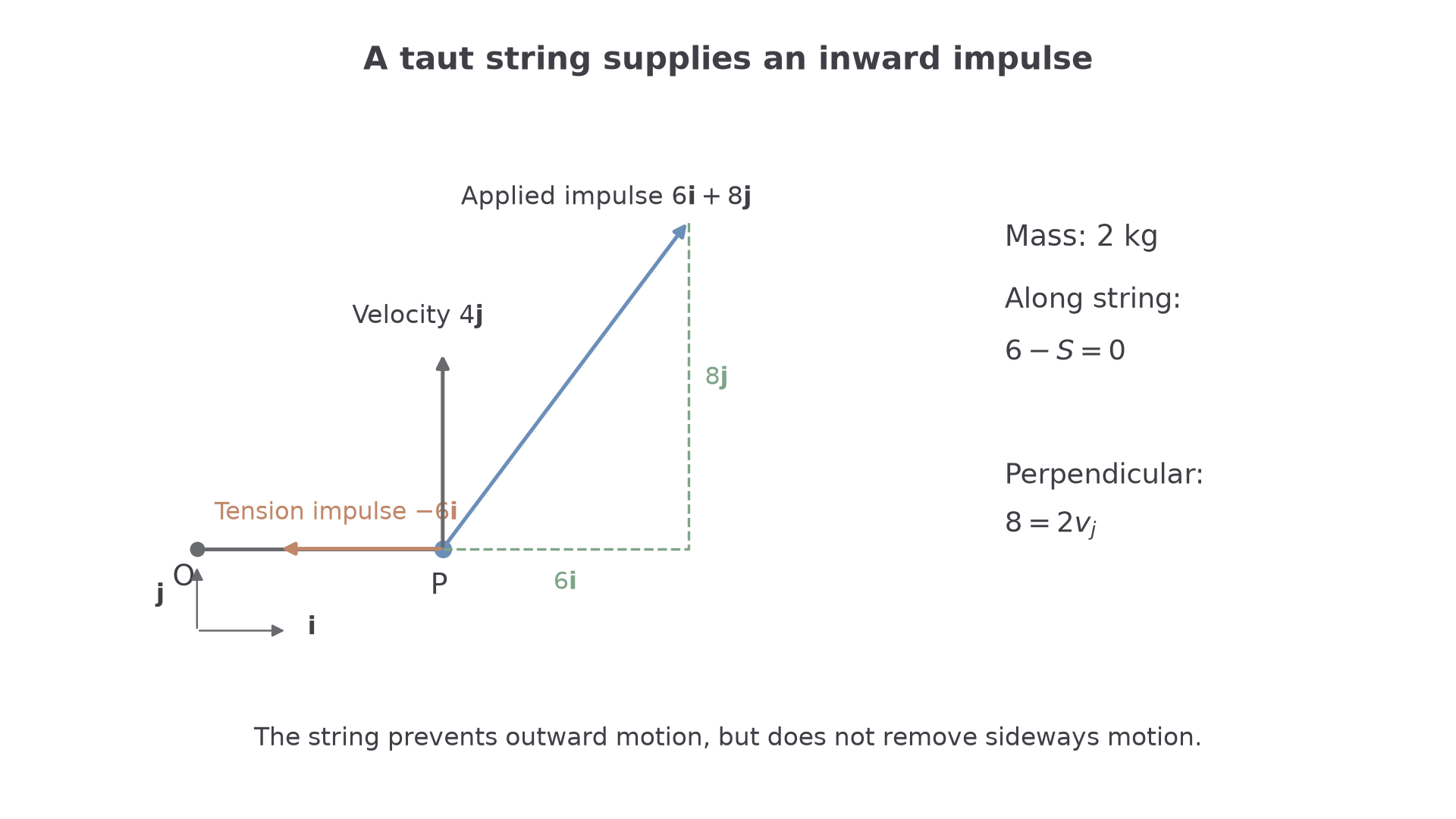
These constraint rules follow from the fixed string length and are not in the formula booklet. Apply the vector impulse–momentum principle with every impulse included.
Worked example 5: an impulse along the string
Question. A particle of mass is at rest on a smooth horizontal plane, attached to a fixed point by a taut light inelastic string. The direction away from the fixed point is . An impulse acts on the particle. Find the tension impulse and the immediate velocity.
Plan. Include the inward tension impulse and impose zero velocity along the taut string.
Why this step? The applied impulse alone would send the particle away from the fixed point, but the inelastic string supplies the opposing impulse needed to prevent that motion.
Answer. Tension impulse ; immediate velocity .
Check. The two impulses cancel and is non-negative.
Change only the direction of the applied impulse, adding a perpendicular component. The string still controls only its own direction.
Continue this lesson.
You’re previewing NovaLearn without an account. Create a free account to read the rest.
Create free account