8.03i–8.03k - Group structures and Lagrange's theorem
Small groups have surprisingly few possible structures. You will recognise the groups of orders up to seven, use Lagrange's theorem to restrict subgroup orders, and analyse larger finite groups and infinite groups from their definitions. The key is to turn a statement about the whole group into a precise restriction on its elements or subsets.
Lagrange's theorem
Could a group of order have a subgroup of order ? Four is smaller than six, so counting alone does not rule it out. But group structure does: a subgroup must fit the group in equal-sized pieces, and does not divide .
You already know
A subgroup uses the same operation as the ambient group. In a finite group, an element's order divides the group order. A cyclic group of order has exactly one subgroup of each positive divisor order, generated by an appropriate power of a generator.
For a glimpse of why equal-sized pieces appear, take addition modulo and its subgroup . Adding to its members gives ; adding gives . These three equally sized sets partition the whole group. Lagrange's theorem makes the resulting divisibility precise for every finite group. You need its statement and applications; a proof is not required.
[DIAGRAM: asset_name: Equal-sized copies of a subgroup; asset_slug: h245_8_03_lagrange_partition; caption: Addition modulo six splits the group into three disjoint two-element sets obtained by adding a fixed element to the subgroup; description: Six residues from 0 to 5 are arranged in three shaded pairs. The subgroup H contains 0 and 3; the set 1 plus H contains 1 and 4; the set 2 plus H contains 2 and 5. Each pair contains two elements. An equation states that 6 equals 3 times 2. A note explains that the translated sets partition the group; the translated sets themselves need not be subgroups.]
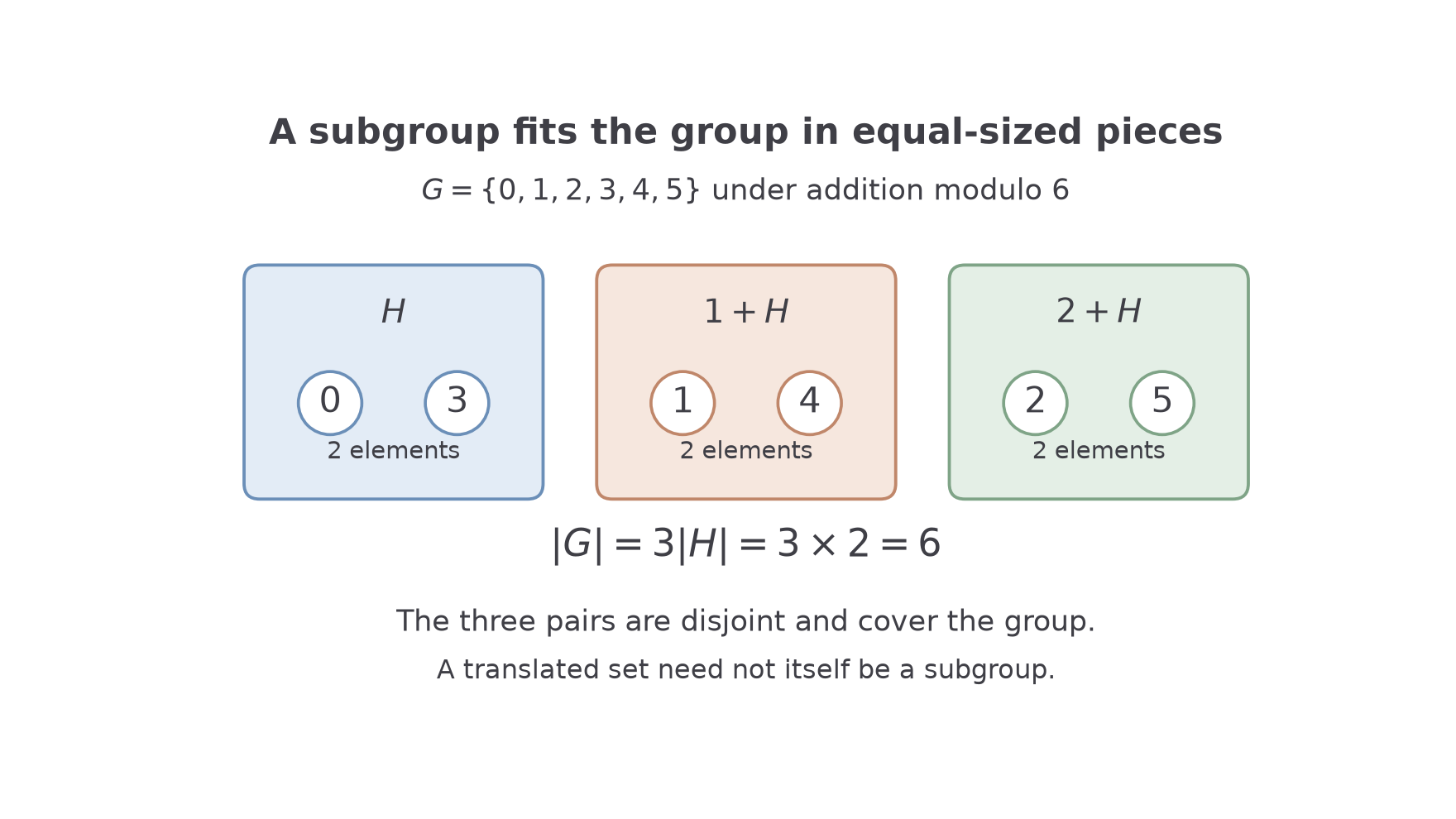
The shifted sets are not generally subgroups: does not contain the identity . They explain the size restriction without introducing extra subgroups.
Lagrange's theorem
If is a subgroup of a finite group , then
The order of a subgroup is a positive factor of the order of the group.
Not in the formula booklet: learn it.
The theorem restricts possible orders; divisibility alone does not prove that a subset is a subgroup, or that a general group has a subgroup of every divisor order. For a cyclic group, existence for each divisor is known from its power structure. Also is a subgroup with elements, so Lagrange immediately gives .
Worked example 1: possible subgroup orders
Question. A group has order . State all possible orders of proper subgroups, justifying your answer.
Plan. List the positive factors of , then exclude the whole group order.
Why keep ? The trivial subgroup is proper in a non-trivial group.
Answer. The possible proper subgroup orders are , by Lagrange's theorem. This list gives permitted sizes, rather than a claim that each occurs in every group of order .
Check. An order such as is smaller than , but , so it is excluded.
Change just the group order from to . The restriction still concerns factors, not all smaller integers.
Worked example 2: a different group order
Question. A group has order . State all possible orders of proper subgroups, justifying your answer.
Plan. Apply the same divisor test to .
Why is absent? A subset with six elements could exist, but it cannot be a subgroup of this finite group.
Answer. The possible proper subgroup orders are .
Check. Each listed integer divides , including the trivial subgroup order .
State the theorem's relationship explicitly when justification is requested; merely writing a list gives no reason for rejecting other sizes.
Watch out
Wrong: “Lagrange says .” Right: the smaller subgroup order divides the larger group order, . The theorem applies to finite groups.
The original order- puzzle now has its answer, since .
Group structures up to order seven
There is only one structure of prime order, but a group of order four or six has a choice.
Suppose , where is prime, and choose . Lagrange gives . Its order cannot be , so it is : generates the whole group. Thus every group of prime order is cyclic, and every non-identity element is a generator.
For order , either an element has order , giving a cyclic group, or every non-identity element has order . In the latter case, write the elements . The Latin square property forces and : the product cannot be , or . Similarly the other distinct non-identity pairs multiply to the third one. This is the rectangle symmetry structure.
Cyclic and Klein group notation
denotes the cyclic group of order , represented by addition modulo or by the powers of a generator with . The Klein four-group, written here, has four elements , with and , , . It is abelian but not cyclic.
The complete list of structures up to order seven is short. “Same structure” means that the elements can be consistently renamed without changing any products; this will be called isomorphism in the next lesson.
| Group order | Structures | Orders of the non-identity elements |
|---|---|---|
| trivial group | none | |
| one of order | ||
| two of order | ||
| , or | : two of order , one of order ; : three of order | |
| four of order | ||
| , or the equilateral triangle symmetry group | : two of order , two of order , one of order ; triangle: two of order , three of order | |
| six of order |
Only the triangle group in this table is non-abelian. The notation will mean this group of six symmetries; naming conventions for dihedral groups vary, so keep its actual actions and size in view. The small-group structures and the prime-order result are not in the formula booklet: learn them. Structures of higher order are analysed from information given in the question; no catalogue of larger groups is needed.
Key idea
Prime order forces cyclic structure; the first two choices occur at orders and , distinguished by their element orders and commutativity.
A count of the orders can identify the structure without completing a whole table.
The two groups of order six
The difference between the two six-element groups appears in the interaction between an element of order three and one of order two.
In the triangle group, use for a rotation with , and for a reflection with . Its elements are . Reversing a rotation with a reflection gives
so moving past reverses the power of . This follows by following vertices, or by observing that reflection reverses clockwise and anticlockwise directions. In the cyclic six-element structure, by contrast, the two generators can commute.
Worked example 3: products in the triangle group
Question. In , the six-element triangle group, and . Find and .
Plan. Use the relation to move each to the right, then reduce powers of .
Why not combine the two -powers immediately? They are separated by , and the group is not commutative.
Answer. , so has order ; and .
Check. A reflection followed by a different reflection gives a rotation. Reversing the last product gives , not .
Change just the interaction law: keep of order and of order , but now suppose and the six elements are distinct.
Worked example 4: commuting generators
Question. A group has the six distinct elements , with and . Determine the order of , and hence identify the group structure.
Plan. Use commutativity to collect powers of and , and show the first return to the identity.
Why is the distinctness information useful? It ensures that none of the first five displayed elements is secretly the identity.
Answer. , so generates the whole group and its structure is .
Check. Its powers visit all six given elements. In the triangle group the same-looking product instead has order .
Continue this lesson.
You’re previewing NovaLearn without an account. Create a free account to read the rest.
Create free account