4.03e, 4.03f - Successive and 3D transformations
Combine transformations in the right order, then recognise the single transformation their product represents. Extend the same column-vector idea to space: reflect in coordinate planes and rotate about coordinate axes, with the viewing direction made explicit. Successive transformations are the focus of ; single transformations in three dimensions are the focus of .
The first transformation goes on the right
Does “rotate, then reflect” give the same result as “reflect, then rotate”? Take a quarter turn anticlockwise about , followed by reflection in the -axis. The point goes first to , then to . Reverse the order and it goes first to , then to . The order changes the answer.
You already know
A transformation acts by pre-multiplying a position column. Matrix multiplication is associative, but generally not commutative. A product's rightmost factor reaches the position vector first.
If acts first, . If then acts, . Associativity, rather than a memory trick, explains the order.
Successive transformations
The product represents the transformation followed by the transformation . For three transformations performed in the order , then , then , the combined matrix is . Not in the formula booklet: learn it.
Read a written sequence from left to right, but build its matrix with each new transformation on the left.
Worked example 1: rotate then reflect
Question. A rotation through anticlockwise about has matrix . Reflection in the -axis has matrix . Find the matrix for the rotation followed by the reflection, and the image of .
Plan. Form , because acts first, then apply the product.
Why this step? The reflection must act on the rotated image, so its matrix is to the left of the rotation matrix.
Answer. Combined matrix ; image .
Check. Separately, .
The second example changes only the order of the same two transformations.
Worked example 2: reflect then rotate
Question. Find the matrix for reflection followed by rotation , using the matrices above, and the image of .
Plan. Form and then apply it.
Why this step? Reversing the story reverses the product, which changes its off-diagonal signs.
Answer. Combined matrix ; image .
Check. , agreeing with the product.
The two resulting matrices are reflections in different diagonals. Neither sequence can be identified merely by listing its two ingredients.
Watch out
Wrong: “ means then , because is written first.” Apply the product to a column: , so acts first.
Change the mirror while keeping the order logic.
Recognising a composite transformation
Multiplication can turn a long description into a familiar single transformation; recognise the result only after the product is formed.
For example, the first sequence above has matrix , so it is reflection in . Two moves have become one. A single transformation description needs its complete geometry: “reflection” alone leaves infinitely many possible mirrors.
Problem-solving
Calculate the composite matrix, then inspect the images of and . Compare with the standard matrices; a unit image is a useful sign check.
Repeated rotations are an especially useful case. Rotations about the same origin add their angles, so repeated quarter turns cycle after four steps. This also follows by multiplying their matrices. The angle-addition rule and are not supplied in the formula booklet; learn the reasoning, using the supplied rotation matrix.
Worked example 3: two reflections become a rotation
Question. Reflection in the -axis is followed by reflection in . Describe geometrically the single transformation.
Plan. Put the second reflection on the left and recognise the product.
Why this step? The product, rather than either reflection by itself, identifies the required single transformation.
Answer. Rotation through anticlockwise about the origin.
Check. , confirming the positive quarter turn.
The second example changes only the order of those two reflections. This reverses the rotation, and gives a useful repeated-transformation problem.
Worked example 4: the reversed rotation repeated
Question. Let represent reflection in followed by reflection in the -axis. Describe its transformation and determine .
Plan. Reverse the product, identify the quarter turn, then reduce the exponent using a full-turn cycle.
Why this step? A full-turn block acts as the identity; only the remainder changes the final image.
Answer. is rotation through clockwise about , and .
Check. Three clockwise quarter turns equal one anticlockwise quarter turn.
The two reflections provide a concrete explanation of non-commutativity: their order determines the direction of the turn.
Exam tip
When asked for the single transformation, give one complete description. Listing the original transformations does not answer that demand. For “determine” a large matrix power, explain the cycle and remainder.
Use the same clockwise-quarter-turn matrix with a new exponent.
Reflections in coordinate planes
In space, a mirror is a plane: reflection reverses the coordinate perpendicular to it and preserves the two coordinates lying along it.
You already know
The point has position column . The - plane has equation , the - plane has equation , and the - plane has equation .
For reflection in , the point becomes : only its distance across the - plane changes sign. The three unit images now form three columns.
Coordinate-plane reflections
Not in the formula booklet: learn it.
Name the plane of reflection, rather than an axis. A reflection in preserves the whole - plane, not just the -axis.
Worked example 5: reflection in the y-z plane
Question. Write down the matrix for reflection in the - plane, and find the image of .
Plan. The plane is , so negate only .
Why this step? The equation tells you that , rather than or , measures distance across the mirror.
Answer. Matrix as displayed; image .
Check. The midpoint lies in the mirror, and the joining segment is parallel to the -axis.
The second example changes only the plane of reflection.
Worked example 6: reflection in the x-z plane
Question. Write down the matrix for reflection in the - plane, and find the image of .
Plan. Use , negating only .
Why this step? The two letters naming the plane are the coordinates that stay unchanged.
Answer. Matrix as displayed; image .
Check. The midpoint lies in the - plane.
These matrices have one negative diagonal entry. Negating two coordinates instead produces a half turn about the remaining coordinate axis, a different transformation.
Watch out
Wrong: using for reflection in the - plane. That changes both coordinates within the plane. Right: use , which changes only its perpendicular coordinate.
The third plane gives the matched check.
Rotations about coordinate axes
A rotation about a coordinate axis leaves that coordinate unchanged and rotates the two perpendicular coordinates.
The axis of rotation is the line through the origin about which points turn. OCR defines a positive rotation as anticlockwise when looking towards the origin from the positive side of that axis. The viewing direction is part of the meaning: looking from the other end reverses the apparent direction.
[DIAGRAM: asset_name: Positive rotations viewed from their axes; asset_slug: h245_4_03_3d_rotation_views; caption: Positive quarter turns send positive y towards positive z about x, positive z towards positive x about y, and positive x towards positive y about z; description: Three coordinate cross-section panels as viewed towards O from the positive rotation axis. About positive x, screen right is positive y and screen up positive z. About positive y, screen right is positive z and screen up positive x. About positive z, screen right is positive x and screen up positive y. Each panel shows an anticlockwise quarter-turn arrow from the right-hand positive axis to the upper positive axis and labels the viewing position]
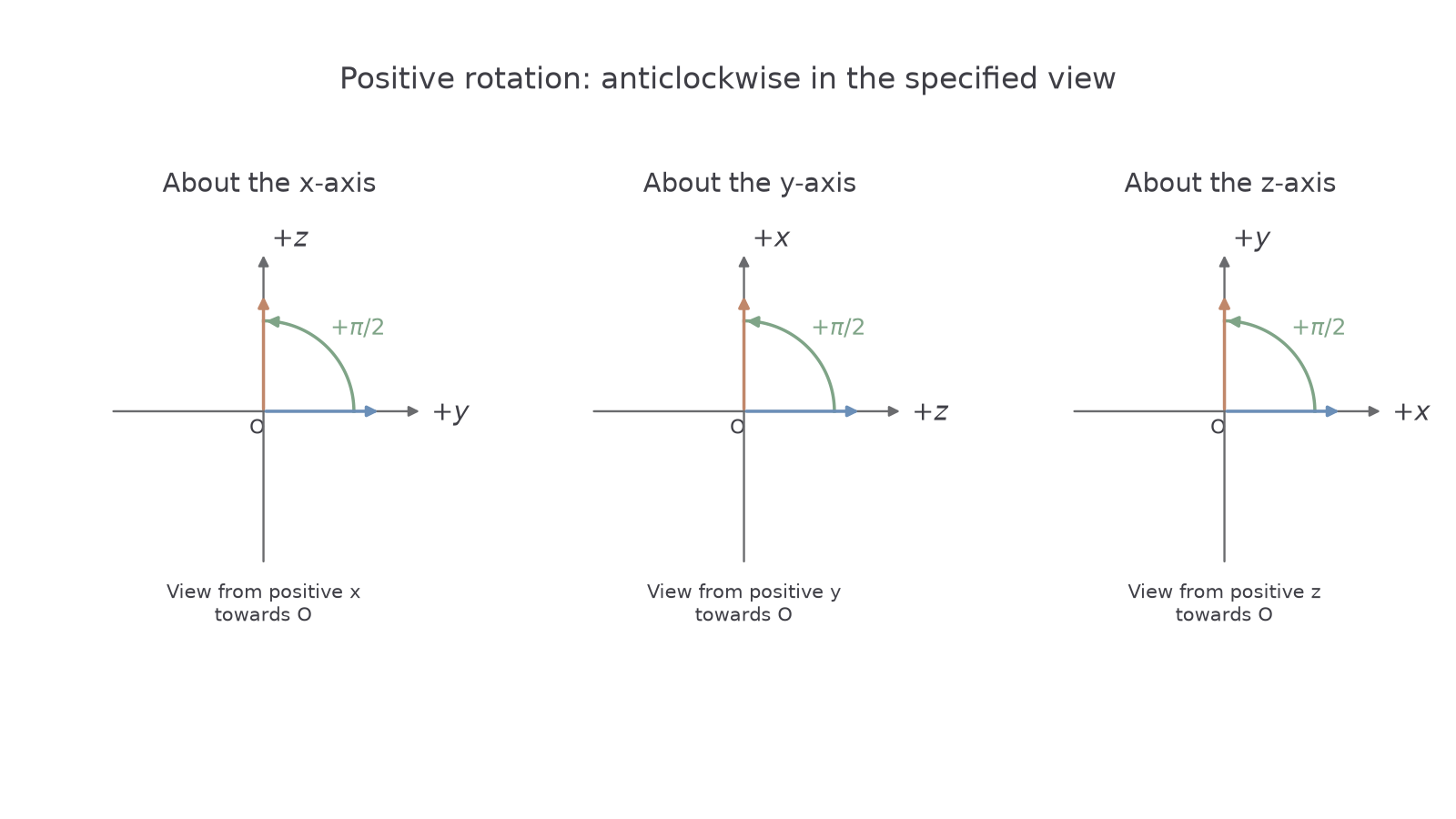
Rotations in three dimensions
Positive angles use the viewing convention above:
In the formula booklet.
For the -axis rotation, it is the ordered pair , rather than , that turns in the familiar positive sense. This explains the sine signs that otherwise look inconsistent. A negative angle reverses any of these rotations.
Worked example 7: a positive rotation about x
Question. Find the matrix for rotation through about the positive -axis, using OCR's positive direction, and the image of .
Plan. Substitute into ; leave the -coordinate fixed.
Why this step? The unchanged first row marks the rotation axis; the pair makes an anticlockwise quarter turn in the specified view.
Answer. Matrix as displayed; image .
Check. stays , and before and after. The positive unit point maps to the positive unit point.
The second example changes only the axis, keeping the same angle and object point.
Worked example 8: a positive rotation about y
Question. Find the matrix for a positive rotation through about the -axis, and the image of .
Plan. Substitute into , keeping fixed and checking the sine signs.
Why this step? Positive turns towards positive when viewed from the positive -axis; the reversed sine signs would turn the other way.
Answer. Matrix as displayed; image .
Check. is unchanged, is preserved, and maps to .
The same test handles the third axis: a positive rotation about turns positive towards positive . It is the two-dimensional rotation acting in each horizontal plane.
Watch out
Wrong: declaring a rotation clockwise without saying from which end of its axis you are looking. Use “looking towards from the positive side of the axis” before deciding the angle's sign.
The final check changes the axis again, then reverses the angle. The opening question is settled too: order matters because the second transformation acts on a changed object.
Quick Recap
- In a product, the rightmost transformation acts first: means , then .
- Recognise a composite after multiplying; give the complete description of the resulting single transformation.
- A coordinate-plane reflection negates only the coordinate perpendicular to the mirror plane.
- A coordinate-axis rotation fixes that coordinate. Positive means anticlockwise when viewed towards from the positive axis.
“Rotate, then reflect” can differ from “reflect, then rotate”: our two orders gave reflections in and , respectively.