6.05d, 6.05e - Motion in a vertical circle
Use energy to find speed on a vertical circular path, then resolve forces towards the centre and along the tangent. You will distinguish radial acceleration from the acceleration that changes speed, interpret a rod's force as tension or compression, and combine perpendicular acceleration components.
Speed from height change
At the same speed, a particle at the side of a vertical circle has the same radial acceleration as one at the bottom. Does it have the same total acceleration? Gravity will make the answer more interesting: it changes speed as well as direction.
Start with the speed. A particle moves on a smooth fixed circular wire of radius , starting at its lowest point with speed . At the side it has risen ; at the top it has risen . Its kinetic energy pays for that gain in gravitational potential energy.
You already know
Kinetic energy is , and a vertical rise increases gravitational potential energy by . Mechanical energy is conserved when no force does dissipative work. A normal reaction or radial constraint force does no work along a smooth circular path.
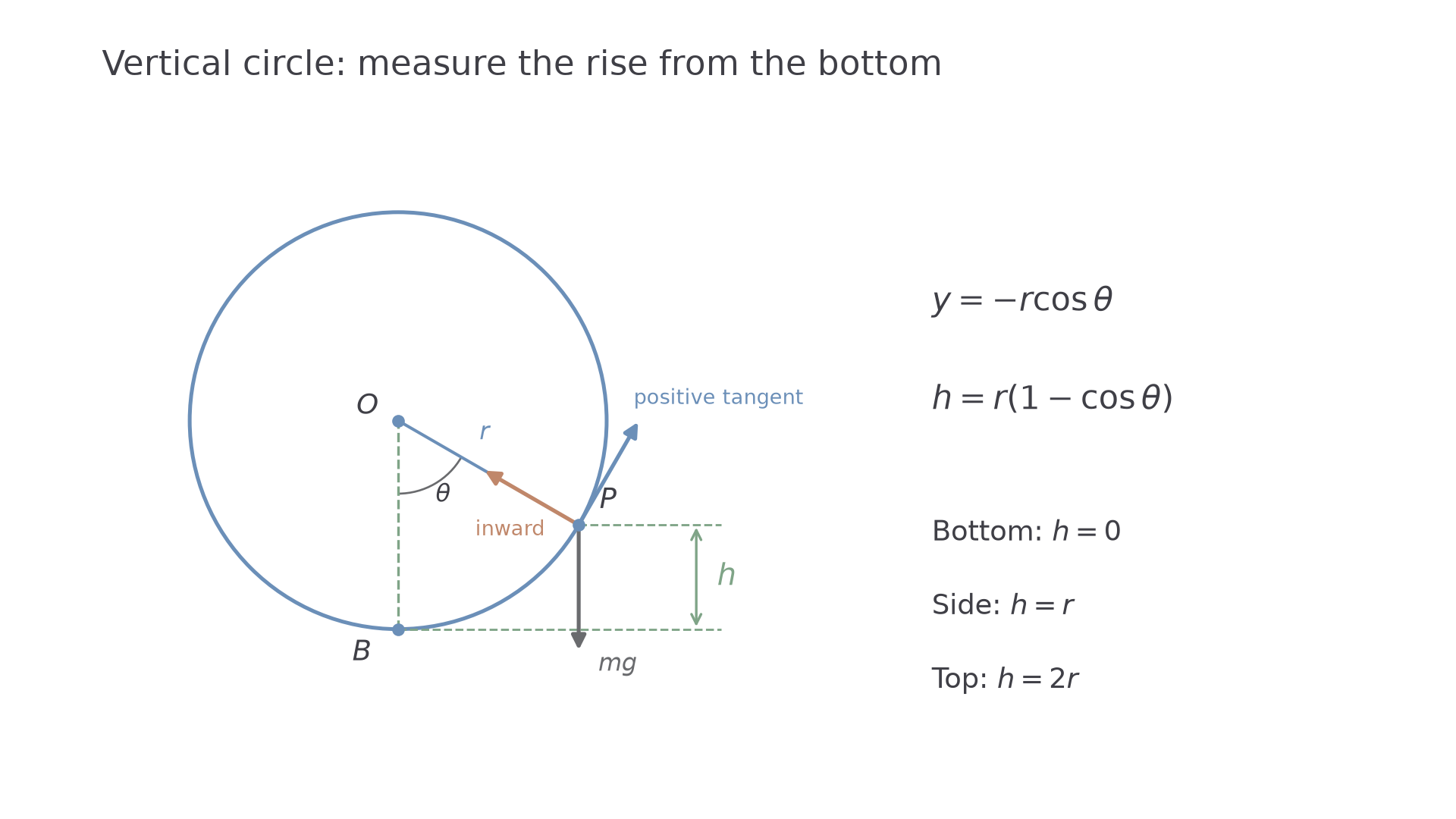
Measure from the downward vertical, increasing from the bottom towards the right-hand side. The particle has coordinates relative to the centre. Its rise above the bottom is therefore . At , the height is zero; at , it is .
[DIAGRAM: asset_name: Height and forces in a vertical circle; asset_slug: h245_6_05_vertical_geometry; caption: With theta measured from the downward vertical, the rise from the lowest point is r(1 - cos theta); description: A circle with centre O, lowest point B, and particle P in the lower right quadrant. A radius OP of length r and a downward vertical radius OB define angle theta. A horizontal dashed guide through P shows its vertical coordinate -r cos theta relative to O. A sage vertical bracket from B level to P level is labelled h = r(1 - cos theta). At P a clay arrow points along the inward radius and a blue arrow points up the tangent in the direction of increasing theta. Weight mg is drawn vertically down from P]
Energy on a vertical circular path
If speed is at the lowest point, only gravity does work, and the circular constraint still applies, then
so .
Not in the formula booklet: learn it.
The formula is a consequence of energy, rather than a constant-acceleration equation along the arc. In a derivation or a detailed-reasoning question, show the energy balance with its actual kinetic and potential-energy terms. Also check that the point can be reached: a negative value of signals an impossible proposed position under this model.
Worked example 1: part-way up the circle
Question. A bead moves on a smooth fixed circular wire of radius . It passes through the lowest point at . Determine its speed when .
Plan. Calculate the vertical rise and equate the loss of kinetic energy to the gain in potential energy.
Why use the vertical rise rather than arc length? Gravitational potential energy depends on height, while the smooth wire's force does no work.
Answer. , to 3 significant figures.
Check. , and the bead has slowed while rising.
Change only the angle, moving to the upper half. The height formula still works: its cosine is now negative.
Worked example 2: above the centre
Question. For the same bead and initial speed, determine the speed when .
Plan. Use the new height, keeping the same initial energy and datum.
Why retain the minus sign of the cosine? Above the centre the rise exceeds , so the negative cosine must increase the height.
Answer. , to 3 significant figures.
Check. The bead has risen a further since example 1, and .
At equal heights on the two sides, the speed is the same if the same conserved-energy motion reaches both points. The tangent directions differ, so the velocity vectors do not match.
Watch out
Wrong: the height gained from the bottom is . Right: it is . The proposed height must give zero at the bottom and at the top.
Move to a new height and write the energy equation before evaluating it.
Radial forces and a rod's direction
Once energy has supplied the speed, Newton's second law supplies the constraint force. Resolve towards the centre, using the component of weight with its correct sign.
The inward unit direction is . Weight acts vertically downwards, so its inward component is . At the bottom weight is outward; at the top it is inward. This simple check is more reliable than memorising a sign for every picture.
Inward force equation
If denotes the signed force exerted by a radial rod, positive towards the centre, then
For a taut string, replace by its non-negative tension . For a smooth circular wire, use its signed radial reaction in place of .
Not in the formula booklet: learn it.
A rigid rod can pull the particle towards the centre, giving and tension, or push it away, giving and compression. The magnitude of a compressive force is . A string cannot provide compression: a negative proposed tension would invalidate a taut-string calculation. Finding when that happens belongs to the next lesson.
Worked example 3: a rod in tension
Question. A particle is attached to a light rigid rod of length , freely pivoted at its other end . It passes through the lowest point at . Determine the force in the rod at , stating whether it is in tension or compression.
Plan. Use energy to find , then resolve towards , initially taking the rod's force as inward.
Why include the weight component? The rod's force is not the entire radial resultant; here part of it is needed to overcome weight's outward component.
Answer. The rod is in tension of .
Check. Its inward resultant is .
Change only the point to the top of the same circle. The rod can now be required to push outwards.
Worked example 4: a rod in compression
Question. For the same particle, rod and initial speed, determine the force in the rod at the highest point.
Plan. Use the full height gain , then let the radial equation decide the force's direction.
Why is a negative result allowed? A rod can push away from . Here gravity alone would supply too much inward force for the actual speed, so the rod reduces the inward resultant.
Answer. The rod is in compression of .
Check. Weight inward minus the rod's outward gives the required inward. Also , so the particle reaches the top on this rigid constraint.
The signed calculation answers both parts of the physical question: the magnitude and whether the rod pulls or pushes.
Watch out
Wrong: a negative value of means the rod model fails. Right: for a rigid rod it means compression, with magnitude . A negative tension would fail for a string because a string cannot push.
Choose another point in the same motion and interpret the sign.
Acceleration along the tangent
Gravity also has a tangential component. A radial string, rod or smooth-wire reaction cannot oppose it, so it determines the rate of change of tangential velocity.
Take the positive tangent in the direction of increasing , with unit direction . The tangential component of weight is . On the right-hand half of the circle, , it points down the tangent, opposite an ascending particle's motion. On the left-hand half its sign reverses.
Continue this lesson.
You’re previewing NovaLearn without an account. Create a free account to read the rest.
Create free account