4.09c - Areas enclosed by polar curves
Find an area by adding thin sectors as a ray sweeps through a polar curve. You will choose limits from the geometry, integrate squared radii, handle shared regions and radial gaps, and use an area formula containing a parameter.
Adding thin sectors
How much area does the cardioid enclose? Its greatest radius is 4, but would treat it as a circle centred at the pole. We need an area method that allows the radius to change with direction.
Think first of a small circular sector. With radius 2 and angle 0.1 radians, its area is . Doubling the radius to 4 gives area : four times as much, not twice as much. This is why the polar area integrand contains a square.
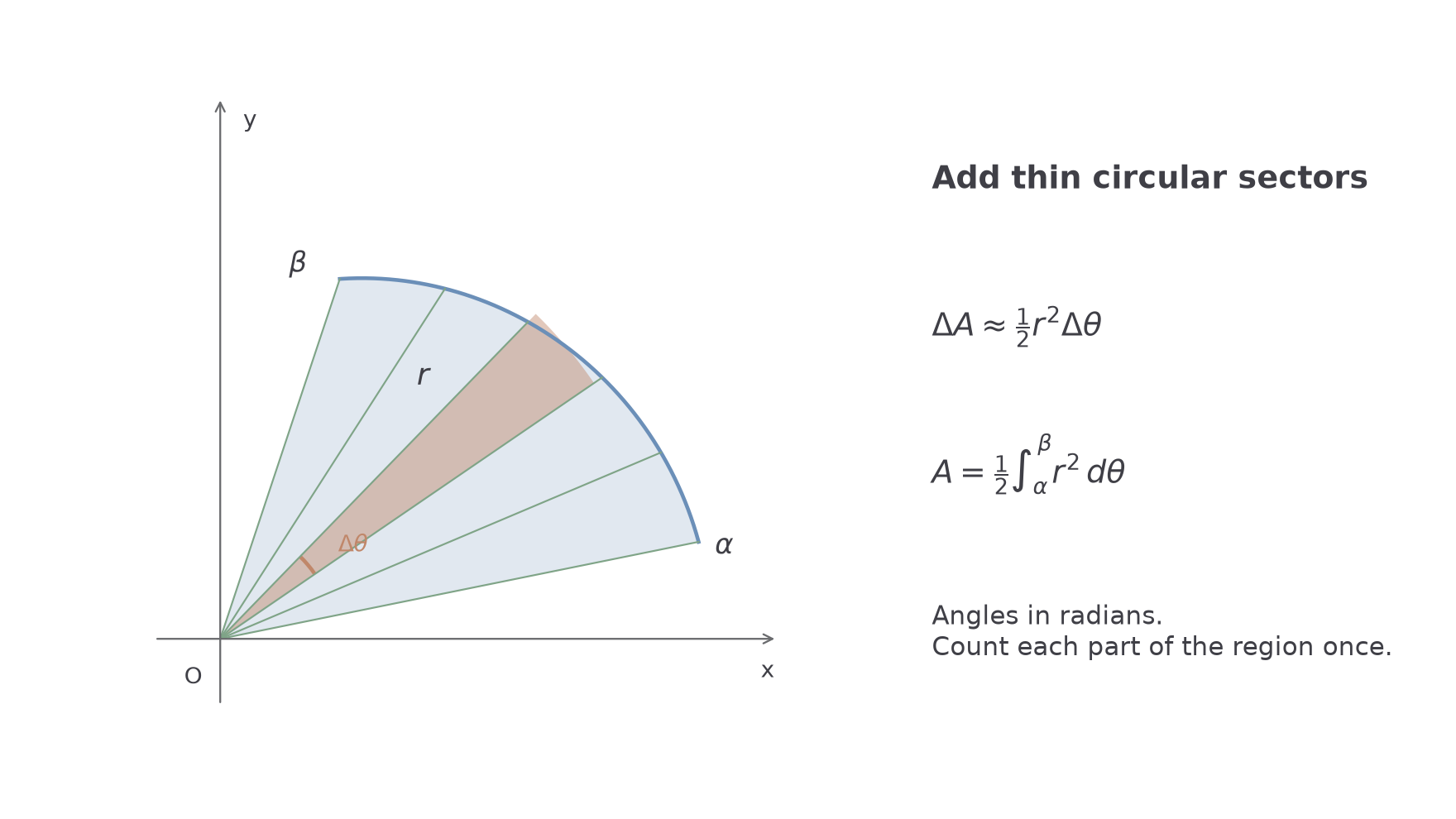
[DIAGRAM: asset_name: Polar area as a sum of sectors; asset_slug: h245_polar_sector_area; caption: Thin sectors have approximate area one half r squared delta theta; adding them leads to an integral; description: A blue polar arc bounds a shaded region swept from angle alpha to beta. Sage rays divide the region into thin sectors. One clay sector highlights its angle delta theta and its approximate radius r. The side panel shows delta A approximately one half r squared delta theta and A equals one half the integral of r squared with respect to theta, with angles in radians and no repeated counting]
You already know
A circular sector of radius and angle radians has area . This assumed Mathematics result is not in the formula booklet. You can integrate powers and use .
For a changing radius, a sufficiently thin piece is approximately a sector with area . Add the pieces, then let their angles shrink towards zero. The sum becomes a definite integral.
Area swept by a polar curve
The area bounded by and the rays , is
Here , angles are in radians, , and the sweep must count the required region exactly once. For a complete closed loop, choose a sweep that starts and ends at the same point on the curve, often the pole.
In the formula booklet.
The rays need not be visible sides of a complete loop. They can be a way to split a region into manageable pieces, provided the pieces cover it once without overlaps.
Key idea
The integral adds areas swept from the pole. Establish the required angular interval before calculating; squaring the radius does not repair an incorrect interval.
The wrong integrand can look deceptively similar to the correct one.
Choosing the angular sweep
Use the sketch and the zeros of to decide whether your integral covers a whole loop, part of a loop or the same region twice.
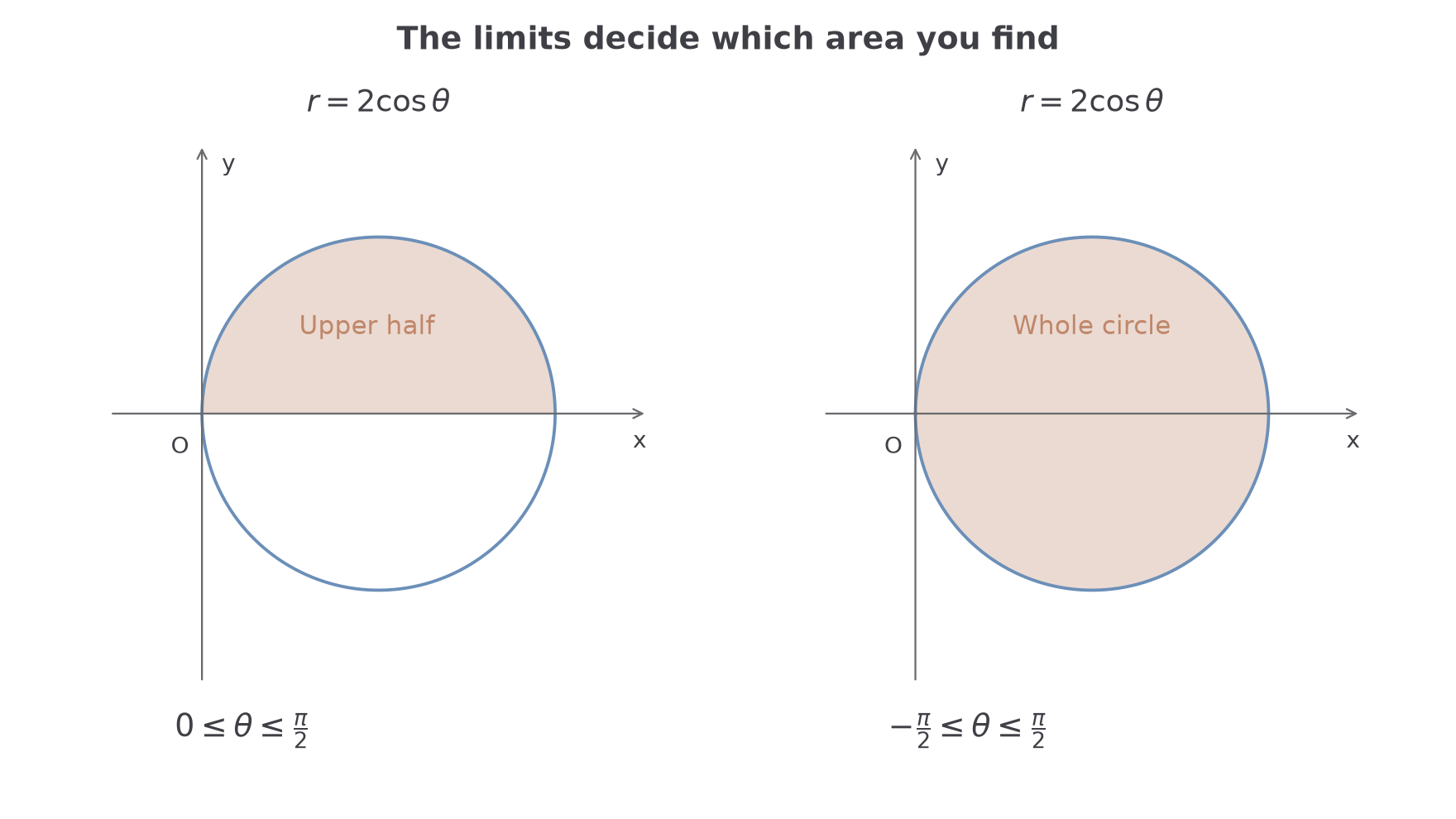
The curve , , is the circle . Its pole is on the boundary. Angles between 0 and sweep only the upper half of the circle, even though sounds like “a quarter turn”.
[DIAGRAM: asset_name: Half a circle and a complete circle from different limits; asset_slug: h245_polar_circle_limits; caption: For a circle through the pole, a quarter-turn sweep gives half the circle and a half-turn sweep gives all of it; description: Two equal-scale diagrams show the circle r = 2 cos theta, centred at (1, 0) with radius 1. The left shades the upper half swept from zero to pi over 2. The right shades the whole circle swept from minus pi over 2 to pi over 2. The limits are printed below each diagram]
Worked example 1: the upper half of a circle
Question. Determine the exact area swept by for .
Plan. Use the stated limits, square the radius and replace cosine squared by its double-angle form.
Why this step? The limits describe the rays that sweep the upper half; the radius is measured from the circle's edge, not from its centre.
Answer. square units.
Check. The circle has radius 1, so its upper half has area .
Worked example 2 changes only the requested region: now find the entire circle. The admissible angular interval must widen accordingly.
Worked example 2: the complete circle
Question. Determine the exact area enclosed by , using the convention .
Plan. Solve for the pole angles, use the interval between them where the radius is non-negative, then integrate.
Why this step? These rays both meet the curve at the pole, and every non-pole point on the circle occurs once between them.
Answer. square units.
Check. Twice the area in the previous example is , agreeing with the area of a circle of radius 1.
The square in the formula can conceal a domain mistake.
Watch out
Wrong: for this circle. The expression is negative for half that interval, and the resulting value is twice the required area. Right: use one admissible sweep, such as .
Now change only the scale and keep one complete admissible sweep.
Trigonometric area integrals
When a polar radius contains a sum, square the whole sum before integrating, including its cross term.
For the opening cardioid , the radius is non-negative over a complete turn. The curve is traced once as runs from 0 to , with the pole reached at . The isolated zero does not split the area into overlapping regions.
Use the power-reduction identity for the squared trigonometric term. In this booklet, , and hence , are assumed identities to learn; they are not supplied.
Worked example 3: area of the opening cardioid
Question. Determine the exact area enclosed by , .
Plan. Expand the squared bracket, reduce cosine squared and integrate over one complete turn.
Why this step? The square applies to the entire radius; omitting the cross term changes the area swept on almost every ray.
Answer. square units.
Check. The region lies inside the circle , so its area must be less than . Symmetry also lets you double the area swept from 0 to , giving the same result.
Worked example 4 changes only the coefficient of cosine, from 2 to 1. The curve now stays away from the pole, but the area method is unchanged.
Worked example 4: a positive least radius
Question. Determine the exact area enclosed by , .
Plan. Expand , then integrate over the complete turn.
Why this step? Although the curve no longer reaches the pole, every direction still has one boundary radius, so a full-turn sweep covers the enclosed region once.
Answer. square units.
Check. Since , the area lies between and ; does.
Over a full turn the cross term happened to integrate to zero in these examples. You must still retain it: it need not vanish over a shorter interval.
Watch out
Wrong: . Right: . With a parameter in or , missing this term can also change the optimisation problem.
The next check keeps the same cosine term and changes the constant.
Continue this lesson.
You’re previewing NovaLearn without an account. Create a free account to read the rest.
Create free account