4.07e, 4.07f - Inverse hyperbolic functions as logarithms
Understand the inverse hyperbolic functions, including the domain and range of each, in 4.07e. In 4.07f you will derive their logarithmic expressions from exponentials and use them for exact values and equations, keeping careful track of the branch of inverse cosine hyperbolic.
Inverses and the cosine branch
Why does have two solutions, while has only one value? You already know the equation has the solutions . An inverse function must return just one output, so it cannot simply return both.
You already know
and are strictly increasing, with ranges and . The even function has range and is strictly increasing when its domain is restricted to . An inverse swaps a function's input and output.
A one-to-one function has an inverse because each output came from exactly one input. To invert , choose its non-negative-input branch. The reflection in then becomes a function, just as it does for the other two hyperbolic functions.
[DIAGRAM: asset_name: Hyperbolic functions and their inverses; asset_slug: h245_inverse_hyperbolic_graphs; caption: Each inverse is the reflection of its original function in y = x, using only the non-negative-input branch of cosine hyperbolic; description: Three equal-scale panels show blue original functions and clay inverse functions reflected in the dotted line y = x. The sine panel shows sinh and its inverse through the origin. The cosine panel shows cosh only for x at least zero, beginning at (0, 1), and its inverse beginning at (1, 0). The tangent panel shows horizontal asymptotes y = plus or minus 1 for tanh and vertical asymptotes x = plus or minus 1 for its inverse. Domain and range statements appear beneath every panel]
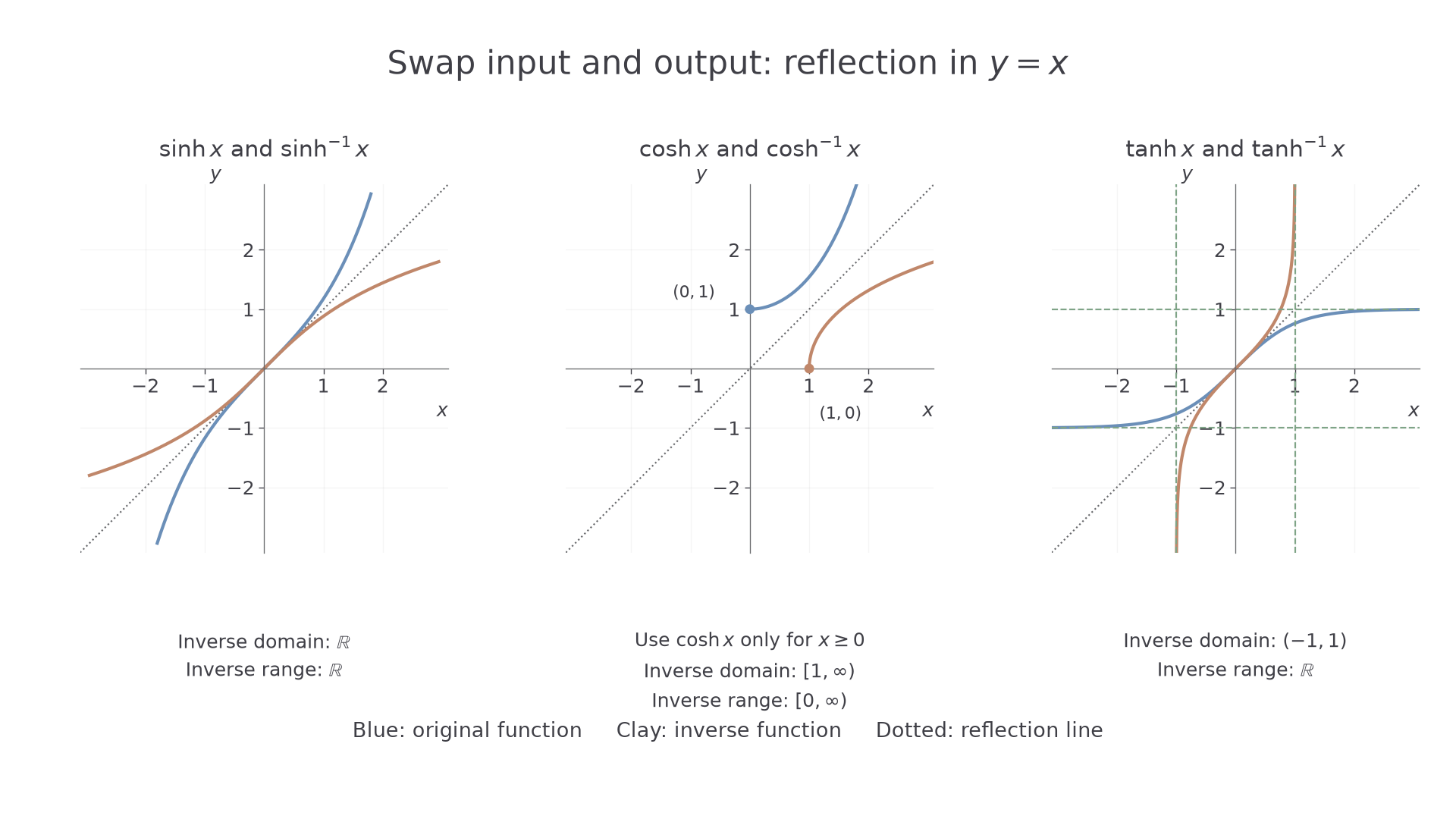
The output restrictions are part of the definitions, not an extra choice made while solving a particular question.
Inverse hyperbolic functions
The real inverse hyperbolic functions are defined by
The alternative notations are , and , respectively.
For example, , and . There is no real value of or . An inverse function is not a reciprocal: means the input whose sine hyperbolic is , while means a division.
| Function | Domain | Range |
|---|---|---|
These domains and ranges follow by swapping those of the original functions, with the stated restriction for . The domain/range table is not in the formula booklet; learn it. It also explains a useful boundary case: , not , because the inverse output must be non-negative. This composition rule is not in the formula booklet; learn it.
Key idea
returns the non-negative input; solving a cosine hyperbolic equation may require its negative partner as well.
Use the definition rather than interpreting the superscript as an ordinary power.
The logarithmic form of inverse sine hyperbolic
To turn an inverse into a logarithm, start with its defining equation and solve for an exponential.
Let . Then , so with ,
Because , the plus choice is positive and the minus choice is negative for every real . Hence , and taking logarithms gives the inverse. Even when is a large negative number, the argument of this logarithm stays positive.
Inverse sine hyperbolic as a logarithm
For every real ,
The logarithm's argument is positive for every real .
In the formula booklet.
The quadratic equation belongs in a derivation: quoting the printed formula is not a derivation of it. When merely finding a value, however, you can use the booklet result directly.
Worked example 1: a positive exact value
Question. Find the exact value of , giving your answer as a logarithm.
Plan. Substitute the entire fraction into the logarithmic expression and simplify its square root.
Why this step? The square root contains the square of the entire input, so , not .
Answer. .
Check. .
The next example changes only the sign of the input. The same positive square root now combines with a negative first term, producing a logarithm of a number below .
Worked example 2: a negative exact value
Question. Find the exact value of , giving your answer as a logarithm.
Plan. Keep the negative sign outside the square root and simplify the resulting positive argument.
Why this step? A negative inverse value does not require a negative logarithm argument. The logarithm is negative when its positive argument lies between and .
Answer. .
Check. , agreeing with the odd sine hyperbolic function.
A sign mistake in the quadratic root can make a perfectly valid real inverse appear undefined.
Watch out
Wrong: is another possible real branch. That expression is always negative, whereas . Only survives.
Apply the same calculation to a new negative input.
The logarithmic form of inverse cosine hyperbolic
The cosine calculation produces two positive exponential roots, so the branch restriction must do more work than it did for sine.
Continue this lesson.
You’re previewing NovaLearn without an account. Create a free account to read the rest.
Create free account