8.02a–8.02d - Bases, divisibility and the division algorithm
Read and calculate with numbers in different bases, use familiar divisibility tests, and build a test for an unfamiliar prime. You will also express division precisely using a quotient and a remainder, so that a calculation becomes a statement you can prove.
Place value in any base
Why is the palindrome divisible by , and does the same pattern survive if you change the number base? The digits look innocent; their place values contain the explanation.
In base ten, . In base five, the same string of digits means . The subscript tells you how large a place becomes when you move one step left.
You already know
An integer power gives repeated multiplication, and . Expanding and factorising polynomials lets you work with a base that is not yet known.
Each digit must fit inside a single place: a digit equal to the base must be carried into the next place.
Base notation
In an integer base , the digits are . A non-zero number has a non-zero first digit. For example,
The letters represent , respectively, when the base is large enough. Thus , but is not a valid digit.
The value of a digit string is its place-value expansion. To go the other way, divide repeatedly by the new base: the first remainder is the units digit, the next is the next digit, and so on. This place-value rule and conversion method are not in the formula booklet: learn them.
[DIAGRAM: asset_name: Place values in base five and base twelve; asset_slug: h245_8_02_place_values; caption: Changing the base changes the place values, not the meaning of a digit; description: Two rows of three pale boxes show 234 in base five above place values 25, 5, 1 and 2A4 in base twelve above place values 144, 12, 1. Arrows connect each digit to its contribution. The totals 69 and 412 are shown in base ten.]
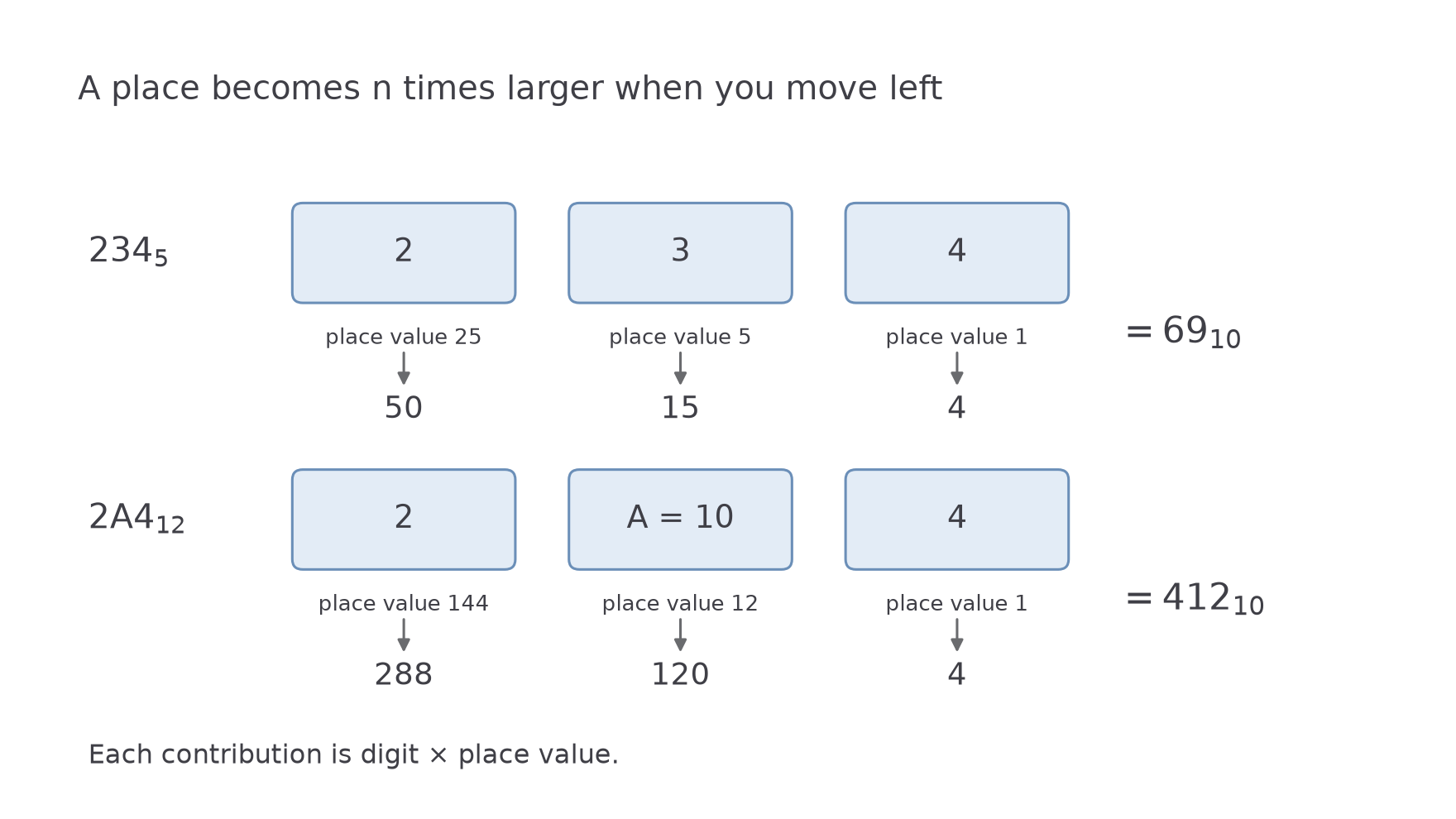
The same conversion can be checked in reverse, which is useful when several remainders look alike.
Worked example 1: converting both ways
Question. Express in base ten and in base five.
Plan. Expand the first number in powers of five; divide the second repeatedly by five and read its remainders upwards.
Why this step? Dividing by five removes the units place and shifts every other digit one place right, so the remainders emerge from right to left.
Answer. and .
Check. , as required.
The next example changes the base to twelve. The method is identical; a remainder of ten now needs a letter.
Worked example 2: a letter is a digit
Question. Express in base ten and in base twelve.
Plan. Use , then apply the same place-value and repeated-division methods with twelve.
Why this step? A letter in a numeral records one digit, not an algebraic variable or two separate digits.
Answer. and .
Check. . All three digits are less than twelve.
Read the subscript before attempting any arithmetic.
Watch out
Wrong: . Right: . Also, is invalid: the digit cannot occur in base seven.
Try the two directions with a fresh pair of numbers.
Algebra with a base
When the base is unknown, a numeral is a polynomial waiting to be expanded.
For example, , so gives . You must also check , because the largest digit is three. Solving the equation does not by itself make a base valid.
The same expansion reveals patterns that hold for every permitted base. If are digits and , the four-digit palindrome has value
The bracket is an integer, so the numeral is divisible by . This identity is not in the formula booklet: learn how to obtain it by expansion and factorisation. In particular, : the opening pattern is already taking shape.
An equation between two bases needs a separate expansion on each side.
Worked example 3: finding an unknown base
Question. Given that , determine .
Plan. Expand in powers of , solve the resulting quadratic, and keep only an integer base that permits every digit.
Why this step? The negative algebraic root is a root of the polynomial, but it cannot be a base in this setting.
Answer. .
Check. .
The second example changes one feature: the value on the right is itself written in a base involving . Expand that side too.
Worked example 4: two related bases
Question. Given that , determine .
Plan. Expand each numeral using its own base, then check the resulting base restrictions.
The equality would require , which is impossible.
Why this step? The same digit string can have different values in different bases; the base must be substituted into every power, not added to the final value.
Answer. There is no such base .
Check. At , the two values are and ; their difference remains two for every .
An impossible equation is a complete answer when the algebra proves that no allowed base works.
Watch out
Wrong: . Each place value changes. Right: .
In a proof about a digit pattern, state that the factor left after factorising is an integer: that is what turns algebra into divisibility.
Standard divisibility tests
A divisibility test keeps just enough information to decide whether a number is an exact multiple.
Divisibility
For integers and , means that for some integer . For example, , and , but .
These standard tests apply to base-ten numerals. You may use them without proof; the tests are not in the formula booklet: learn them.
| Divisor | Test |
|---|---|
| The last digit is even. | |
| The sum of the digits is divisible by . | |
| The number formed by the last two digits is divisible by . | |
| The last digit is or . | |
| The number formed by the last three digits is divisible by . | |
| The sum of the digits is divisible by . | |
| The alternating sum of the digits is divisible by , including zero. |
For , either sign convention works: has alternating sum , while has . Both are divisible by eleven. For a short numeral, the “last three digits” test simply uses the whole numeral.
To test a composite divisor, combine tests for coprime factors, or divide by one factor and test the quotient for the next. For example, divisibility by needs both tests, since and have no common factor greater than one. Checking divisibility by and only establishes divisibility by , not necessarily by .
Here are two tests with the number held fixed, so you can see exactly what changes with the divisor.
Worked example 5: combining coprime tests
Question. Use standard tests to determine whether is divisible by .
Plan. Test and , whose product is and which are coprime.
Why this step? The two tests account for the complete factors and ; neither repeats a prime factor from the other.
Answer. Both tests pass, so .
Check. .
The next example changes only the divisor. It now contains one more factor of two, so the previous two tests do not finish the job.
Worked example 6: repeated tests on a quotient
Question. Use standard tests to determine whether is divisible by .
Plan. Since , divide by eight and test the quotient for divisibility by eighteen.
Why this step? Testing the quotient makes repeated prime factors count again; testing the original number for eight and eighteen would only establish divisibility by their least common multiple, seventy-two.
Answer. , so .
Check. , so the division is not exact.
Continue this lesson.
You’re previewing NovaLearn without an account. Create a free account to read the rest.
Create free account