6.06a - Motion under a variable force
A changing force needs a differential equation, and the most useful form of acceleration depends on the variables in the question. You will predict velocity from time or position, use separation of variables or an integrating factor, and decide when a solution must stop because the force law changes.
Choosing the form of acceleration
Can a particle reach a speed limit in a finite time, even though the force pushing it tends to zero? Surprisingly, the answer depends on how the force tends to zero. We will finish with a model that reaches its limiting speed in finite time and then travels at that speed.
You already know
Choose a positive direction and resolve the resultant force before using Newton's second law for a particle of constant mass. You can solve separable first order equations and linear equations using an integrating factor; initial conditions select a particular solution.
Suppose a particle has velocity along the -axis. If its force is given in terms of time, acceleration is natural. If force is given in terms of position and the question asks for velocity at a position, introducing time creates an unnecessary unknown.
The chain rule supplies another route. On a portion of the motion where velocity can be expressed as a differentiable function of position,
For example, a particle under a signed force satisfies . Both sides now involve only and , so separation gives the velocity-position relation directly. A negative force means negative acceleration; it does not by itself mean negative velocity.
Acceleration in a straight line
For signed velocity ,
The second form is used on a branch on which is a differentiable function of . For constant mass , the signed resultant force is
Not in the formula booklet: learn it.
The two forms describe the same acceleration; they are choices of variable, not different laws. The constant-acceleration formulae are supplied in the booklet, but they cannot be used with a changing acceleration.
| What the model gives or asks for | Useful first choice |
|---|---|
| Force as a function of time; velocity at a time | |
| Force as a function of position; velocity at a position | |
| Force as a function of velocity alone | Either form: let the required answer decide |
Resistance needs particular care. A resistance of magnitude , with , has signed force while , but while . The expression combines both cases. In contrast, already opposes motion for either sign of . These force expressions are not supplied in the formula booklet; construct their signs from the direction of motion.
Key idea
Use the variable that connects the force law to the required answer. Keep velocity signed, keep mass constant, and check any division by velocity before using the result at rest.
At a turning point, and the graph of against may have a vertical tangent. Use the original equation in time to interpret that instant; do not assume is finite or cancel a zero velocity.
A force depending on position
Integrating links the square of velocity to position, so its final square root must agree with the direction of motion.
Take the force on a particle. For it pulls towards the origin; for it points the other way. On an outward journey from the origin, the particle slows down. The useful integral is , an application of the usual power rule, rather than a separate formula to memorise.
Worked example 1: finding the first stopping position
Question. A particle of mass moves along the -axis under signed resultant force , where is in metres. At , its velocity is . Find its velocity on the initial outward journey and its first stopping position.
Plan. Use , integrate with the initial condition, and choose the positive square root until the first stop.
Why this step? Squaring has removed the direction of velocity. The initial direction chooses the positive branch before the first stop.
Answer. for , and the particle first stops at .
Check. At , the positive root is . Differentiating gives , exactly the force equation. At the first stop the force is negative, so the particle then reverses.
Change only the initial velocity from to . The force law is unchanged; the integration constant and the turning position change.
Worked example 2: the returning branch
Question. The same particle starts at the origin with velocity . Find its first stopping position and its velocity when it next returns to .
Plan. Integrate the same force equation, use the new initial velocity, then choose the negative root on the return journey.
Why the negative root? The particle is now travelling in the negative direction. Its speed is positive, but its velocity is negative.
Answer. The first stopping position is ; on returning to , velocity is .
Check. At , force and acceleration are both negative. On the outward journey that slows the particle; on the returning journey it increases its speed. The same value of is consistent with both directions.
An equation for can describe both journeys even though one formula for does not.
Watch out
Wrong: “ on the return journey.” Right: there. Also, does not predict an imaginary physical velocity: it identifies a position this motion cannot reach.
Vary the initial velocity once more and use the force direction to identify the first positive turning position.
Resistance proportional to speed squared
A resistance law first needs its constant of proportionality, then Newton's second law turns it into a solvable equation.
Suppose a particle moves positively under resistance alone. If its resistance magnitude is proportional to , write with . A measured force at one velocity determines . The resultant is , not . In this model, velocity stays positive while decreasing, so the negative resistance expression remains appropriate throughout the motion.
Worked example 3: calibrating resistance
Question. A particle moves along a horizontal line under resistance alone, proportional to the square of its speed. The resistance is when its speed is . At , its velocity is . Determine in terms of .
Plan. Find , use the position form of acceleration, and separate variables while .
Why use ? The required relationship is between and ; this choice avoids finding time first.
Answer. , for .
Check. , so . The expression is positive at every finite , consistent with the branch used in the division.
Change only the initial velocity to . The rate of exponential decrease with position stays the same, which gives a useful comparison.
Worked example 4: the distance to halve the speed
Question. The same particle and resistance law now have initial velocity at . Find the distance travelled before the speed is halved, and determine whether the model predicts a finite stopping distance.
Plan. Use the same separated equation with the new condition, then solve for half the initial speed and inspect the limit.
Why cancel the initial velocity? The question asks for a fraction of the starting speed. That fraction has the same position for every positive starting speed under this particular law.
Answer. The speed halves after . There is no finite stopping distance: tends to zero as , but is positive at every finite position.
Check. In the first example, as well. Doubling the position to halves the speed again, rather than making it zero.
The model's infinite journey is a mathematical prediction, not a promise about a real object. At very low speeds, another resistance mechanism may matter. A useful criticism identifies both the prediction and why the assumed force law may fail there.
[DIAGRAM: asset_name: Quadratic drag in position and time; asset_slug: h245_6_06_quadratic_drag; caption: Under quadratic resistance, a positive velocity decreases exponentially with position but reciprocally with time, and reaches zero at neither a finite position nor a finite time; description: Two side-by-side graphs for a 4 kg particle with resultant force -2v squared N and initial velocity 6 metres per second. The left graph plots v = 6 exp(-x/2) for x from 0 to 9, with the point x = 2 ln 2, v = 3 marked. The right graph plots v = 6/(1 + 3t) for t from 0 to 4, with the point t = 1/3, v = 3 marked. Both have a dashed horizontal zero-velocity asymptote and stay above it. Labels state that the same half-speed event has different numerical position and time.]
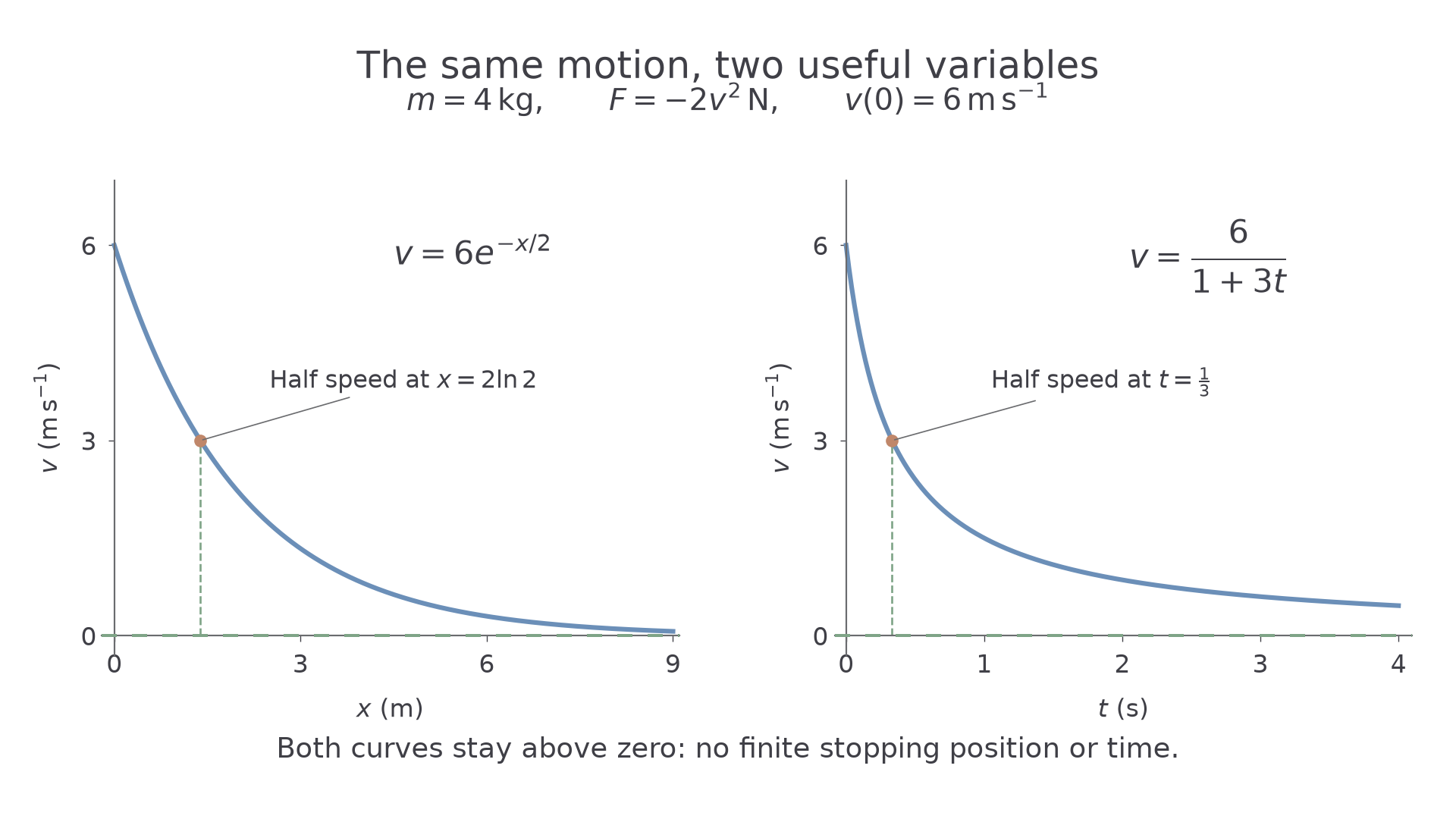
You can check the time prediction without introducing a new resistance law. Newton's law also gives , so
Thus velocity is positive for every finite as well. The exponential position solution and reciprocal time solution describe the same motion. Both are derived results for this force law and are not in the formula booklet.
Watch out
Wrong: “ means the particle stops after a sufficiently long finite time.” Right: the limit can be zero although every finite-time velocity is positive. Distinguish an approach to rest from actually reaching rest.
The first step in an OCR “show that” force model should show mass, the signed force and the chosen acceleration in the same Newton's-law equation. Clear substitution and rearrangement establish the given result.
Continue this lesson.
You’re previewing NovaLearn without an account. Create a free account to read the rest.
Create free account