4.02d - Using exponential form
Write a complex number as , keeping its modulus and angle visible, and calculate with that form. You will convert between representations, simplify products and quotients, and use conjugate exponentials to separate real and imaginary contributions.
Reading and writing exponential form
Can two non-real numbers, and , add to an integer? The notation hides their coordinates, but reveals a symmetry. By the end of the lesson you will be able to find their sum without a long decimal calculation.
You already know
Euler's formula is . Modulus-argument form is , where . Multiplication multiplies moduli and adds arguments.
For example, means . It has modulus , not , and argument . The whole belongs in the exponent.
[DIAGRAM: asset_name: Three forms of the same complex number; asset_slug: h245_4_02_exponential_forms; caption: Cartesian, trigonometric and exponential forms locate the same point; description: An equal-scale Argand diagram shows the point root 3 + i, with radius 2 and angle pi/6. A side panel aligns z = root 3 + i, z = 2(cos pi/6 + i sin pi/6) and z = 2e to the i pi/6, identifying coordinates, length and angle.]
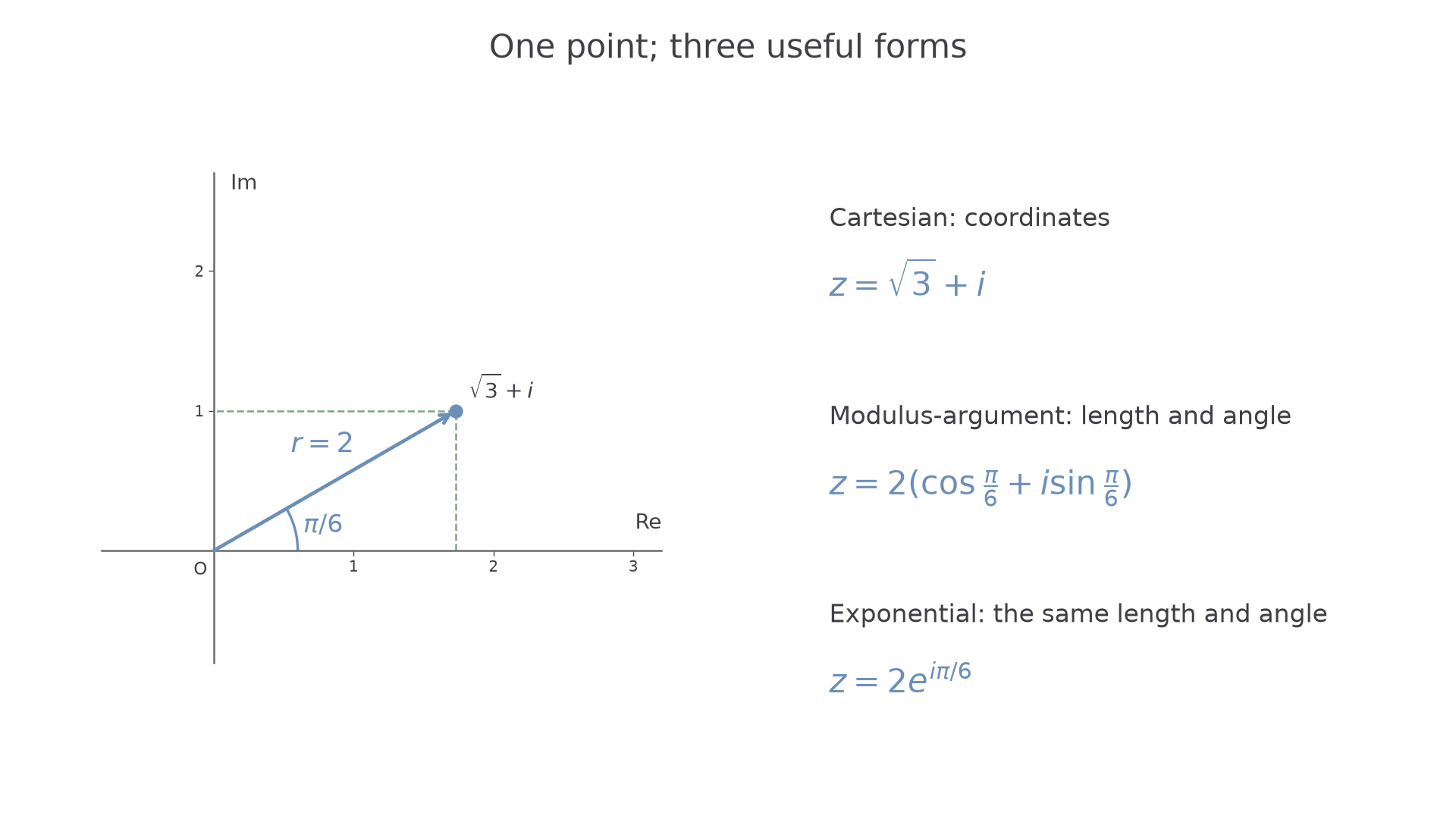
Exponential form
For a non-zero complex number with modulus and argument :
All arguments , , represent the same number. Zero can be written for any real , but has no argument.
Not in the formula booklet: learn it.
A negative coefficient in front must be absorbed into a half turn before you can read off a modulus.
Worked example 1: converting directly from trigonometric form
Question. Express in exponential and cartesian forms.
Plan. Replace the trigonometric bracket by an imaginary exponential, and use exact sine and cosine for the cartesian form.
Why this step? The modulus sits outside the exponential, and the angle goes in its exponent multiplied by .
Answer. , or .
Check. The cartesian modulus is , with a second-quadrant direction.
Change only the sign of the coefficient. Negating a vector adds a half turn to its angle; it does not make its length negative.
Worked example 2: absorbing a negative coefficient
Question. Write in the form , where , , and give its cartesian form.
Plan. Use , combine angles, and choose the principal argument.
Why this step? Reading as the modulus would violate ; shifting the angle keeps the value while making the length positive.
Answer. , or .
Check. Both cartesian coordinates are the negatives of those in Worked example 1.
Exponential form is especially economical when the angle would otherwise be written twice.
Watch out
Wrong: has modulus . Right: its modulus is , and its principal argument is . A modulus is a distance.
Use Euler's formula to check the sign of each coordinate.
Products and quotients in exponential form
The usual exponential laws make the length-and-angle arithmetic compact. Keep the real moduli separate from the imaginary exponents until the last line.
For example, . The laws are the same ones established geometrically: the complex exponents record the addition or subtraction of angles.
Products and quotients
For positive real , , and real , :
The quotient requires a non-zero denominator. For a positive integer , repeated multiplication also gives .
Not in the formula booklet: learn it.
The equivalent trigonometric power statement is printed as de Moivre's theorem in the booklet; these exponential product and quotient laws must be known.
Worked example 3: a product
Question. Let and . Determine in exponential form, with principal argument in .
Plan. Multiply coefficients, add exponents, and remove a full turn if needed.
Why this step? is an argument of the product, but the required principal interval excludes it.
Answer. .
Check. The result has modulus and points into the third quadrant, as the summed angle predicts.
Change only the operation from multiplication to division. The coefficient is divided and the second angle is subtracted.
Worked example 4: a quotient
Question. For the same , , determine in exponential form.
Plan. Divide the real coefficients and subtract the exponents in numerator-minus-denominator order.
Why this step? Multiplication by would add ; division must undo that addition.
Answer. .
Check. .
The exponent is a sum under multiplication, never a product of the angles.
Watch out
Wrong: , multiplying the exponents. Right: . Exponents add when the bases are the same.
Leave the answer in the form requested. Expanding a product into cartesian coordinates is unnecessary when exponential form is asked for.
Conjugate exponential combinations
Opposite angles give conjugate points. Adding those points cancels their imaginary parts; subtracting cancels their real parts. This is a useful way to recognise a real or purely imaginary expression before calculating it.
For a real , Euler's formula gives
Add or subtract these two lines to see the cancellation.
Adding and subtracting conjugate exponentials
For real :
These are consequences of Euler's formula, not exponential laws for adding bases.
Not in the formula booklet: learn it.
In particular, a sum of exponentials is not found by adding their exponents. The cancellation works here because of conjugation.
Worked example 5: a real sum
Question. Find the exact value of .
Plan. Factor out and combine the conjugate exponentials using Euler's formula.
Why this step? The two numbers are reflections in the real axis; their vertical contributions are equal and opposite.
Answer. , answering the opening question.
Check. The cartesian forms are and , whose sum is .
Change only the operation to subtraction. The horizontal coordinates now cancel instead.
Worked example 6: a purely imaginary difference
Question. Find the exact value of .
Plan. Factor out and use the difference of conjugate exponentials.
Why this step? Subtracting the lower point from the upper one doubles their positive vertical displacement.
Answer. .
Check. Directly subtracting the cartesian forms in Worked example 5 gives the same answer.
The surprising integer in the opening puzzle came from symmetry, so no decimal approximation was needed at any stage. These cancellations will later let you rewrite trigonometric expressions in a compact algebraic form.
Watch out
Wrong: . Right: the product is ; the sum is . At , the sum is , which immediately disproves the wrong rule.
Check whether a sum or a product is actually written before applying an exponential law.
Quick Recap
- represents length at angle ; absorb a negative coefficient into a half turn.
- Products add the angles and multiply the moduli; quotients subtract the angles and divide the moduli.
- Full turns give equivalent exponential forms, so check the requested argument interval.
- Conjugate exponential sums are real; their differences are purely imaginary or zero.
The opening sum is .