6.02d–6.02f - Kinetic and potential energy
Calculate kinetic energy from a speed or a velocity vector, and gravitational potential energy from a chosen reference level. You will interpret mechanical energy, compare energy changes and use vector constant-acceleration equations when the final velocity is not given directly.
Kinetic energy and mechanical energy
If two identical particles move equally fast in opposite directions, do their kinetic energies cancel? Their velocities point opposite ways, but their energies do not. Each moving particle has positive kinetic energy; turning a velocity arrow around does not turn its energy negative.
You already know
Speed is the magnitude of velocity. Work has units , and . Use unless a question specifies otherwise.
A moving body has an energy store associated with its motion. A body can also have potential energy associated with its position or with the configuration of a system, such as a stretched spring.
Mechanical energy
The mechanical energy of a body or modelled system is its kinetic energy plus its potential energy. Kinetic energy is associated with motion; gravitational potential energy is associated with position in a gravitational field. Thermal energy is not part of mechanical energy. For example, a moving raised load has both kinetic and gravitational potential energy; a stationary raised load has no kinetic energy.
Calculating mechanical energy is a statement about a particular state. Whether the total stays constant during motion depends on which forces act; that is the later lesson on conservation.
Kinetic energy
A particle of mass moving with speed has kinetic energy
Use mass in kilograms and speed in to obtain joules. , with exactly when the particle is at rest.
Not in the formula booklet: learn it.
The square matters: doubling speed quadruples kinetic energy, while doubling mass only doubles it. A speed increase of therefore has a larger energy effect when the particle is already travelling quickly.
Worked example 1: energy from a speed
Question. A particle of mass moves with speed . Find its kinetic energy.
Plan. Substitute the mass and the square of the speed into the kinetic-energy formula.
Why this step? Kinetic energy depends on speed squared, so would have both the wrong value and the wrong units.
Answer. The kinetic energy is .
Check. , as required.
Worked example 2 changes only the speed: it doubles. Predict the factor before calculating.
Worked example 2: doubling the speed
Question. The same particle now moves with speed . Find its kinetic energy and the increase from its previous state.
Plan. Calculate the new kinetic energy, then subtract the initial value.
Why this step? An energy change is the difference of two squared-speed expressions, not the square of the speed change.
Answer. The kinetic energy is , an increase of .
Check. , matching the predicted factor .
Keeping the two energy values separate makes the subtraction reliable.
Watch out
Wrong: . Right: . For the example above, squaring the speed increase would give , not .
Use the same particle once more, with a different final speed.
Gravitational potential energy and the datum
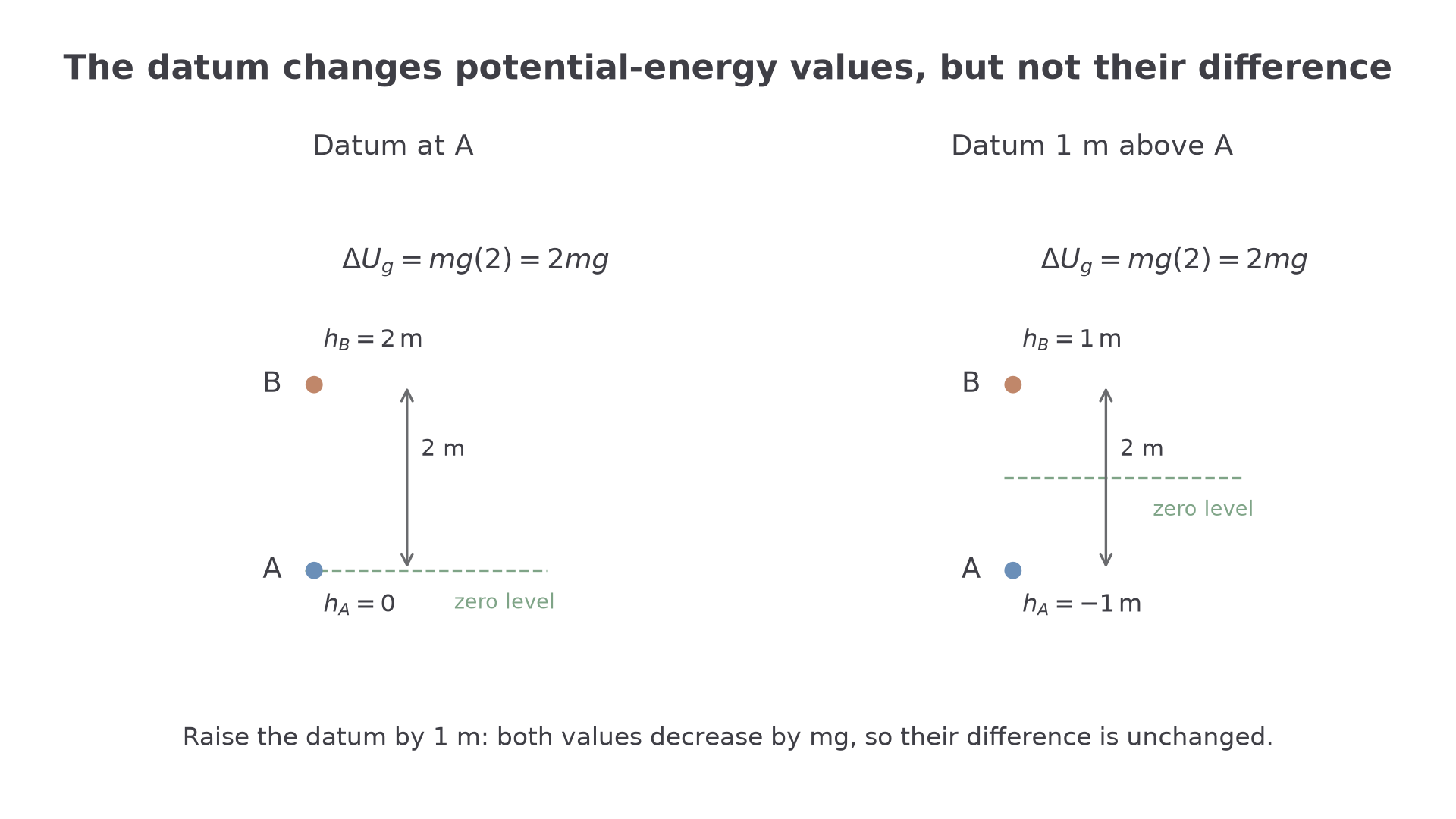
Gravitational potential energy needs a reference level, called a datum. Its value may be negative below that level; its change between two positions does not depend on the datum.
Near the Earth's surface, model gravitational acceleration as constant. Raising a mass slowly through vertical height requires work against its weight. This motivates the gravitational potential-energy expression. The relevant distance is the vertical rise, even when the body travels along an inclined or curved route.
Gravitational potential energy
With a chosen zero level and signed vertical height above it,
These expressions assume a uniform gravitational field. Potential energy is measured in joules.
Not in the formula booklet: learn it.
Changing the datum adds the same constant to every gravitational potential energy of a fixed mass. For a striking consequence, you can make the numerical mechanical energy negative by changing the zero level, without changing the particle's motion at all. Energy differences retain their meaning.
[DIAGRAM: asset_name: Two gravitational energy reference levels; asset_slug: h245_6_02_gpe_datum; caption: Changing the zero level changes both potential-energy values by the same amount, so the energy difference is unchanged; description: Two panels show the same points A and B separated by a vertical rise of two metres. In the first panel the zero level is at A and B is two metres above it. In the second panel the zero level is one metre above A, so A has height negative one metre and B positive one metre. Both panels state the potential-energy increase is 2mg.]
Worked example 3: heights from the floor
Question. A particle moves from height to height above a floor. Take gravitational potential energy to be zero at the floor. Find its initial and final gravitational potential energies and the increase.
Plan. Use the same datum for both states and subtract.
Why this step? Both potential energies must use the same zero level before they can be compared.
Answer. The potential energies are and , with an increase of .
Check. The rise is , giving .
Worked example 4 changes only the datum: put zero potential energy above the floor. The physical journey is unchanged.
Worked example 4: a negative potential energy
Question. For the same particle moving between the same two positions, take zero gravitational potential energy at height above the floor. Find the initial and final potential energies and the increase.
Plan. Express each height relative to the new datum, allowing negative values.
Why this step? A negative potential energy means a position below the chosen zero; it does not mean a negative mass or a negative speed.
Answer. The potential energies are and , again with an increase of .
Check. Each value is less than in example 3, so subtracting the pair removes the datum shift.
On a slope, calculate the vertical rise before the energy; for distance up a slope at angle to the horizontal, it is . This geometric relationship is not in the formula booklet.
Watch out
Wrong: . Right: use the signed vertical height change. A horizontal displacement has zero gravitational potential-energy change, whatever its length.
A different datum should change the two energy values together.
Continue this lesson.
You’re previewing NovaLearn without an account. Create a free account to read the rest.
Create free account