6.04e - Rigid bodies in equilibrium
Use force and moment balance for one rigid body under coplanar forces. Find support forces and a suspended body's orientation, then decide whether a body on an incline can remain at rest, slide or topple. Relate every calculation to a clear force diagram and the body's actual centre of mass.
Force balance and moment balance
A block is wide and high. It stands on a rough plane that is tilted slowly. Will it slide first, or topple first? A force calculation alone cannot answer that: it can establish whether the forces balance while missing their turning effect.
You already know
Resolve forces in two perpendicular directions. A force's moment is its magnitude times the perpendicular distance from the chosen point to its line of action. Represent the body's weight by acting at its centre of mass .
All the forces here act in one plane: they are coplanar. For equilibrium there must be no resultant force and no resultant turning effect. Two equal opposite parallel forces can have zero resultant force but still turn a body if their lines of action differ. Replacing a body by a particle would lose that distinction.
Equilibrium under coplanar forces
For a body at rest in a plane,
Choose signs for each direction and for clockwise or anticlockwise moments. The point may be anywhere: choosing a point on an unknown force's line of action removes that force from the moment equation.
Not in the formula booklet: learn it.
Put each external force on the diagram once. Forces between parts of one rigid composite body are internal, so they are not added to its external-force diagram.
[DIAGRAM: asset_name: A lamina supported by two vertical strings; asset_slug: h245_rigid_two_supports; caption: The weight acts at G, while the strings act at their attachment points; description: A rectangular sign of width 1.2 metres hangs from two vertical strings at its upper corners A and B. Upward arrows labelled T A and T B act at those corners. A downward arrow marked 58.8 newtons acts on a vertical line 0.8 metres from A through the known centre G of a non-uniform sign. Horizontal dimension arrows identify 0.8 and 1.2 metres.]
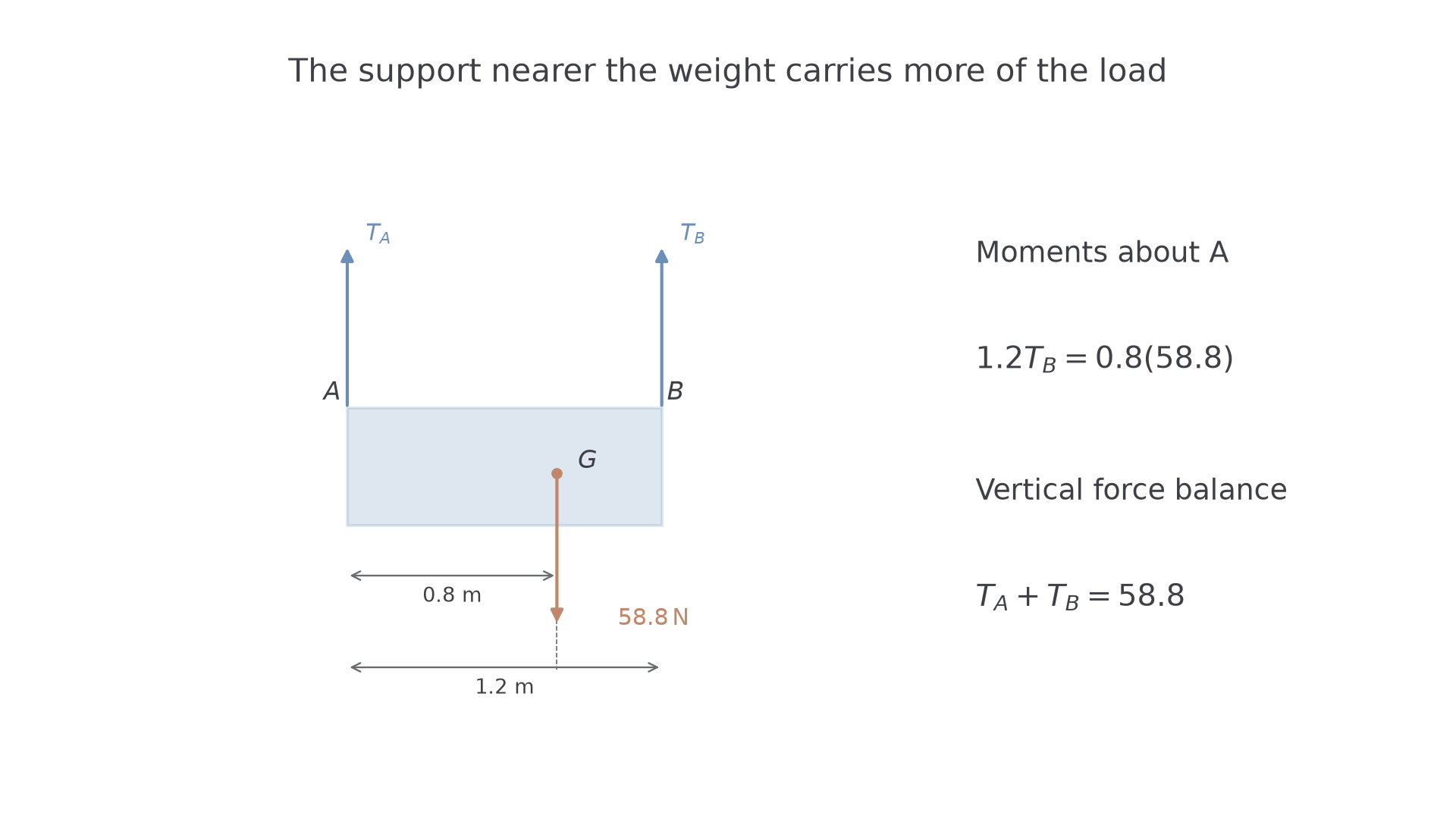
Start with a uniform sign, then change only its mass distribution.
Worked example 1: two supports share a weight
Question. A uniform rectangular sign of mass and width hangs in a vertical plane from vertical light strings at its two upper corners and . Find the tension in each string.
Plan. Use symmetry to locate the weight, take moments about , then resolve vertically.
Why this step? Taking moments about removes , whose line of action passes through ; no string length is needed.
Answer. Both tensions are .
Check. The sign's symmetry requires equal tensions, and their sum is its weight.
Keep the same total mass, outline and supports, but move the centre of mass towards . The nearer support should carry more of the weight.
Worked example 2: an off-centre weight
Question. A non-uniform sign has the same mass and supports, but the horizontal distance from to is . Find the two tensions.
Plan. Replace the weight's lever arm by , then use the same equilibrium equations.
Why this step? Moving changes the turning effect of the same weight, so total mass alone cannot determine the load on each support.
Answer. and .
Check. Moments about give , consistent with the answer.
When all non-zero moment terms involve weights, a common may cancel. When tensions or other forces are also present, every term must still have force times distance units.
Watch out
Wrong: , mixing force on one side with mass on the other. Right: . Also use the perpendicular distance to the force's line, not an arbitrary sloping distance to its application point.
Move the centre towards the left support instead.
A body suspended from one point
A body hanging freely from one point settles with its centre of mass vertically below that point. Two vertical forces, the support force and the weight, can balance both force and moment only when their lines of action coincide.
If were to one side, its weight would turn the body. If were directly above the suspension point, the exact position would balance moments but be unstable: a small disturbance would move it away. “Hangs freely in stable equilibrium” selects below the support. If the support is at , there is no preferred orientation in this ideal model. These equilibrium and stability facts are not in the formula booklet.
[DIAGRAM: asset_name: A suspended rectangle turns until G is below P; asset_slug: h245_rigid_suspension; caption: The vertical line PG determines the resting orientation; description: Two equal-scale diagrams show a uniform rectangular lamina eight units wide and six units high. In body coordinates the top edge AB is horizontal and the centre G is four units right and three down from A. The suspension point P is two units right of A. In the equilibrium diagram the lamina has rotated clockwise by arctan of two thirds, leaving PG vertical. Upward support force at P and downward weight at G share a line. The angle between AB and the horizontal is labelled theta.]
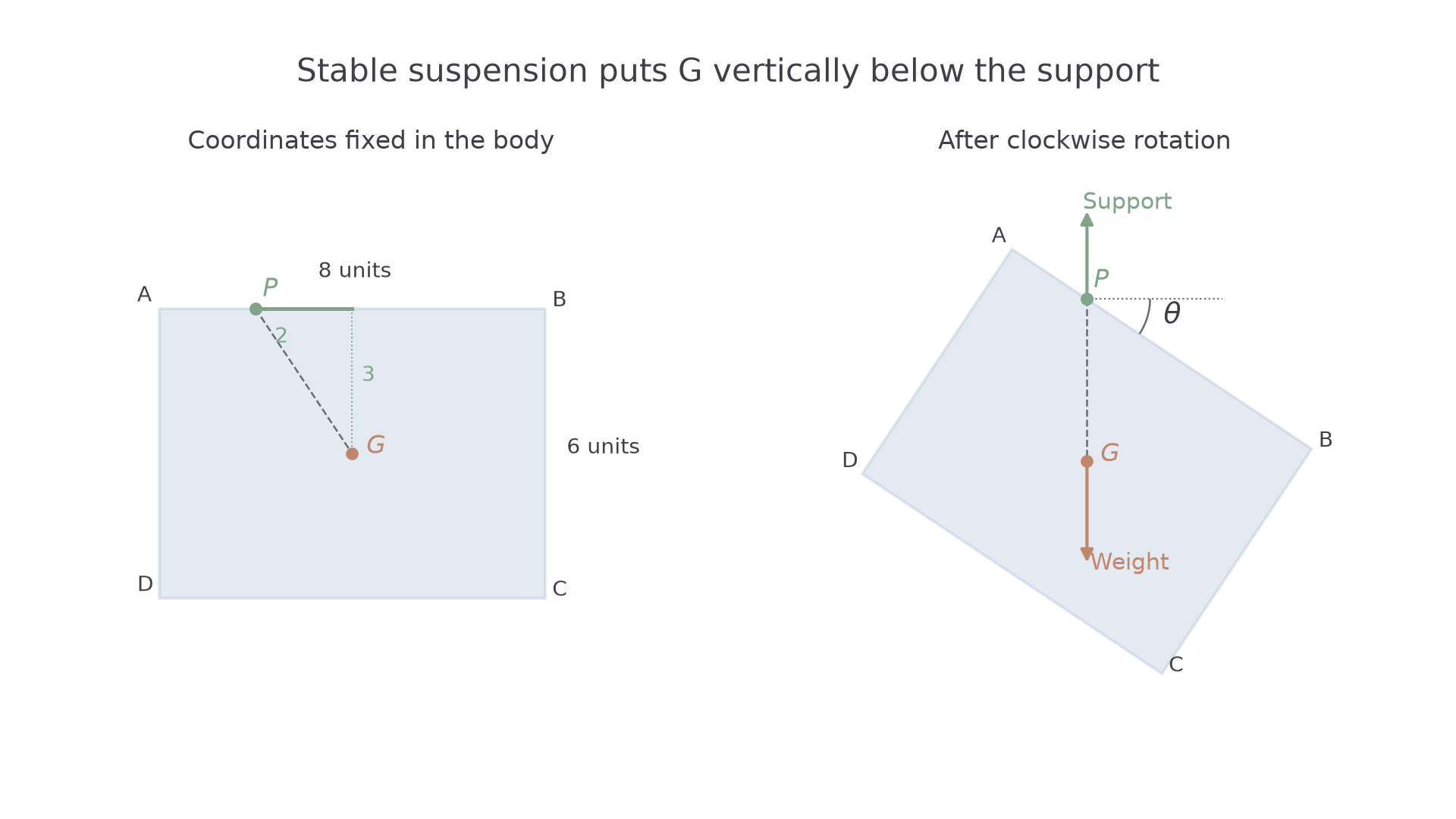
Choose coordinates fixed in the body to find the direction of . Then rotate the body until that line is vertical; do not confuse its angle with the angle asked for.
Worked example 3: suspension from a corner
Question. A uniform rectangular lamina has vertices , , and in coordinates fixed in the lamina. It hangs freely from . Find the acute angle that makes with the horizontal in stable equilibrium.
Plan. Locate , then turn vertically downwards and relate its direction to .
Why this step? The ratio gives the angle to the vertical line from the edge, not the edge's angle to the horizontal.
Answer. to three significant figures.
Check. On rotating clockwise by , the horizontal displacement of from is , so the weight passes through .
Change only the suspension point to on the top edge. The centre stays where it was in the body, but its direction from the support changes.
Worked example 4: moving the suspension point
Question. The same lamina now hangs freely from . Find the acute angle that makes with the horizontal in stable equilibrium.
Plan. Use the displacement from to , then set its horizontal component after rotation to zero.
Why this step? Distances must be measured from the actual support , so using rather than would solve the previous suspension problem.
Answer. The acute angle is .
Check. The vertical displacement after rotation is , so is below , giving the stable orientation.
This is also a practical locating method: suspend an irregular lamina from one point and mark the vertical through that point, then repeat from another point. The two marked lines meet at , provided the body and its mass distribution stay unchanged.
Watch out
Wrong: reporting the angle of to an edge when the question asks for the edge's angle to the horizontal. Right: draw the vertical through the support in the final position and label the requested angle on that diagram.
Move the support one unit farther along the same edge.
Toppling and the line of weight
A contact surface can push on a body but cannot pull it down. As the body's weight line moves towards an edge of its supporting base, the resultant contact force moves towards that edge too. Once the weight line lies beyond the base, contact forces can no longer balance its turning effect.
For a body on an inclined plane, let be its downhill contact edge in the vertical cross-section. Let have coordinate uphill along the plane and coordinate perpendicular above it. If the plane makes angle with the horizontal, the horizontal displacement of from is .
Continue this lesson.
You’re previewing NovaLearn without an account. Create a free account to read the rest.
Create free account