6.02k–6.02m - Power and driving force
Interpret power as a rate of work, calculate driving force at a given speed and find the greatest steady speed on a level or inclined road. You will also calculate instantaneous power from a variable force and a velocity vector in two dimensions, keeping the sign of the result.
Average and instantaneous power
Can an engine keep the same power while its driving force gets smaller? Yes: if the vehicle moves faster, each newton acts through more metres each second. The same work per second can then be delivered by a smaller force.
First separate an amount of work from the rate at which it is done. Two motors might each transfer , but the one that takes half as long has twice the average power.
You already know
Work is measured in joules, . The work-energy principle relates signed resultant work to the kinetic-energy change. Newton's second law is .
Power refers to a specified force or energy transfer. Engine power, power against resistance and the resultant rate of kinetic-energy change are different quantities unless the force balance makes them equal.
Power
Power is the rate at which a force does work. Average power is total work divided by the elapsed time; instantaneous power is the work rate at one instant. Its SI unit is the watt, with and . Work and power are not interchangeable: is an amount of work, while is a rate.
If is cumulative work by a specified force, the following expressions distinguish its average and instantaneous rates.
Power as a work rate
Over a time interval of duration ,
If power is constant, work done is . A force doing negative work has negative power.
Not in the formula booklet: learn it.
For example, if the numerical cumulative work in joules is , with in seconds, average power over the first is , while instantaneous power at is . The rate has increased during the interval.
Worked example 1: average power
Question. A motor does of useful work in . Find its average useful power in watts and kilowatts.
Plan. Divide useful work by elapsed time, then convert watts to kilowatts.
Why this step? The calculation uses the useful work specified, so it gives useful output power; it does not determine the motor's electrical input power.
Answer. The average useful power is .
Check. .
Worked example 2 changes only the time taken: the same work is now done in half the time.
Worked example 2: the same work more quickly
Question. The motor does the same of useful work in . Find its average useful power.
Plan. Divide the unchanged work by the new elapsed time.
Why this step? Power compares work with time. Halving the time doubles the rate without changing the work total.
Answer. The average useful power is .
Check. , the reciprocal of the time factor .
An average alone does not tell you how power varied within the interval.
Watch out
Wrong: , with units written as watts. The product has units , which are not power units. Right: average power is , with units .
Keep work and elapsed time visible in your next calculation.
Driving force and acceleration
When a driving force acts along the velocity, its instantaneous power is force multiplied by speed. This gives the driving force at the specified instant, not the resultant force on the vehicle.
In a short time , a vehicle moving at speed travels approximately . A forward force then does approximately work. Dividing by and taking the instantaneous limit gives .
Power and tractive force
For a tractive force acting in the direction of velocity of speed ,
Use in watts and in to obtain in newtons. The resultant force must still include resistance and any component of weight.
Not in the formula booklet: learn it.
At fixed positive power, doubling speed halves the available driving force. The ideal constant-power formula cannot describe the instant of starting from rest: is undefined at , and real engines have force limits.
Worked example 3: the driving force is not the resultant
Question. A vehicle of mass moves along a straight horizontal road against constant resistance . Its engine supplies . Find its acceleration when its speed is .
Plan. Use power and speed to find driving force, then subtract resistance before applying Newton's second law.
Why this step? The engine's is only one force. Resistance reduces the resultant to .
Answer. The acceleration is , to 3 significant figures.
Check. Power used against resistance is . The remaining equals .
Worked example 4 changes only the speed. With the same engine power, the available driving force decreases.
Worked example 4: faster motion at the same power
Question. For the same vehicle, resistance and engine power, find the acceleration when the speed is .
Plan. Recalculate driving force at the new speed before resolving forces.
Why this step? Constant power does not mean constant driving force or constant acceleration. You must use the speed at the instant asked for.
Answer. The acceleration is , to 3 significant figures.
Check. The remaining power is , agreeing with .
That declining acceleration leads to a greatest steady speed when the available forward force just balances the opposing forces.
Watch out
Wrong: using engine power when resistance is present. Right: engine power is , while on this level road. The difference is the rate of kinetic-energy increase.
Change the instantaneous speed once more.
Greatest steady speed on a slope
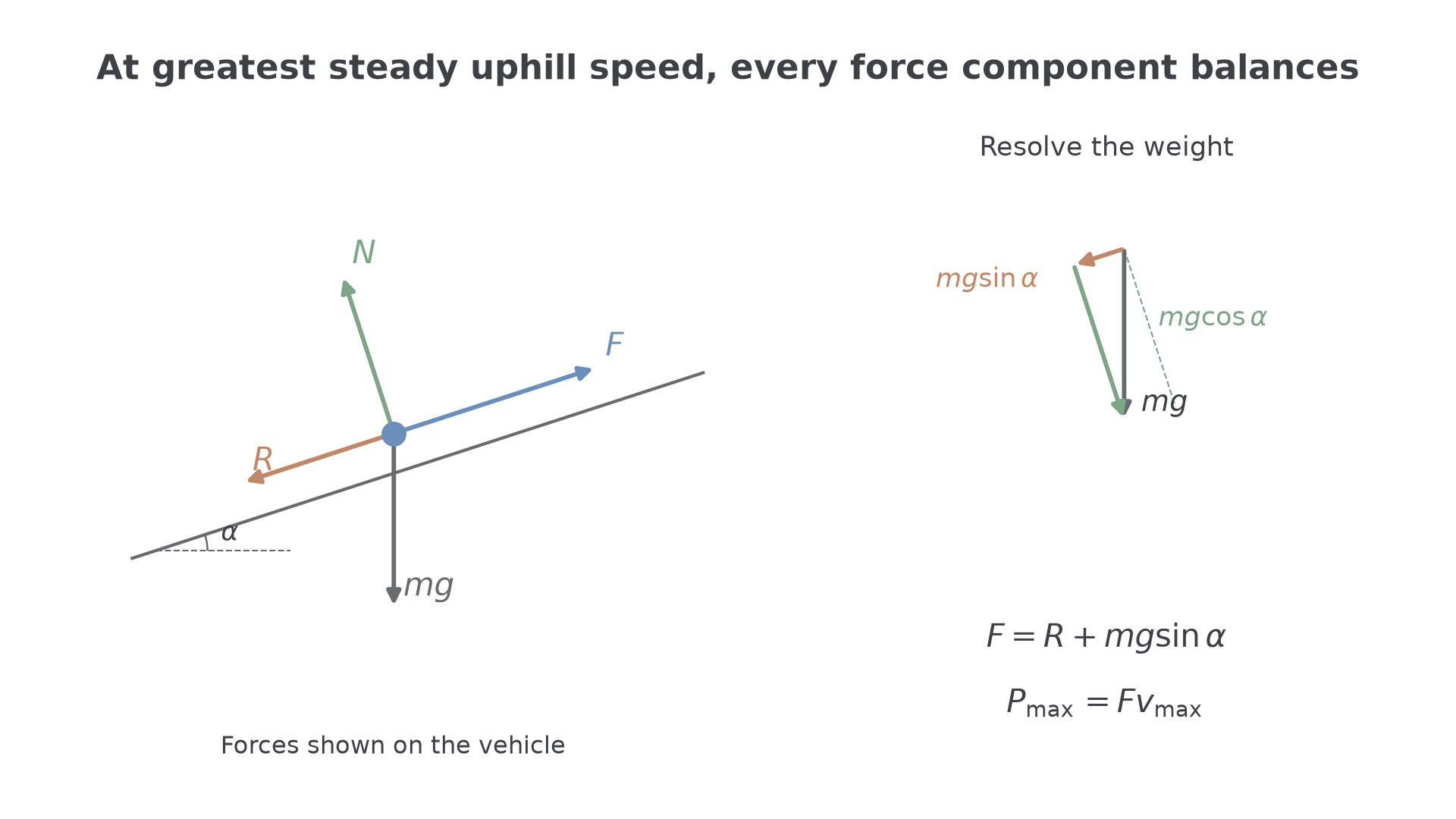
A greatest steady speed is found from zero acceleration at the maximum available power, with all forces resolved along the road.
For a road inclined at angle to the horizontal, weight has component down the road and perpendicular to it. For a vehicle moving straight along the road without perpendicular acceleration, the normal contact force is , if there are no other perpendicular forces. These resolving results are assumed mechanics and are not in the formula booklet.
[DIAGRAM: asset_name: Driving force and resistance on an inclined road; asset_slug: h245_6_02_power_incline; caption: For uphill motion, both resistance and the component mg sin alpha oppose the driving force; description: An inclined straight road rises to the right at angle alpha above the horizontal. A vehicle is shown with blue driving force F up the road, clay resistance R down the road, vertical weight mg downward, and a sage normal reaction perpendicular to the road. A separate component sketch resolves weight into mg sin alpha down the road and mg cos alpha into the road. A panel states at greatest steady uphill speed, F equals R plus mg sin alpha, and maximum power equals Fv.]
Continue this lesson.
You’re previewing NovaLearn without an account. Create a free account to read the rest.
Create free account