4.02s - Using roots of unity
Use the roots of to describe regular polygons, prove sums of roots and their real parts, and calculate sides, diagonals and exact trigonometric values. Algebra and symmetry will explain why a regular pentagon contains the golden ratio.
Roots of unity as repeated rotations
Why is a diagonal of a regular pentagon times as long as a side? A pentagon does not look like a quadratic equation, but its vertices supply one.
Begin with the fifth roots of 1. One is 1 itself. The others are reached by repeatedly turning through around the unit circle:
Their fifth powers are all 1, because their arguments become integer multiples of . Joining them in order gives a regular pentagon with centre .
You already know
The roots of a non-zero complex number have the same modulus and spacing . Multiplication by a unit complex number is a rotation about ; the angle added is its argument.
For roots of 1, the common modulus is 1 and the first angle is 0. It is useful to name the first anticlockwise step .
Roots of unity
The nth roots of unity are the solutions of . For , put ; the complete set is . For example, the fourth roots of unity are . The number 0 is not a root of unity.
The exponential list is supplied in the booklet.
Roots of unity
For a positive integer ,
are the distinct solutions of .
In the formula booklet.
With , multiplication by moves one vertex anticlockwise to the next. Also , so reduce powers modulo : for fifth roots, . The inverse and conjugate coincide, since :
This relation is not separately printed in the formula booklet; it follows from . More generally, , with exponents understood modulo .
[DIAGRAM: asset_name: Fifth roots of unity form a pentagon; asset_slug: h245_4_02s_pentagon_unity; caption: Multiplication by omega moves one vertex anticlockwise around the regular pentagon; description: Equal-scale Argand axes labelled Re and Im with origin O and a unit circle. The five blue vertices are labelled 1, omega, omega squared, omega cubed and omega to the fourth. Sage dashed lines pair omega with omega to the fourth and omega squared with omega cubed across the real axis. One clay side from 1 to omega and one blue diagonal from 1 to omega squared are distinguished, and an arc marks the central angle 2pi/5]
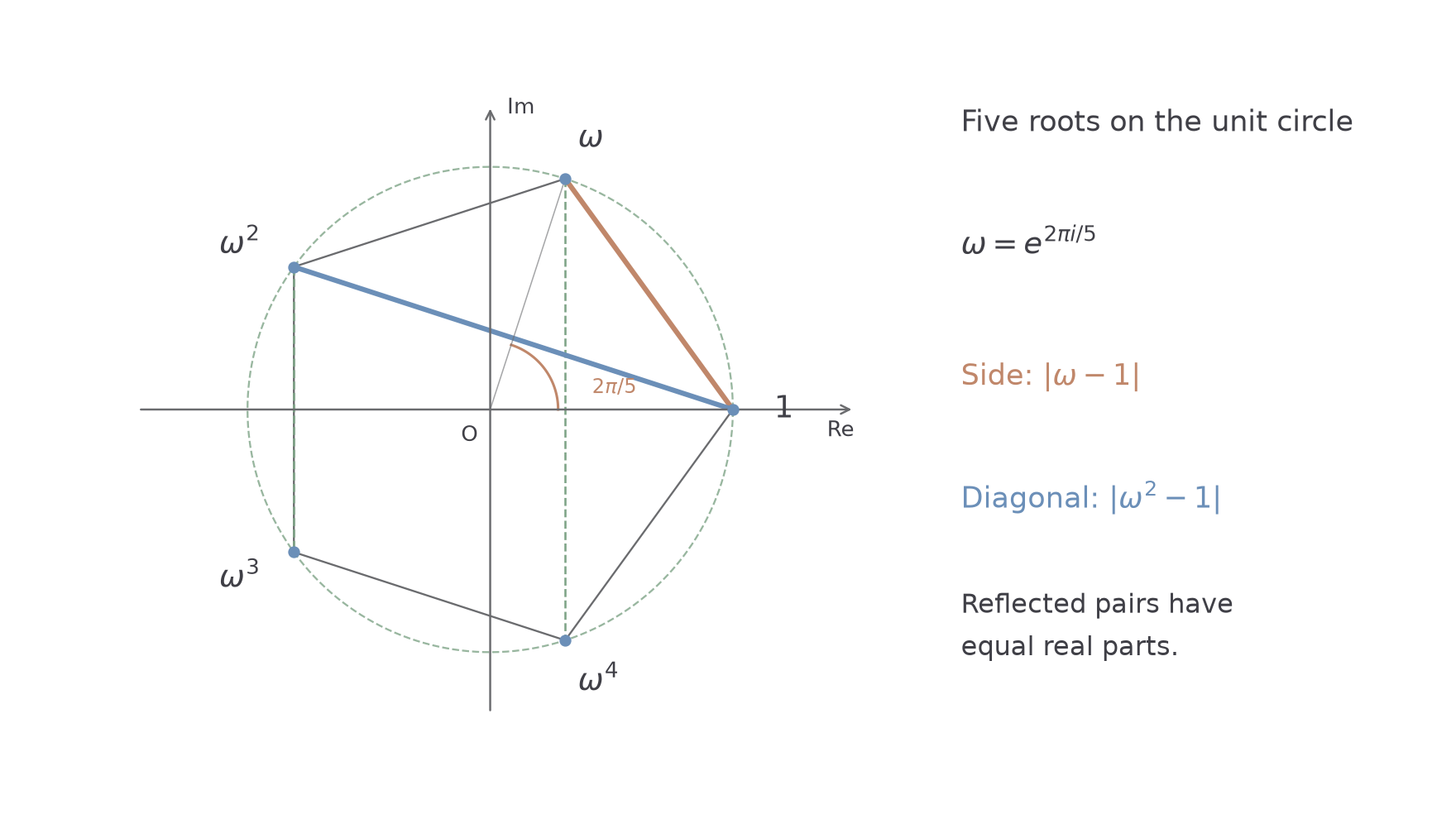
Choose the step carefully: is a sixth root of unity, but its powers reach only three of the six vertices. The choice always reaches every vertex.
Key idea
Roots of unity turn the geometry of a regular polygon into powers of one complex number; multiplication moves around the vertices and conjugation reflects them.
Reflection preserves a vertex's real part and reverses its imaginary part; it does not negate the whole vertex.
Sums of roots and their real parts
The complete set of roots of unity sums to zero when , so the real coordinates sum to zero and the imaginary coordinates sum to zero.
Let , where . This is a GP:
The denominator is non-zero because . Geometrically, the vertex position vectors balance around . Taking real and imaginary parts is legitimate because addition adds the coordinates separately.
Sum of all roots of unity
For and ,
Consequently,
Not in the formula booklet: learn it.
The exception has only the root 1, whose sum is 1. Also, a partial list does not generally sum to zero: for example, although both terms are fourth roots of unity.
Worked example 1: the real parts of fifth roots
Question. By considering the fifth roots of unity, determine
Plan. Sum all five roots, take real parts, and pair the reflected vertices.
The conjugate pairs have equal real parts:
Why this step? Reflection in the real axis duplicates each non-real vertex's horizontal coordinate, so five terms collapse to a constant and two doubled cosines.
Answer. .
Check. The two cosines are approximately and , whose sum is .
Worked example 2 changes only the number of vertices, from five to seven. There are now three conjugate pairs.
Worked example 2: the real parts of seventh roots
Question. By considering the seventh roots of unity, determine
Plan. Take real parts of the complete root sum, pair with , and divide by 2.
Why this step? An odd number of roots leaves 1 on its own, while all the other roots are in reflected pairs. The answer is unchanged even though the individual cosines are different.
Answer. .
Check. The three values are approximately , and , which sum to .
These exact cosine sums are consequences of the root sum, not separate formula-booklet entries. For even , remember the real root as well as 1 when pairing the remaining roots.
Watch out
Wrong: the non-real nth roots alone sum to zero. The zero sum uses every root, including 1 and, when is even, . Right: start with the complete list before deleting or pairing terms.
With nine vertices there are four conjugate pairs and the same single unpaired root 1.
Sides and diagonals as complex differences
The distance between vertices represented by and is , so subtracting roots of unity measures sides and diagonals directly.
For the unit-circle points 1 and , centre the difference:
Taking moduli gives , since . This is the same chord length you get by splitting an isosceles triangle into two right-angled triangles.
A chord between roots of unity
For and ,
The sine is positive because . On a circle of radius , multiply this length by .
Not in the formula booklet: learn it.
For any pair of vertices , , factor out . Its modulus is 1, so the distance is still . The chord depends on the number of steps between vertices, not the starting vertex.
Worked example 3: a pentagon side
Question. The fifth roots of unity are vertices of a regular pentagon. Find the exact length of one side.
Plan. Take the adjacent vertices 1 and , and calculate their difference's modulus.
Why this step? Subtraction describes the displacement along the side, whereas the modulus of either vertex alone is just its radius from .
Answer. .
Check. Numerically , shorter than the diameter 2, as a pentagon side must be.
Worked example 4 changes only the step between vertices, from one step to two. The chord is now a diagonal.
Worked example 4: a pentagon diagonal
Question. Find the exact length of a diagonal of the same pentagon.
Plan. Use vertices 1 and and take the modulus of their difference.
Why this step? The angle between the radii doubles, so the half-angle inside the chord formula changes from to .
Answer. .
Check. , longer than the side and still shorter than the diameter. Vertices three steps apart give the same length because .
The ratio is already simple:
This follows from the double-angle sine identity. It is not a separate formula-booklet result; the next part finds its exact value.
Watch out
Wrong: the distance between two unit roots is 1 because both have modulus 1. Their moduli measure distances from , not from each other. Right: subtract the vertices, then take the modulus.
The same difference method works with another regular polygon; only the angular step changes.
Exact values from the pentagon
The fifth-root sum links two cosines; a double-angle identity turns that link into a quadratic equation.
From the second part,
Either cosine can be used as the unknown. The two values are the two roots of the same quadratic, and the diagram chooses the correct sign.
Worked example 5: the first vertex's real part
Question. Using the fifth roots of unity, determine the exact value of .
Plan. Put , use , and solve the quadratic from the root sum.
Why this step? The angle is in the first quadrant, so its cosine is positive. Only one quadratic root fits the geometry.
Answer. .
Check. , matching the first vertex's real coordinate. Substitution into gives zero exactly.
Worked example 6 changes only the chosen vertex from to . The quadratic is unchanged, but the sign selection reverses.
Worked example 6: the second vertex's real part
Question. Using the fifth roots of unity, determine the exact value of .
Plan. Put , express using the double angle of , and choose the negative quadratic root.
Why this step? The second vertex lies to the left of the imaginary axis, so its real part is negative; the negative quadratic root is required.
Answer. .
Check. Its approximate value is . Adding it to gives , agreeing with the earlier root sum.
These exact values are derived results, not printed in the formula booklet. To finish the opening question, is acute and
Therefore the pentagon's diagonal-to-side ratio is , the golden ratio. Scaling or rotating the pentagon does not change that ratio.
Watch out
Wrong: keeping both signs from the quadratic gives two possible values of . An angle has one cosine value. Right: use its quadrant to select the sign, and state that reason in a “determine” question.
For exact lengths on a larger circle, squared distances avoid nested square roots: . This is the squared chord formula, derived here rather than supplied separately in the booklet.
Quick Recap
- The nth roots of unity are , with ; they form a regular polygon when .
- For , all roots sum to zero. Taking real and imaginary parts gives trigonometric sums.
- Conjugate vertices have equal real parts; use their symmetry to pair cosine terms.
- Sides and diagonals are moduli of differences, and their lengths depend on the vertex step.
- A root sum combined with a multiple-angle identity can determine exact trigonometric values.
The opening pentagon has diagonal-to-side ratio , obtained from the geometry and algebra of its five roots.