6.03a–6.03d - Momentum and its conservation
Use signed velocities to calculate momentum in one dimension, then extend the idea to vectors in a plane. You will apply conservation of momentum to two particles, recognise the assumptions that make it valid, and distinguish a conserved vector from a conserved speed or kinetic energy.
Momentum has a direction
Can two moving particles have zero total momentum? A particle of mass moving right at and one of mass moving left at will answer that question by the end of this lesson. Neither particle is stationary, so “zero” needs some care.
You already know
Velocity includes direction; speed is its magnitude. In one dimension, choose a positive direction and keep it throughout. Newton's second and third laws describe resultant forces and equal and opposite interaction forces.
A light ball and a heavy ball travelling at the same velocity are not equally easy to stop. Momentum combines the mass and the velocity in one quantity.
Linear momentum
The linear momentum of a particle is its mass multiplied by its velocity. It is a vector, with the same direction as the velocity when the mass is positive. For example, a particle moving left has negative momentum if right is positive. A particle at rest has zero momentum; a particle moving left does not have “negative speed”.
In a straight line, a signed scalar contains all the direction information you need.
Momentum in one dimension
For a particle of constant mass , moving with signed velocity ,
The SI unit is . Its magnitude is .
Not in the formula booklet: learn it.
Multiplying by mass changes the size of the velocity, but keeps its sign.
Worked example 1: motion in the positive direction
Question. Right is positive. Find the momentum of a particle of mass moving right at .
Plan. Write the signed velocity before multiplying by the mass.
Why this step? A speed becomes a signed velocity only after you use the chosen positive direction.
Answer. The momentum is , to the right.
Check. Dividing by recovers .
Change just the direction of motion. The magnitude of the momentum stays the same, while its sign changes.
Worked example 2: the same speed in the opposite direction
Question. Right is positive. Find the momentum of a particle of mass moving left at .
Plan. Give the velocity a negative sign, then use .
Why this step? The sign records the direction in the calculation; a final description must agree with it.
Answer. The momentum is , or magnitude to the left.
Check. Reversing the direction twice returns the original momentum.
The mass is always positive; the direction comes from the velocity.
Watch out
Wrong: a leftward speed of means when right is positive. Right: use , so . Dropping the sign loses the direction.
Practise keeping the sign and the unit together.
Momentum in a plane
In two dimensions there is no single positive direction that describes every motion, so keep both velocity components.
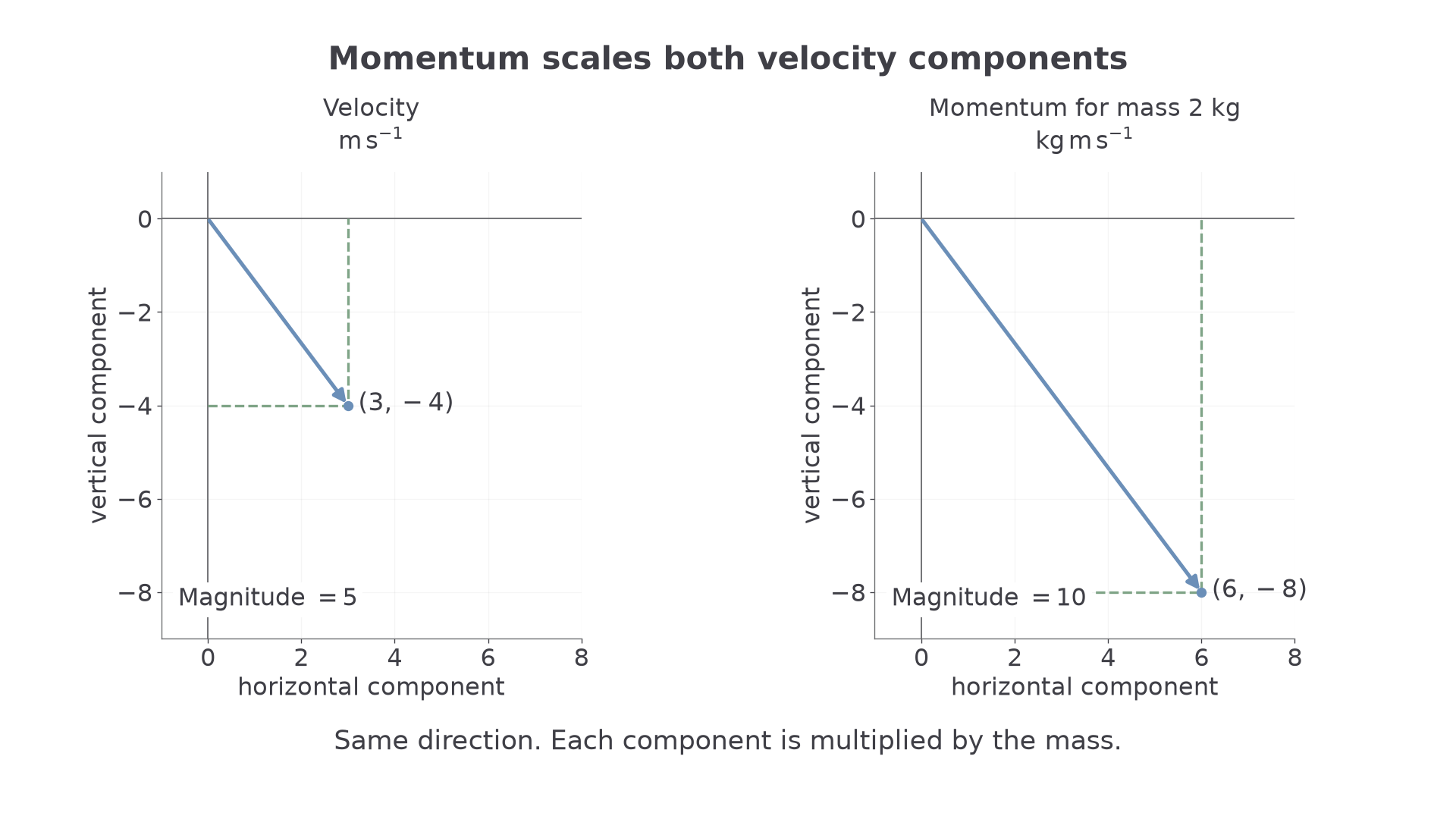
A particle of mass with velocity has momentum . The momentum arrow is parallel to the velocity arrow. Its magnitude is not the sum of its components.
[DIAGRAM: asset_name: Momentum scales a velocity vector; asset_slug: h245_6_03_momentum_vectors; caption: Multiplication by mass scales both velocity components and preserves the direction; description: Two separate equal-scale coordinate panels show velocity (3,-4) in metres per second and momentum (6,-8) in kilogram metres per second for a mass of 2 kg. Blue arrows point down and right, with dashed component guides. The velocity has magnitude 5 and the momentum has magnitude 10. The panels have separate unit labels so that quantities of different dimensions are not plotted on one physical scale]
Momentum in two dimensions
For constant mass and velocity ,
The momentum vector has unit .
Not in the formula booklet: learn it.
Calculate the vector first if the question also asks for its magnitude or direction.
Worked example 3: vector and magnitude
Question. A particle of mass has velocity . Find its momentum and the magnitude of its momentum.
Plan. Multiply each component by the mass, then use Pythagoras.
Why this step? Momentum is a vector, so Pythagoras is applied after forming its perpendicular components.
Answer. , with magnitude .
Check. Speed is , so mass times speed is .
Change only the sign of the vertical velocity component. The direction changes, but the magnitude does not.
Worked example 4: reflecting the direction
Question. A particle of mass has velocity . Find its momentum and the magnitude of its momentum.
Plan. Scale both components, then find the length of the resulting vector.
Why this step? A reflection changes one component's sign, so squaring the components gives the same magnitude.
Answer. , with magnitude .
Check. The momentum is now above the horizontal, as is the velocity.
A direction cannot be recovered from a magnitude alone.
Watch out
Wrong: . A magnitude is non-negative. Right: . Also remember the mass: is speed, not momentum.
The next question changes the numbers and puts the horizontal component in the negative direction.
Conservation in a straight line
When two particles interact, their individual momenta can change while their total momentum stays fixed.
During an interaction, the force of on and that of on are equal and opposite. For constant masses, Newton's second law gives
The internal forces cancel in this sum. If the resultant external force is zero, the total is constant. During a brief collision, conservation is also a good approximation when external effects over the short collision time are negligible. A smooth horizontal surface is a standard model: weight and the normal reaction balance vertically, and there is no horizontal friction.
Continue this lesson.
You’re previewing NovaLearn without an account. Create a free account to read the rest.
Create free account