4.04b - Equations of planes
Describe a plane using two directions within it or one direction perpendicular to it. You will construct and convert all four plane forms, and verify that apparently different equations describe the same set of points.
A point and two directions
A triangular panel has corners , and . Can one equation describe the whole flat surface through the panel, including the points beyond its edges? A line needs one direction of travel; a plane needs two independent directions.
You already know
A line is . Subtract position vectors to obtain a displacement. Two non-parallel vectors have a non-zero vector product perpendicular to both.
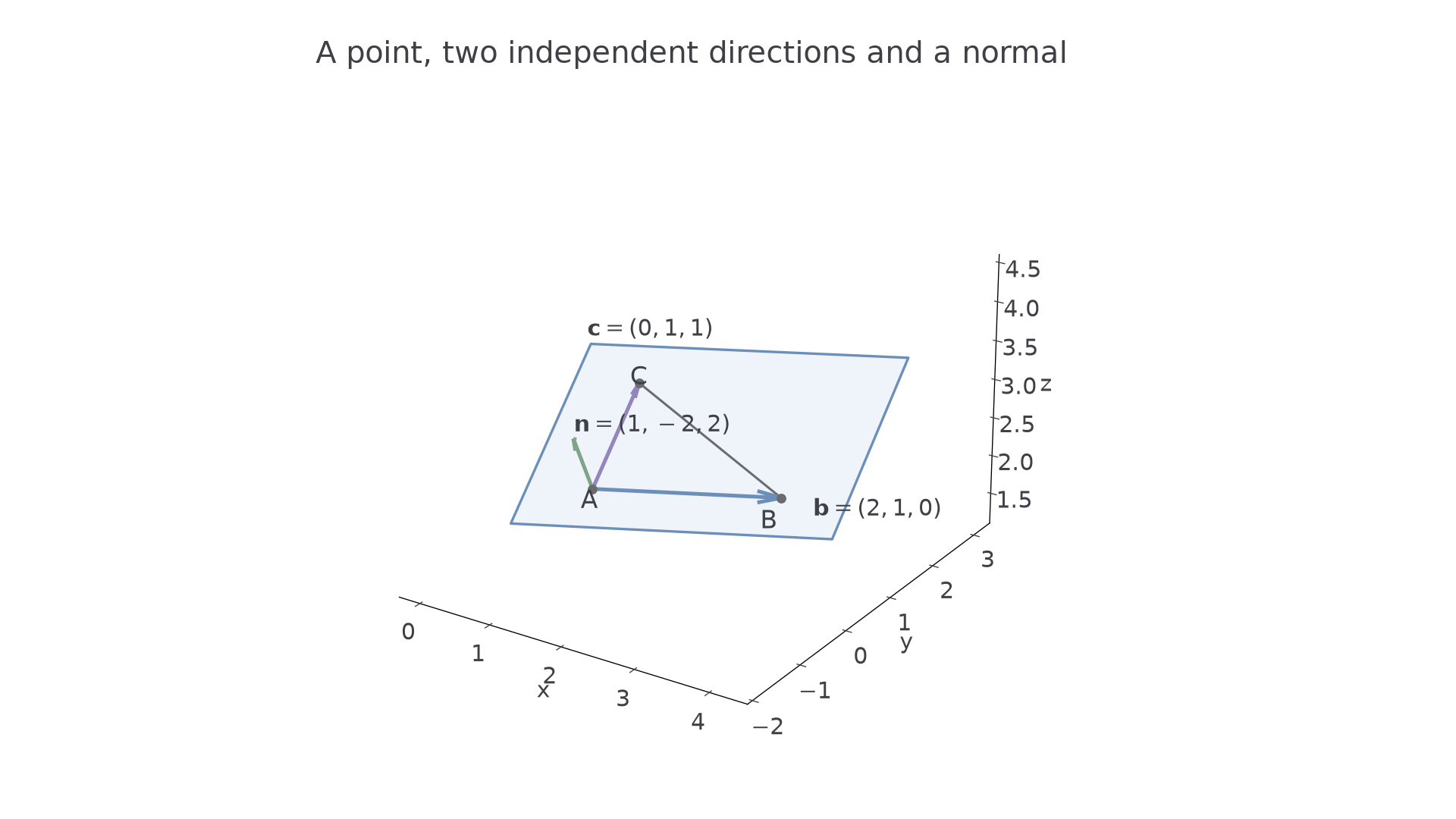
From , the displacements and point along two edges. Move any real multiple of the first and then any real multiple of the second. These moves fill a plane, because the two directions are not parallel. The parameters vary independently: there is no requirement that they add to 1.
[DIAGRAM: asset_name: Two directions determine a plane; asset_slug: h245_4_04b_plane_directions; caption: Two independent directions fill the plane, and a normal points out of it; description: Exact three-dimensional diagram of a plane through A=(1,0,2), with arrows b=(2,1,0) and c=(0,1,1) from A to B and C, and a normal arrow n=(1,-2,2). A pale plane patch extends beyond the triangle ABC.]
Parametric vector equation of a plane
A plane through , parallel to two non-parallel non-zero vectors and , has equation
For example, describes the panel's whole plane. Parallel direction vectors would give only a line, not a plane.
This parametric plane form is not in the formula booklet: learn it. Three non-collinear points fix exactly one plane; three collinear points do not. A useful consequence is that a plane has infinitely many pairs of spanning directions: and work just as well as and . Indeed, , which produces every original combination.
Worked example 1: three non-collinear points
Question. Find a vector equation of the plane through , and .
Plan. Use as the starting point and the two edge displacements as directions.
Why this step? The displacement vectors lie in the required plane; the position vectors of and need not be parallel to it.
Answer. The displayed equation, with .
Check. Parameter pairs , and give , and . The directions are not proportional, so they span a plane.
Worked example 2 changes one feature: the third point moves onto the line through the first two. Checking independence now prevents a false plane equation.
Worked example 2: when three points are insufficient
Question. Do , and determine a unique plane? Justify your answer.
Plan. Compare the two displacements from .
Why this step? Two parameters do not guarantee two independent directions: here they combine into a single line parameter.
Answer. No. The points are collinear, so infinitely many planes contain them.
Check. Both and contain all three points, and they are different planes.
The condition on the directions is as important as the form of the equation.
Watch out
Wrong: using three given position vectors as though the last two were edge displacements. Right: subtract one chosen point from the other two before using them as spanning directions.
Try the boundary case again with a different third point.
Normal and cartesian equations
A normal vector replaces two directions within a plane with one direction perpendicular to the entire plane.
For the panel, is perpendicular to both edge directions: and . If is any point in the plane, its displacement from is perpendicular to . Hence its scalar product with is zero.
Normal vector
A normal vector to a plane is a non-zero vector perpendicular to every direction in the plane. For , a normal is . For example, is normal to . A vector joining the origin to a point on the plane is not generally a normal.
Expanding the zero scalar product turns a geometric statement into either of the normal forms below.
Normal forms of a plane
For a non-zero normal and a point on the plane,
Neither normal form is printed in the formula booklet.
Not in the formula booklet: learn it.
Writing and gives the cartesian form , with . The booklet prints the equivalent form ; its constant is the negative of the right-hand constant. That cartesian plane form is in the formula booklet. At least one coefficient must be non-zero. The equation describes all of space, and describes no points.
Worked example 3: a point and a normal
Question. Find all three normal/cartesian forms of the plane through with normal .
Plan. Use the displacement form, then expand its scalar product.
Why this step? The normal determines the orientation; the scalar product of the given point determines which parallel plane is required.
Answer. The three displayed forms describe the same plane.
Check. Substituting gives , and the cartesian coefficients reproduce the given normal.
Worked example 4 changes one feature: the normal is multiplied by . Both sides of the scalar-product equation must scale together.
Worked example 4: rescaling the normal
Question. Find a cartesian equation of the plane through normal to . Is it the plane in Worked example 3?
Plan. Calculate the right-hand constant with the new normal, then simplify the entire equation.
Why this step? Scaling the normal alone but leaving the constant unchanged would move the plane. Scaling the whole equation preserves its points.
Answer. , equivalent to the same plane .
Check. The new equation's left side is exactly times the old left side and .
A normal can point either way and have any non-zero length.
Watch out
Wrong: reading as . Right: move the constant first, giving .
This is the same sign choice you make when moving a constant in an ordinary equation.
Converting between plane forms
To convert a two-direction equation to a normal equation, construct a vector perpendicular to both directions; to go back, choose one point and two independent displacements perpendicular to the normal.
For , the vector supplies a normal. This use of the supplied vector-product formula needs no result about its magnitude. A non-zero product also confirms that the directions span a plane. Conversely, in , choose two coordinates freely and solve for a coordinate whose coefficient is non-zero. The two free coordinates become the two parameters.
Worked example 5: parametric to cartesian
Question. Determine a cartesian equation of
Plan. Find a normal using the vector product, then substitute the starting point.
Why this step? A normal must be perpendicular to both spanning directions. Either one alone would leave many possible normals.
Answer. .
Check. For a general parametric point,
so every generated point satisfies the equation.
Worked example 6 changes one feature: the same plane is supplied in cartesian form instead. Now expose its two free coordinates rather than searching for a normal.
Worked example 6: cartesian to parametric
Question. Express in the form .
Plan. Let , and rearrange for .
Why this step? Every choice of fixes exactly one ; allowing all real therefore includes the entire plane.
Answer. The displayed parametric equation, with .
Check. The two directions are independent and both have scalar product zero with ; the starting point satisfies the cartesian equation.
The two different starting points and direction pairs in these examples describe the same plane. The general substitution proves it more convincingly than checking a single convenient point.
Exam tip
To verify a cartesian equation from a parametric plane, substitute the general coordinates and show that both parameters cancel. One point verifies membership of that point, not the identity of two planes. Alternatively, check three non-collinear generated points.
If one cartesian coefficient is zero, choose the free coordinates accordingly. For , let , giving . No division by a zero coefficient is needed. The panel's opening plane is now described in all four forms: parametric, displacement-normal, scalar-product and cartesian.
Quick Recap
- A plane needs a point and two non-parallel directions, or a point and a non-zero normal.
- The forms and express the same perpendicularity condition.
- Cartesian coefficients give a normal; moving the constant across the equals sign changes its sign.
- Use a vector product to convert to a normal, and two free coordinates to convert back.
The panel's whole plane is , equivalently for all real .