7.08a–7.08d - Zero-sum games and pure strategies
Read a pay-off matrix, convert a constant-sum game to zero-sum form and remove dominated choices. You will find play-safe strategies, decide whether a game is stable and identify a Nash Equilibrium by checking whether either player would benefit from changing their own choice.
Pay-offs and zero-sum conversion
Two players share ten points after choosing simultaneously: can a game whose scores always add to ten be analysed as a zero-sum game, and can both players settle on one choice? Suppose A chooses a row and B chooses a column. The table gives A's points; B receives the rest of the ten.
| A's choice | B chooses X | B chooses Y |
|---|---|---|
| P | ||
| Q |
If A chooses P and B chooses Y, their scores are and . A wants a larger entry; B wants a smaller entry because that leaves B more points. Both choices are made without seeing the other player's current choice.
You already know
Subtracting the same constant from every number preserves their order. For example, and . Multiplying an inequality by reverses its direction.
A pay-off measures the outcome for a specified player. It may be negative: winning points means losing points.
Zero-sum game
In a two-person zero-sum game, the two players' pay-offs add to zero for every pair of choices. A pay-off of for A means a pay-off of for B. A pay-off matrix records one player's pay-offs, with the players' choices labelling its rows and columns. For example, A's pay-off means B gains , not that both players lose .
You must establish whose pay-offs the entries represent before comparing them. In an A pay-off matrix, A maximises and B minimises. If the two original pay-offs always add to a constant , subtracting from each player's pay-off makes their sum zero without changing either player's preferences.
Converting a constant-sum game
If the original pay-offs satisfy for every outcome, define
The transformed game has the same best choices as the original game. Recover an original pay-off by adding .
Not in the formula booklet: learn it.
The subtraction changes the reference point for a score. A transformed score of zero means an equal share, rather than no points at all.
Worked example 1: sharing ten points
Question. Convert the opening game to zero-sum form. Interpret the transformed outcome when A plays Q and B plays Y.
Plan. Subtract half the total from each player's score and display A's transformed matrix.
Why this step? B's transformed score is , so the transformed scores are opposites.
Answer. The displayed matrix represents the equivalent zero-sum game. At , both transformed pay-offs are ; both original scores are .
Check. At , A's transformed score is and B's is . Adding gives the original scores and , whose sum is .
The next example changes only the total prize, from ten points to twelve. A's original matrix stays the same, so the correct reference point changes but A's preferences do not.
Worked example 2: changing the total prize
Question. A's original pay-off matrix is still , but the players now share twelve points. Convert the game to zero-sum form and interpret outcome .
Plan. Subtract from both original scores, rather than reusing the previous subtraction of .
Why this step? Zero-sum conversion must use the constant total for this game. A's score of is now below an equal share.
Answer. At , the transformed pay-offs are for A and for B. The original scores are and .
Check. , while . A still prefers Q to P when B chooses Y, because .
Even adding to every entry of A's matrix would leave all comparisons between A's choices unchanged. What matters for the choices is the difference between pay-offs, not the reference score.
Watch out
Wrong: “Every two-person game can be made zero-sum by subtracting one constant.” This works for a constant total. If the totals vary between outcomes, subtracting one fixed amount from both players cannot make every total zero.
Keep the original and transformed scores distinct in your answer.
Dominance and matrix reduction
Some choices are never better than another available choice, whatever the opponent does. Removing such a choice can make a large game much smaller.
For A, compare entries in the same column: a row containing larger pay-offs is preferable. For B, compare entries in the same row: a column containing smaller A pay-offs is preferable. The directions differ because every gain for A is a loss for B.
Dominance
One strategy dominates another if it gives its player at least as good a pay-off against every opposing strategy, and a strictly better pay-off against at least one. If every comparison is strict, it is strict dominance; otherwise it is weak dominance. In an A pay-off matrix, a dominating row has entries at least as large, while a dominating column has entries at most as large. Identical rows or columns are equivalent choices rather than strict improvements.
A player can use a dominating strategy instead of the dominated one without making any outcome worse. Delete the dominated strategy, retain the original labels and check the smaller matrix again. With weak dominance, deletion preserves a way to play optimally but may remove some other equally good possibilities. The dominance rules are not in the formula booklet: learn them.
Worked example 3: rows and columns favour different directions
Question. Reduce the following A pay-off matrix as far as possible by dominance. A chooses P, Q or R; B chooses X, Y or Z.
Plan. Look for rows that A can improve in every column, then compare the remaining columns from B's viewpoint.
Delete Q and R. The remaining row is , with the original column labels X, Y, Z.
Why this step? B wants A's pay-off to be smaller, so the smallest remaining entry is B's best choice.
Answer. A reduced game consists of row P and column Y, with A pay-off .
Check. If B chooses Y, switching from P to Q or R reduces A's pay-off from to or . If A chooses P, switching from Y increases A's pay-off, so B gains nothing by doing so.
The next example changes only the entry , making one comparison an equality. A tie in one column does not prevent dominance when every other comparison points the same way.
Worked example 4: a tied comparison
Question. Reduce the matrix
using dominance.
Plan. Allow equal pay-offs in a dominance comparison, but require no worse outcome in any column.
Delete Q and R. In the remaining row, and , so B can delete X and Z in favour of Y.
Why this step? Replacing Q by P never costs A anything: X gives a tie, while Y and Z give A an improvement.
Answer. The reduced game is again , with A pay-off .
Check. The equality creates no reversal of preference. It would be different if Q's X entry were : then neither P nor Q would dominate the other.
The comparisons are the justification. Merely naming the row or column to delete does not show why it is safe to do so.
Watch out
Wrong: “Delete the row with the smallest total.” A row total assumes an unstated pattern of opposing choices. For rows and , the first is better against X but worse against Y; neither dominates the other.
Use all entries in a comparison, including any ties.
Play-safe strategies and stability
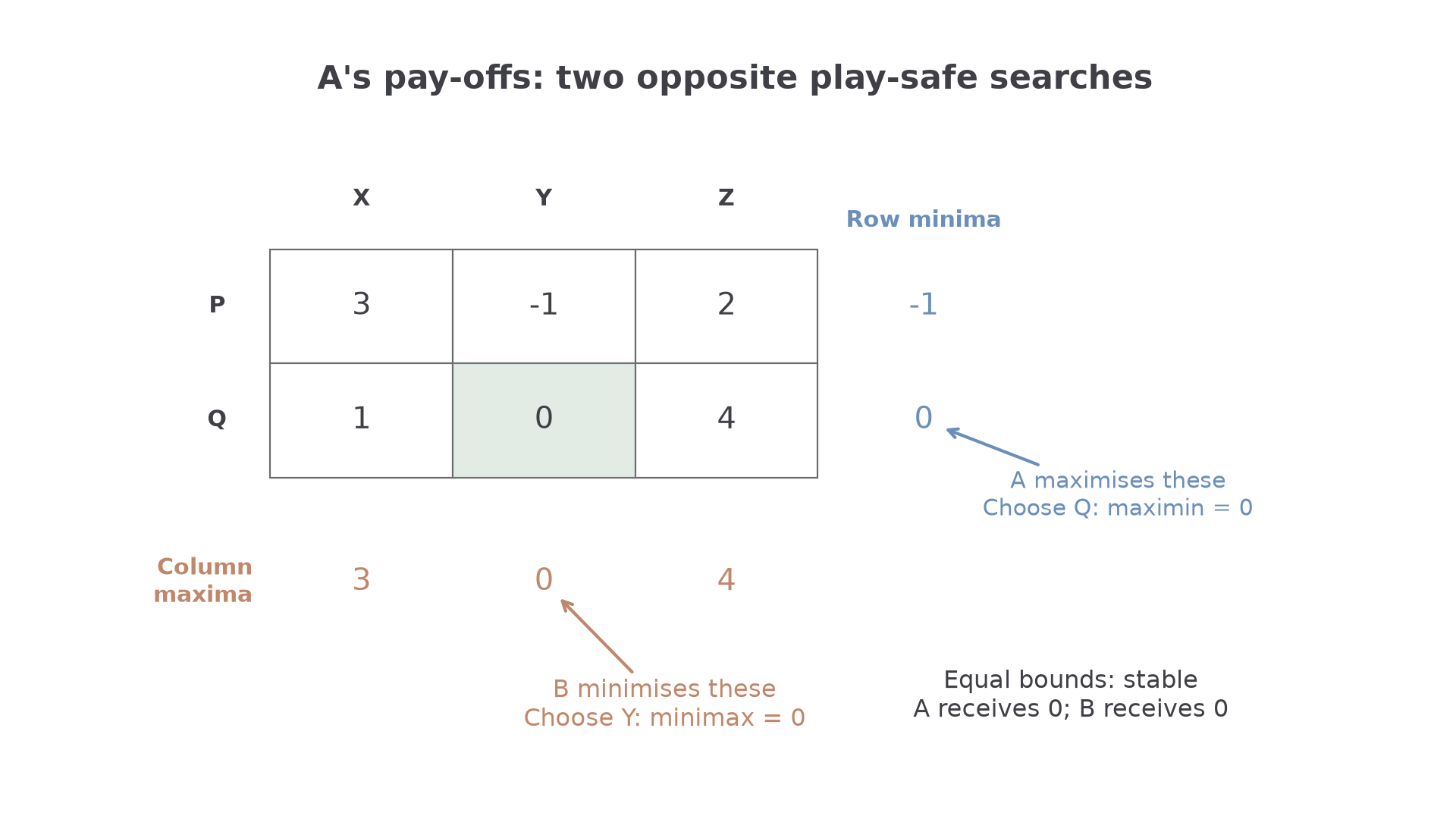
A play-safe choice protects a player against their worst possible outcome. It does not assume that the opponent chooses at random or cooperates.
For A, first find the smallest entry in each row: this is the worst A could receive after choosing that row. Choose the largest of those minima. For B, first find the largest entry in each column: this is the worst loss B could suffer after choosing that column. Choose the smallest of those maxima.
[DIAGRAM: asset_name: Row minima and column maxima in a stable game; asset_slug: h245_7_08_play_safe_matrix; caption: A maximises the row minima while B minimises the column maxima, and both select a pay-off of zero; description: A labelled two by three A pay-off matrix has rows P and Q and columns X Y Z, entries 3 minus 1 2 in P and 1 0 4 in Q. A blue side panel lists row minima minus 1 and 0 and selects Q. A clay lower panel lists column maxima 3 0 and 4 and selects Y. The intersection Q Y is highlighted with value 0. The captions explicitly say A maximises and B minimises A's pay-off]
Continue this lesson.
You’re previewing NovaLearn without an account. Create a free account to read the rest.
Create free account