6.03l - Oblique impacts
Extend Newton's experimental law to two dimensions by resolving along and perpendicular to the line of impact. You will predict the velocity after an oblique impact with a smooth fixed plane or another smooth sphere, assemble the result as a vector, and check the direction and impulse.
The two directions of an impact
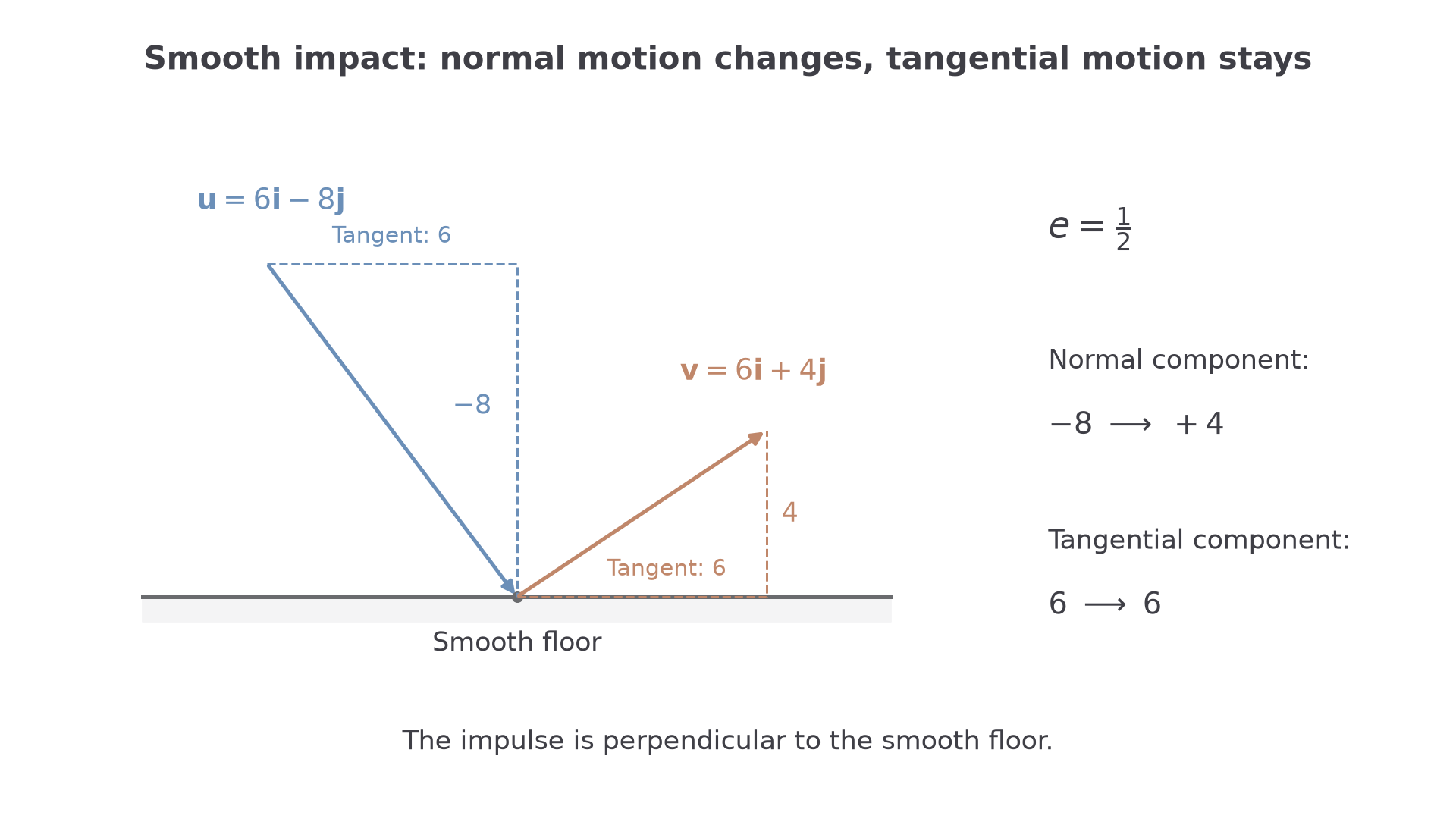
A sphere strikes a smooth floor with velocity . The coefficient of restitution is . Does it rebound with velocity , or ? The difference is whether the floor changes the sideways motion.
You already know
A smooth contact supplies no frictional force. Impulse changes momentum in its own direction. For direct impact, Newton's experimental law multiplies the relative normal velocity by .
The normal direction is perpendicular to the contacting surfaces. The tangential direction is parallel to them at contact. A smooth fixed plane supplies only a normal impulse, so it changes only the normal velocity component. The tangential component is unchanged. For two smooth spheres, their common normal is the line joining their centres at impact; the impulse acts along that line.
[DIAGRAM: asset_name: A smooth plane changes only normal motion; asset_slug: h245_6_03_oblique_components; caption: The normal component reverses and is scaled, while the tangential component stays unchanged; description: A horizontal smooth floor is shown with an incoming velocity arrow (6,-8) into the point of contact and an outgoing arrow (6,4). Separate component arrows mark tangential component 6 before and after, downward normal component -8 before and upward normal component 4 after, for e = 1/2. A normal direction arrow is perpendicular to the floor and a tangential direction arrow lies along it. Labels are separated from the arrows]
Line of impact
The line of impact is the common normal at contact: the line of centres for two smooth spheres, or the perpendicular to a smooth plane at the contact point. Newton's experimental law applies to relative velocity components along this line. It does not reverse the entire velocity vector.
For the opening floor impact, take along the floor and upwards. The tangential velocity stays , while the normal velocity changes from to . The correct rebound velocity is therefore . These smooth-contact component rules are not separately printed in the formula booklet; the normal restitution law itself is supplied.
If the normal component is zero before contact, there is no approach into the surface and no normal impact to apply. If , the immediate outgoing normal velocity is zero. Tangential motion may remain, so an oblique impact with need not bring the sphere to rest. Two spheres with have equal normal velocities immediately afterwards, but need not have equal tangential velocities or coalesce as a single body in the plane.
Key idea
Resolve first. Apply restitution to normal motion, and preserve each particle's tangential motion at a smooth contact.
The word “smooth” supplies one of the equations, rather than merely describing the surface.
A plane aligned with the axes
Choose axes parallel and perpendicular to a plane whenever possible: the impact laws then operate directly on the velocity components.
For a plane with outward unit normal , a sphere approaches with . Its immediate final components are and . The normal relation is Newton's experimental law from the formula booklet; tangential preservation follows from zero tangential impulse and is not printed there. If the normal points the opposite way, both normal signs change and the physical answer is unchanged.
Worked example 1: velocity, impulse and direction
Question. A sphere on a smooth horizontal plane strikes a smooth fixed vertical wall. Take normally away from the wall and along it. The incoming velocity is , and . Find the outgoing velocity, the wall's impulse on the sphere, and the angle the outgoing velocity makes with the outward normal.
Plan. Change the normal component only, subtract momenta, then use the outgoing component triangle for the angle.
Why this step? The requested angle is measured from the normal, so its adjacent component is , not .
Answer. Velocity , impulse , angle .
Check. The impulse is normal to the smooth wall, and points away from it. Final speed is smaller than the incoming speed .
Change only the coefficient to . The impact is perfectly elastic, so the normal speed is preserved as well as the tangential component.
Worked example 2: elastic reflection
Question. The same sphere has the same incoming velocity, but the wall coefficient is . Find the outgoing velocity, impulse and angle to the outward normal.
Plan. Reverse the normal component without changing its magnitude; keep the tangential component.
Why this step? Equal incoming and outgoing angles occur here because , rather than being a general rule for every smooth impact.
Answer. Velocity , impulse , angle .
Check. Both speeds are , so kinetic energy is conserved.
An angle measured from the plane is complementary to the angle measured from its normal. Draw the component triangle before using inverse trigonometry. At zero outgoing speed, a direction angle is undefined.
Watch out
Wrong: use . This would reverse and scale the tangential component too. Right: apply only to the component normal to the plane.
The impulse direction provides a useful second check on your velocity vector.
A plane at an angle to the axes
When the wall is not aligned with the given axes, resolve into a unit normal and a unit tangent, apply the impact laws there, and then return to the original coordinates.
For the line , choose unit normal and unit tangent . They have length and scalar product , so dot products give actual signed velocity components, without an unwanted scale factor.
Resolving and reconstructing the velocity
For perpendicular unit vectors normal to a smooth fixed plane and parallel to it,
Choose towards the side containing the approaching sphere, so . These projection and reconstruction formulae combine the supplied normal impact law with smoothness.
Not in the formula booklet: learn it.
The velocity vector may have two changed cartesian components even though only one normal component changes.
Worked example 3: a tilted wall
Question. A sphere of mass on a smooth horizontal plane strikes a smooth fixed wall whose line in the plane is . It approaches from the side with velocity . The coefficient of restitution is . Find its outgoing velocity and the impulse on it.
Plan. Use , , resolve, then reconstruct.
Why this step? Applying restitution directly to either cartesian component would use a direction that is not normal to the wall.
Answer. Velocity ; impulse .
Check. The impulse equals , so it is normal to the wall. Also : the sphere leaves the permitted side's boundary.
Continue this lesson.
You’re previewing NovaLearn without an account. Create a free account to read the rest.
Create free account