4.02k, 4.02l - Argand diagrams
Use an Argand diagram to represent complex numbers as points and position vectors. You will interpret conjugation as a reflection, addition as a translation, and subtraction as a directed displacement, connecting the picture to the arithmetic you already know.
Points and position vectors
If and , where is , and which way does the arrow representing it point? Subtraction is easy to calculate; making its direction visible is the puzzle this lesson answers.
You already know
For , the real part is , the imaginary part is , the modulus is the distance from the origin, and the argument gives its direction. Add and subtract the two parts separately.
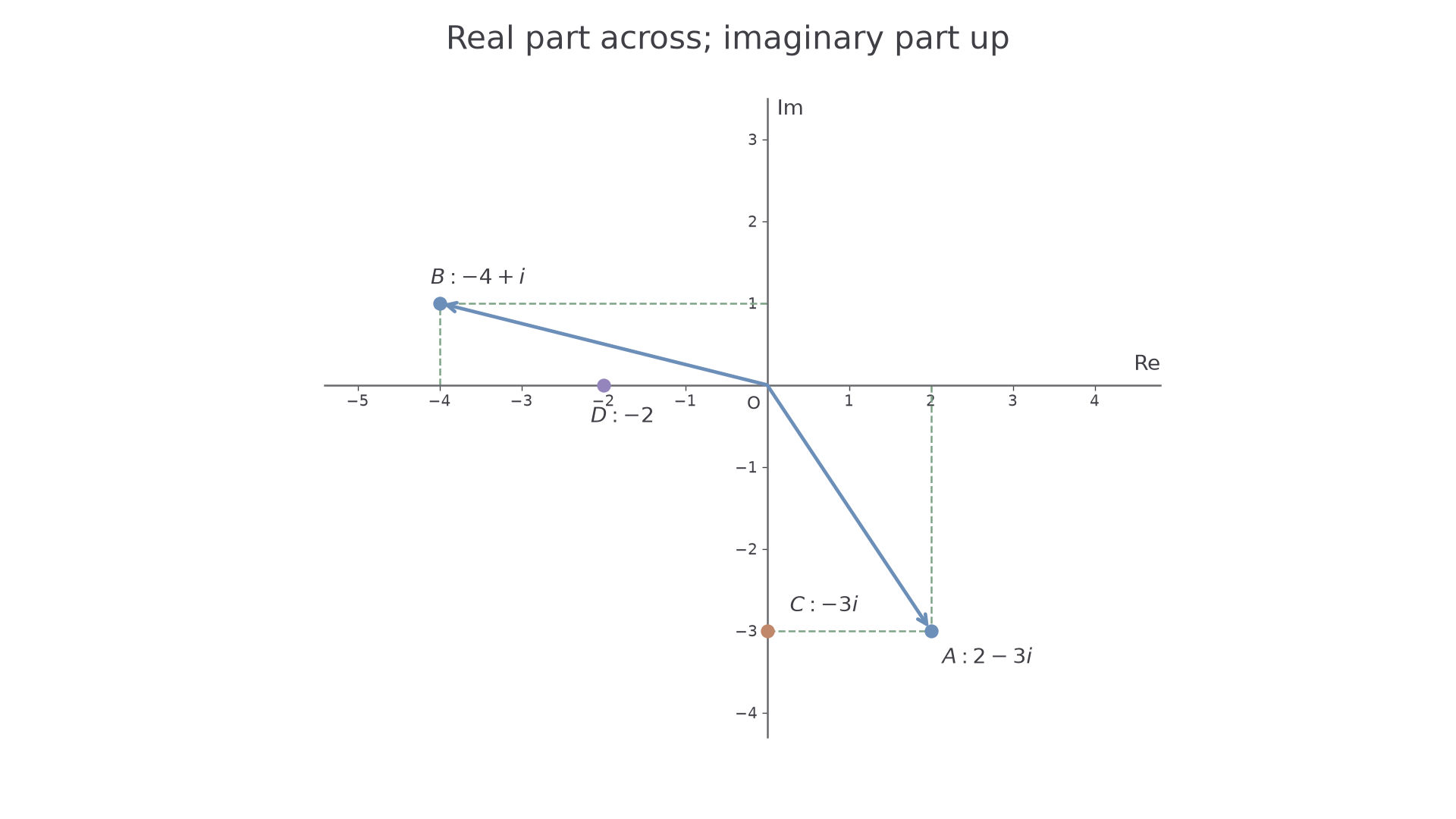
On an Argand diagram the horizontal coordinate is the real part and the vertical coordinate is the imaginary part. Thus is represented by , below and to the right of the origin. An arrow from to that point carries the same information: move units right and units down.
[DIAGRAM: asset_name: Complex numbers as points and vectors; asset_slug: h245_4_02_argand_points; caption: A complex number can name a point or the arrow from the origin to that point; description: Equal-scale Argand axes labelled Re and Im, with O at the origin. Points A = 2 - 3i, B = -4 + i, C = -3i and D = -2 are plotted and labelled. Blue position arrows run from O to A and B. Dashed guides show their real and imaginary coordinates.]
Argand diagram
An Argand diagram represents by the point with coordinates . Its horizontal axis is the real axis and its vertical axis is the imaginary axis. The same number can represent the position vector from to that point. For example, has coordinates , not .
A point is a location; a vector is a displacement. The arrow's direction matters even when its length stays the same. Use equal scales when measuring angles or comparing distances.
Worked example 1: interpreting two points
Question. Points and represent and . State their coordinates and which quadrants contain them.
Plan. Read the real and imaginary parts as horizontal and vertical coordinates, then use their signs.
Why this step? The vertical coordinate is the coefficient of , not an imaginary number itself.
Answer. is in the fourth quadrant; is in the second quadrant.
Check. The signs agree with the diagram: lies below the real axis and above it.
The next example changes only the presence of a zero coordinate. Points on an axis belong to neither neighbouring quadrant.
Worked example 2: points on the axes
Question. Points , and represent , and . State their coordinates and positions.
Plan. Write each number with an explicit real and imaginary part.
Why this step? A missing term has coefficient zero; it does not make the coordinate undefined.
Answer. is on the negative imaginary axis; is on the negative real axis; is .
Check. , , , consistent with their distances from .
These coordinate rules are definitions rather than formula-booklet results; you need to know how to interpret the axes.
Watch out
Wrong: plotting at . Right: , so plot on the imaginary axis. The real axis contains real numbers, including negative ones.
Reading a diagram in reverse simply rebuilds from its two coordinates.
Conjugation as reflection
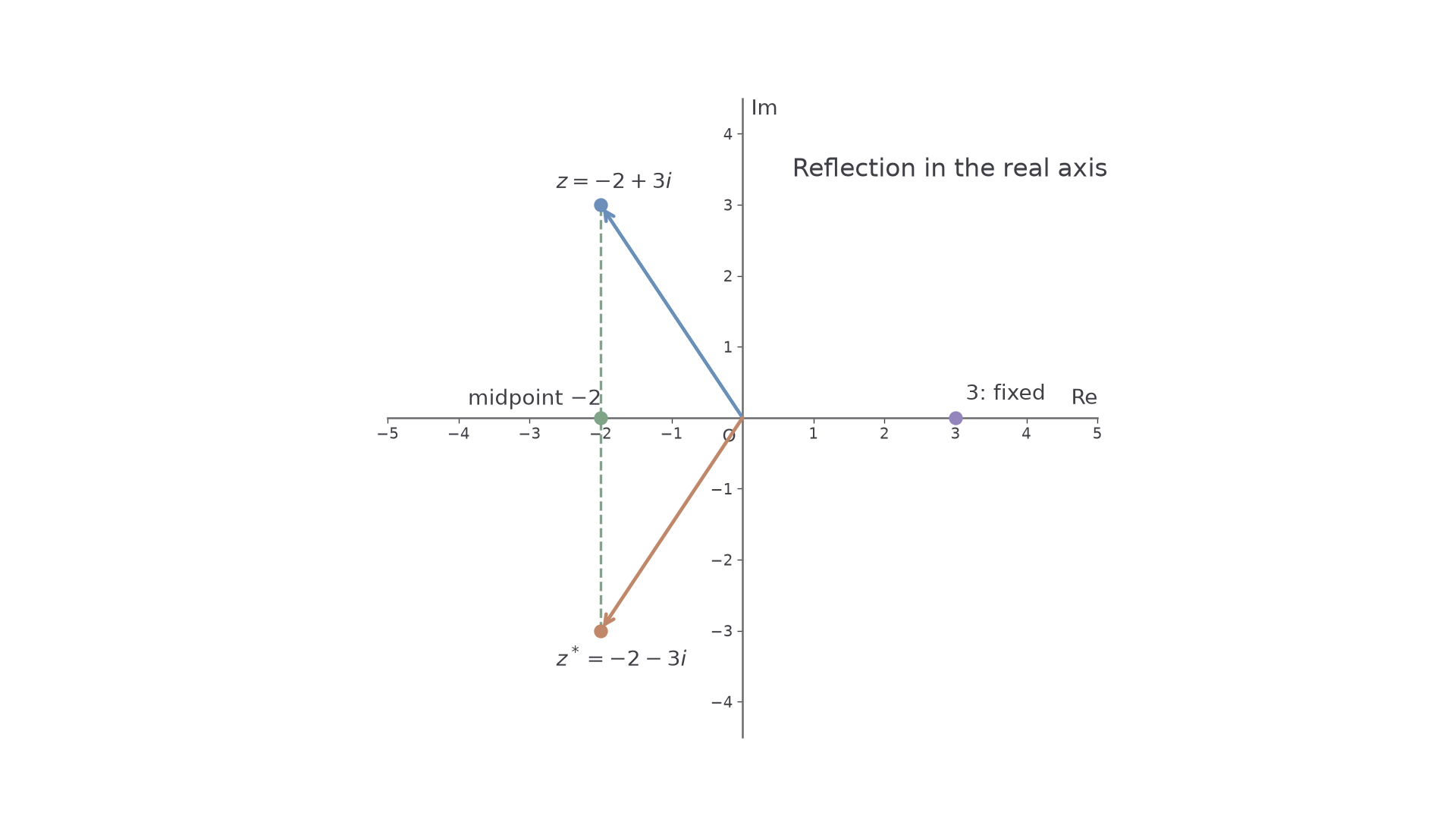
Taking the conjugate changes to , so it reflects the point in the real axis. This is a geometric operation on every point, including the ones the reflection leaves fixed.
For example, and sit directly above and below the same point on the real axis. Their midpoint is , and their separation is . The number itself stays put when conjugated.
[DIAGRAM: asset_name: Conjugation is reflection in the real axis; asset_slug: h245_4_02_conjugate_reflection; caption: Conjugate points share a real coordinate and have opposite imaginary coordinates; description: An equal-scale Argand diagram shows z = -2 + 3i in blue and z star = -2 - 3i in clay, with dashed vertical segment joining them and midpoint -2 marked on the real axis. Position arrows show equal distances from O. A point 3 on the real axis is labelled fixed by conjugation.]
Geometrical effect of conjugation
The mapping is reflection in the real axis. It fixes exactly the real numbers, since exactly when . Reflection in the imaginary axis would instead send to .
Reflection preserves distance from , so . If an argument of is , an argument of is . Adjust by if needed to reach the chosen principal interval: a negative real number still has principal argument in .
There is a useful geometric identity here. The midpoint of a point and its reflection is on the mirror line:
The imaginary coordinate is not merely cancelled by luck; reflection places equal displacements on opposite sides of the axis. These conjugation results are not in the formula booklet: learn them.
Key idea
Conjugation reverses the vertical coordinate while keeping the horizontal coordinate, so its mirror is the real axis.
The point and its negative usually have different real coordinates. Negation is a half turn about , not conjugation.
Addition and directed differences
Adding a fixed complex number translates every point by the same vector; subtracting two complex numbers gives the directed displacement between their points.
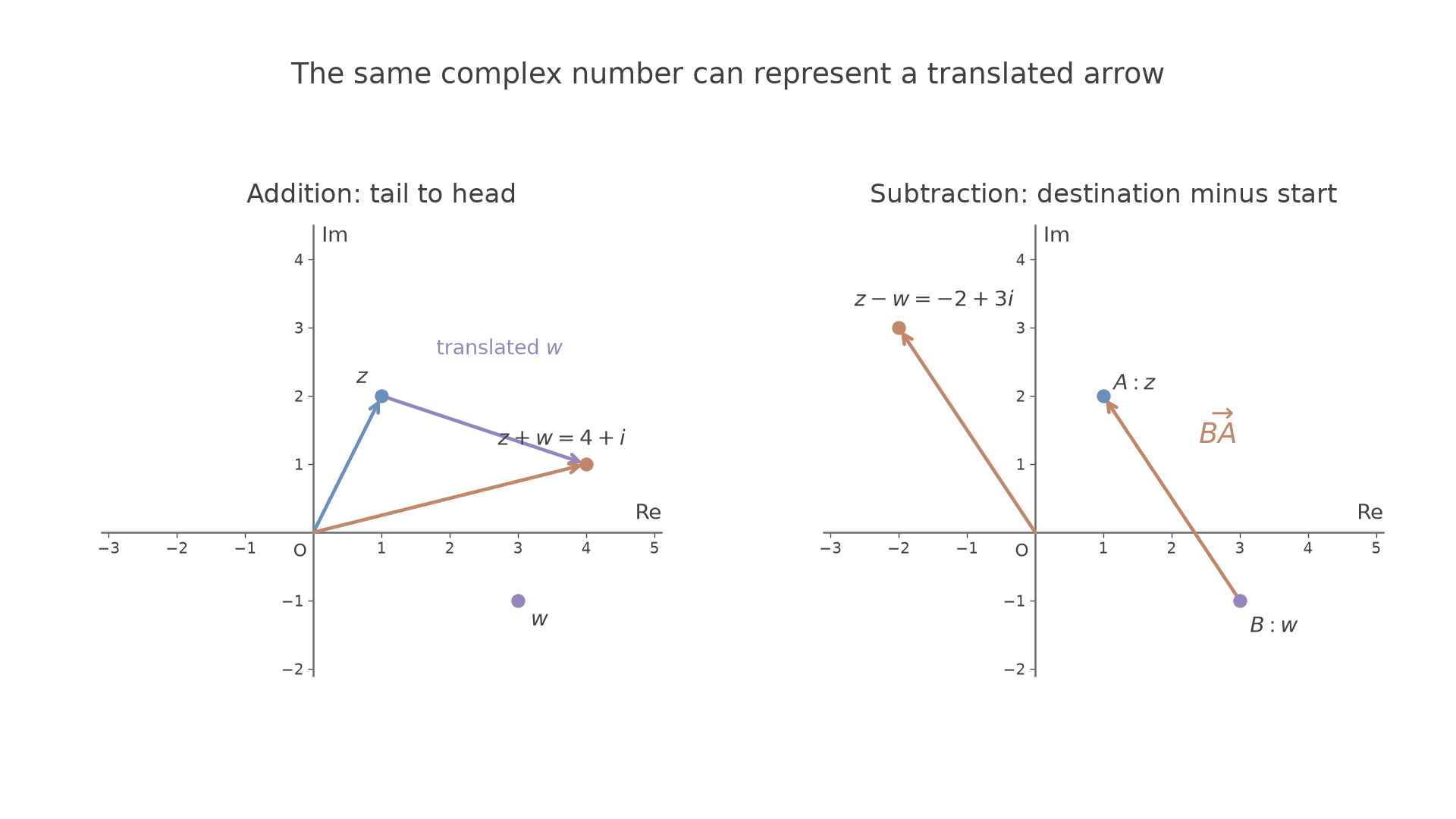
If represents and represents , then the vector from to has components , so it represents . This is the “destination minus starting point” rule for vectors.
[DIAGRAM: asset_name: Addition and subtraction as arrows; asset_slug: h245_4_02_addition_subtraction; caption: Addition uses a translated copy of a position vector; subtraction uses destination minus starting point; description: Two equal-scale Argand panels use z = 1 + 2i and w = 3 - i. The left shows O to z, a translated arrow w from z to z + w = 4 + i, and the diagonal O to z + w. The right shows A at z and B at w, with a clay arrow from B to A labelled z - w = -2 + 3i and a parallel equal arrow from O to -2 + 3i.]
Geometrical addition and subtraction
For complex numbers , :
Here represents and represents . In particular, is the distance .
Not in the formula booklet: learn it.
For addition, place the second arrow's tail at the first arrow's head without rotating or stretching it. The final head represents the sum. Equivalently, use the diagonal of a parallelogram.
Worked example 3: addition as translation
Question. Let and . Find and describe the movement from the point to the point .
Plan. Add coordinates, then compare the final point with the starting point.
Why this step? The same displacement represents wherever its tail is placed.
Answer. ; move units right and unit down from .
Check. From , the move reaches , as in the diagram.
Change only the operation to subtraction. Now the arrow joins two existing points, and its starting point is the number being subtracted.
Worked example 4: subtraction has a direction
Question. For the same , , find , identify the directed arrow it represents, and find the distance between the points.
Plan. Subtract the coordinates and take the modulus of the difference.
Why this step? means destination minus start . The arrow goes from to , even though the sum example started at .
Answer. represents ; the distance is .
Check. , so the arrow reaches the correct destination.
Here is a useful surprise: and are different vectors, but . Reversing a journey changes its direction, not its length.
Watch out
Wrong: “ is the arrow from to .” Right: it is from to . Add the proposed displacement to its starting point to check the direction.
That resolves the opening puzzle. The answer lies at when drawn as a position vector, and the same vector runs from the point to the point .
Quick Recap
- Plot at , using real and imaginary axes and equal scales.
- Conjugation reflects in the real axis; the real numbers are fixed.
- Addition translates a point by the added vector, or gives a parallelogram diagonal.
- The arrow from to represents , and is its length.
For the opening pair, : the arrow runs from to , left and up .