4.10a - General and particular solutions
A differential equation describes a relationship between a function and its derivatives. You will distinguish a whole family of solutions from the particular member selected by initial or boundary conditions, and check both the equation and the conditions.
Families of solutions
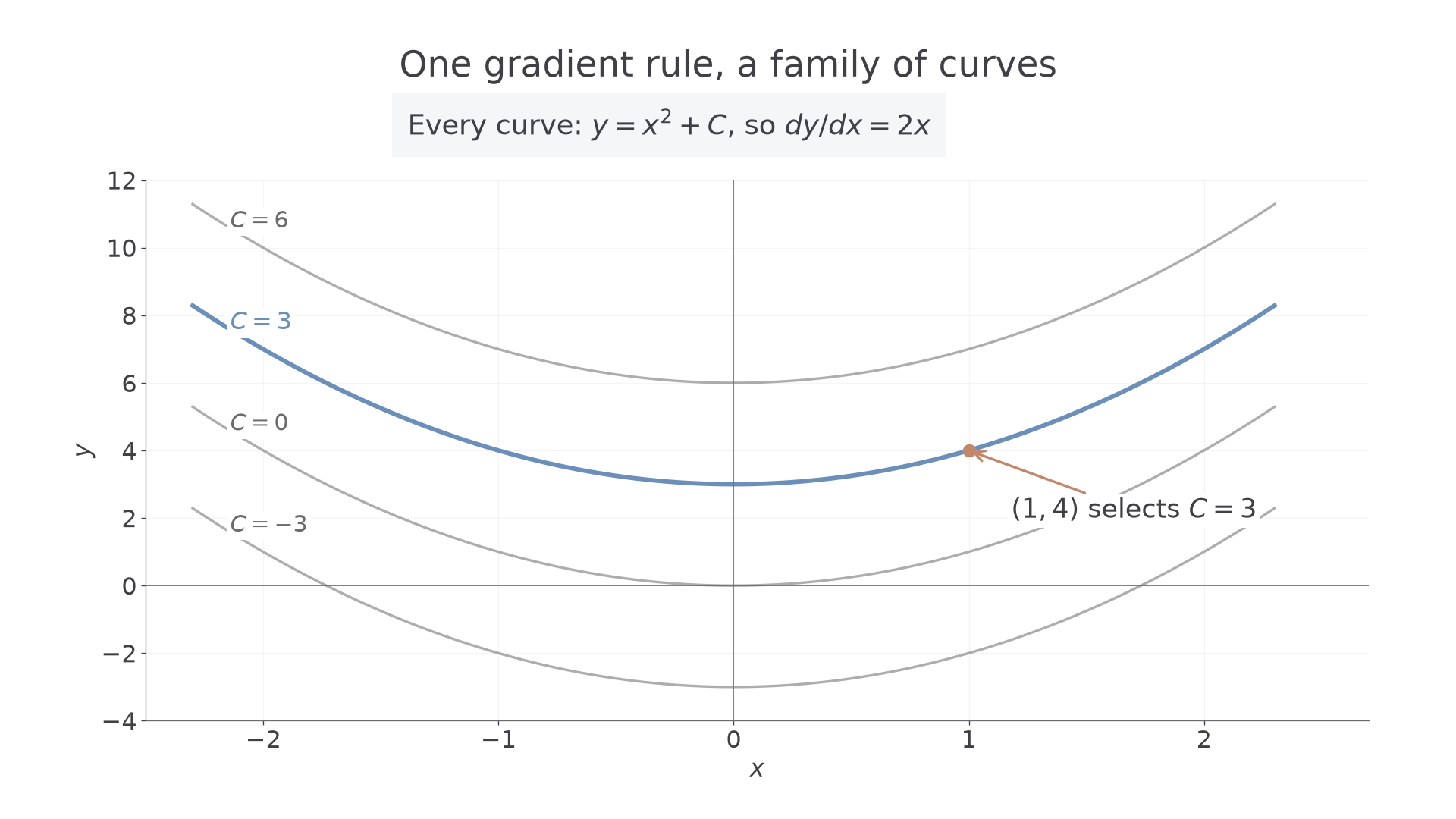
If every point on a curve has gradient , which curve is it? The curves , and all fit. Knowing every gradient still does not tell you the height of the curve.
You already know
Integrating gives . Differentiating a constant gives zero, so integration cannot recover its value without more information.
Here the equation fixes the shape but allows vertical translations. The diagram shows a family, with one member selected by a point.
[DIAGRAM: asset_name: A condition selects one solution; asset_slug: h245_4_10_solution_family; caption: Every curve has gradient 2x, but only y = x squared + 3 passes through the point (1, 4); description: Cartesian plot of y = x squared plus C for C equal to -3, 0, 3 and 6. The C = 3 curve is blue and the others grey. The point (1, 4) is marked and labelled, with a note that it selects C = 3.]
General and particular solutions
A general solution describes a family of solutions using arbitrary constants. A particular solution has those constants fixed by specified conditions.
For , the general solution is , where is an arbitrary real constant. The particular solution through is .
An arbitrary constant is fixed along any one solution, but may take different values for different members of the family. It need not appear as an added constant: is a family too. Taking gives the valid solution of .
The formula booklet does not give these solution definitions or the procedures for verifying a solution and using conditions to determine its constants; learn these principles.
For the regular first and second order equations used here, a general solution has respectively one and two independent arbitrary constants. For example, integrating twice gives . The order is the highest derivative present. Two symbols are not necessarily two independent constants: still has only one adjustable constant, .
There is a useful surprise here: the equation knows the gradient at every value of , yet cannot distinguish any of the infinitely many curves in the picture. One point supplies the missing information.
Key idea
The differential equation fixes a family; extra conditions select its member, if they are consistent and sufficient.
Keep the number of independent choices separate from the number of letters you have written.
Verifying a solution
A proposed solution must satisfy the differential equation throughout its stated interval, not just at the point used to find a constant. Differentiate first and substitute into the original equation.
Solution on an interval
A function is a solution on an interval when the required derivatives exist and substitution makes the differential equation true at every point of that interval. For example, solves on the whole real line; does not, since .
You can verify a supplied family without first knowing how someone found it. This is especially useful when its formula looks unfamiliar.
Worked example 1: checking a first order family
Question. Verify that solves for every real constant .
Plan. Differentiate the proposed solution, then calculate the whole left-hand side.
Why this step? Substitution tests the equation itself; merely finding a derivative does not show that it satisfies the equation.
Answer. The family satisfies for all real and every real .
Check. When , the constant solution gives .
Change just the order of the equation in the next example. You now need a second derivative, but the test is still substitution into the complete left-hand side.
Worked example 2: checking a second order family
Question. Verify that solves .
Plan. Find both derivatives, then collect the coefficients of each exponential separately.
Why this step? The independent exponential terms must cancel separately, whatever and are.
Answer. The family satisfies the equation for every real .
Check. Choosing , gives .
Passing a condition alone is much weaker than passing the equation: many curves pass through one point.
Watch out
Wrong: “, so this solves the differential equation.” Right: check the derivative equation for general , and check the condition separately.
Use the same cancellation test with different exponents.
Continue this lesson.
You’re previewing NovaLearn without an account. Create a free account to read the rest.
Create free account