8.01c–8.01e - Sequence behaviour and Fibonacci numbers
Describe how a sequence behaves and decide what a claimed limit actually means. In 8.01c–8.01d you will distinguish convergence, divergence, oscillation, periodicity and monotonicity, including sequences of differences or ratios; in 8.01e you will explore Fibonacci and Lucas numbers and the golden ratio.
Describing sequence behaviour
The ratios bounce above and below a number near . Can a sequence keep changing direction and still have a limit, and why does this particular number appear?
Each fraction divides one Fibonacci number by the preceding one. You will identify their limit later; first separate the words that describe the journey from the word that describes its destination.
You already know
A recurrence system specifies its initial values and index range as well as its update rule. A closed form lets you study directly; for example, tends to as positive integers increase.
The terms decrease towards . The terms change sign and also approach . Changing direction does not prevent convergence.
Convergence and divergence
A sequence converges to a finite limit if its terms approach as , written or . A sequence without a finite limit diverges. For example, converges to , while diverges to infinity and diverges despite being bounded.
“Bounded” means trapped between fixed finite numbers. It is useful evidence, but boundedness alone does not produce a single destination.
Monotonic, periodic and oscillating
A sequence is monotonically increasing if at every permitted index, and monotonically decreasing if ; use “strictly” when every inequality is strict. A periodic sequence repeats after a fixed positive integer : . Its period is the least such . An oscillating sequence repeatedly changes direction or alternates about a value. For example, has period , whereas oscillates but is not periodic.
Some descriptions can apply together. A constant sequence is monotonic in both non-strict senses, periodic with period , and convergent. A non-constant periodic sequence cannot converge: each distinct value returns indefinitely. Oscillating sequences can converge, remain bounded without converging, or become unbounded.
[DIAGRAM: asset_name: Four different long-term behaviours; asset_slug: h245_8_01_sequence_behaviour; caption: Oscillation can accompany convergence or divergence; boundedness alone does not imply convergence; description: Four panels plot the discrete terms 1 over n, (-1) to the n over n, (-1) to the n and (-1) to the n times n for positive indices. Panels identify monotonic convergence to zero, oscillating convergence to zero, bounded periodic divergence of period two, and unbounded oscillating divergence. Only discrete points are drawn.]
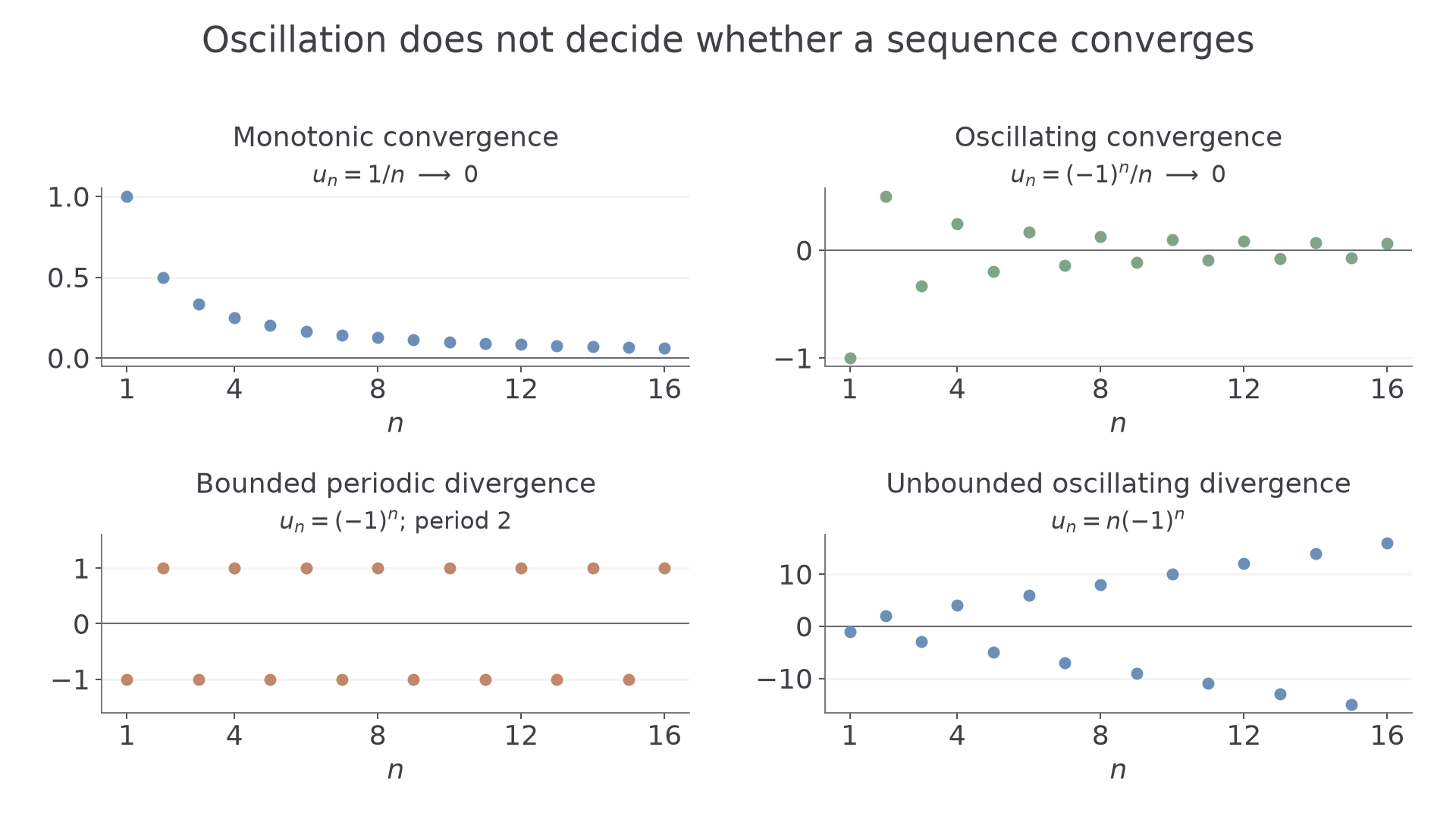
Use each word for a separate feature. Calling “oscillating” does not say whether it converges; calling it “bounded and divergent with period ” settles both questions.
Key idea
A limit concerns one eventual destination. Monotonicity, periodicity and oscillation concern the pattern of the terms.
The following claim confuses a shrinking oscillation with a repeated cycle.
Monotonicity and limits from formulae
A sign calculation proves monotonicity for every index, whereas a list of decimal values only suggests it.
For a real sequence, inspect . A positive difference proves strict increase; a negative one proves strict decrease. For a positive sequence, comparing with is another option. Do not divide an inequality by a term whose sign is unknown.
Successive differences
For every index in the sequence's domain,
Non-strict inequalities give the corresponding non-strict monotonicity.
Not in the formula booklet: learn it.
A rational closed form often reveals its limit by dividing numerator and denominator by the highest power of , or by rewriting it as a constant plus a vanishing term.
Worked example 1: approaching a limit from below
Question. For , , show that the sequence is strictly increasing and find its limit.
Plan. Rewrite the formula to show both the changing part and the limiting constant.
Why this step? The rewrite identifies a positive quantity being subtracted from , and that quantity shrinks as the index grows.
Answer. The sequence is strictly increasing and converges to , from below.
Check. , , ; all are below and increase.
The next example changes only the constant term in the numerator. That reverses the side from which the same limit is approached.
Worked example 2: approaching the same limit from above
Question. For , , show that the sequence is strictly decreasing and find its limit.
Plan. Use the same rewrite and difference calculation, keeping the changed sign.
Why this step? The same positive vanishing term is now added to , so the terms lie above and decrease.
Answer. The sequence is strictly decreasing and converges to , from above.
Check. , , , decreasing towards .
These rational-sequence results are not in the formula booklet: derive them. A sequence may become monotonic only after some index; state the range on which your sign argument works rather than describing the entire sequence from a late pattern.
Watch out
Wrong: “The first three differences are positive, so the sequence is increasing.” Right: show for every permitted . A finite list cannot exclude a later reversal.
The next formula changes the coefficient of as well as its limiting value; the algebraic test stays the same.
Steady states and derived sequences
If a recurrence sequence converges, its consecutive terms have the same limit. Substituting that limit finds possible destinations; it does not prove that the sequence reaches one.
For example, has the fixed point . Starting at gives , so solving has not established convergence.
Steady state
A steady state is a value which remains unchanged by the update. For , it satisfies . Starting at that value produces a constant sequence. If a sequence governed by a continuous update has a finite limit , that limit must satisfy the same equation.
To establish a limit, use a given closed form, a justified bound and monotonicity, or other information in the question. A monotonic bounded real sequence converges; its bound need not itself be its limit. This convergence principle is not in the formula booklet: learn it.
Worked example 3: proving a candidate limit is reached
Question. A sequence satisfies , , and has closed form . Find the steady state and the limits of and .
Plan. Find the fixed point, then use the supplied closed form to justify the limits.
Why this step? The closed form, rather than the fixed-point equation alone, proves convergence from the given initial value.
Answer. The steady state and the limit of are ; the difference sequence tends to .
Check. , , , giving differences , as predicted.
The next example changes only the sign of the multiplier. It preserves convergence while making the differences alternate in sign.
Worked example 4: an oscillating approach to a steady state
Question. A sequence satisfies , , and has closed form . Find its steady state and the limits of , , and .
Plan. Solve for the fixed point, then subtract and divide successive difference formulae.
Why this step? The difference is a sequence in its own right. Dividing its consecutive terms cancels its non-zero coefficient and power.
Answer. The sequence oscillates about the steady state and converges to it. The difference sequence tends to , while .
Check. , giving differences ; their ratios equal .
Continue this lesson.
You’re previewing NovaLearn without an account. Create a free account to read the rest.
Create free account