4.07a–4.07c - Hyperbolic definitions, graphs and identities
Build three new functions from exponentials: , and . You will use their definitions and domains and ranges in 4.07a, sketch their graphs in 4.07b, and prove and use identities in 4.07c, including solving equations exactly.
Building the functions from exponentials
Can two ordinary exponential curves combine to trace a hyperbola? Start with : then and . Half their sum is , and half their difference is . These two numbers satisfy
By the end of the lesson you will see why this happens for every real , not just this convenient choice.
You already know
For real , , , and . Also, when .
Adding and subtracting the same two exponentials creates the hyperbolic cosine and hyperbolic sine. Their names are pronounced “cosh” and “shine”, respectively; the letter stays in the notation throughout your working.
Hyperbolic functions
For real ,
For example, and . These are different functions from , and .
The denominator of never vanishes, because . Multiplying its numerator and denominator by gives a useful second form.
Exponential definitions
For every real ,
Not in the formula booklet: learn it.
When is a logarithm, evaluate the two exponentials first. The resulting fractions are often much simpler than a decimal approximation suggests.
Worked example 1: exact values at a logarithm
Question. Find the exact values of , and .
Plan. Substitute and into the definitions, then divide.
Why this step? A negative exponent means a reciprocal; it does not put a minus sign in front of .
Answer. , and , respectively.
Check. The alternative form gives .
The next example changes just the sign of the input. Watch which output changes sign: this predicts the symmetries of the graphs.
Worked example 2: a negative input
Question. Find the exact values of , and .
Plan. Interchange the exponential values: now and .
Why this step? Replacing by swaps and ; a sum survives the swap, but a difference changes sign.
Answer. , and , respectively.
Check. is still positive, as a sum of positive exponentials must be.
The sign change is predictable, so a negative hyperbolic cosine is a useful warning that a calculation has gone wrong.
Watch out
Wrong: . The exponential terms swap places in a sum, so . It is and that change sign.
Try the same calculation with a different logarithm; retain exact fractions.
Graphs, domains and ranges
The graphs explain which equations have real solutions before you start any algebra.
[DIAGRAM: asset_name: The three hyperbolic graphs; asset_slug: h245_hyperbolic_graphs; caption: Hyperbolic sine is odd and unbounded, hyperbolic cosine is even with minimum 1, and hyperbolic tangent lies strictly between -1 and 1; description: Three coordinate panels show y = sinh x through (0, 0), y = cosh x with minimum (0, 1), and y = tanh x through (0, 0). The first two panels include pale dashed exponential component curves e to x divided by 2 and plus or minus e to minus x divided by 2. The tanh panel has dashed horizontal asymptotes y = 1 and y = -1. All three panels are labelled with their domains and ranges]
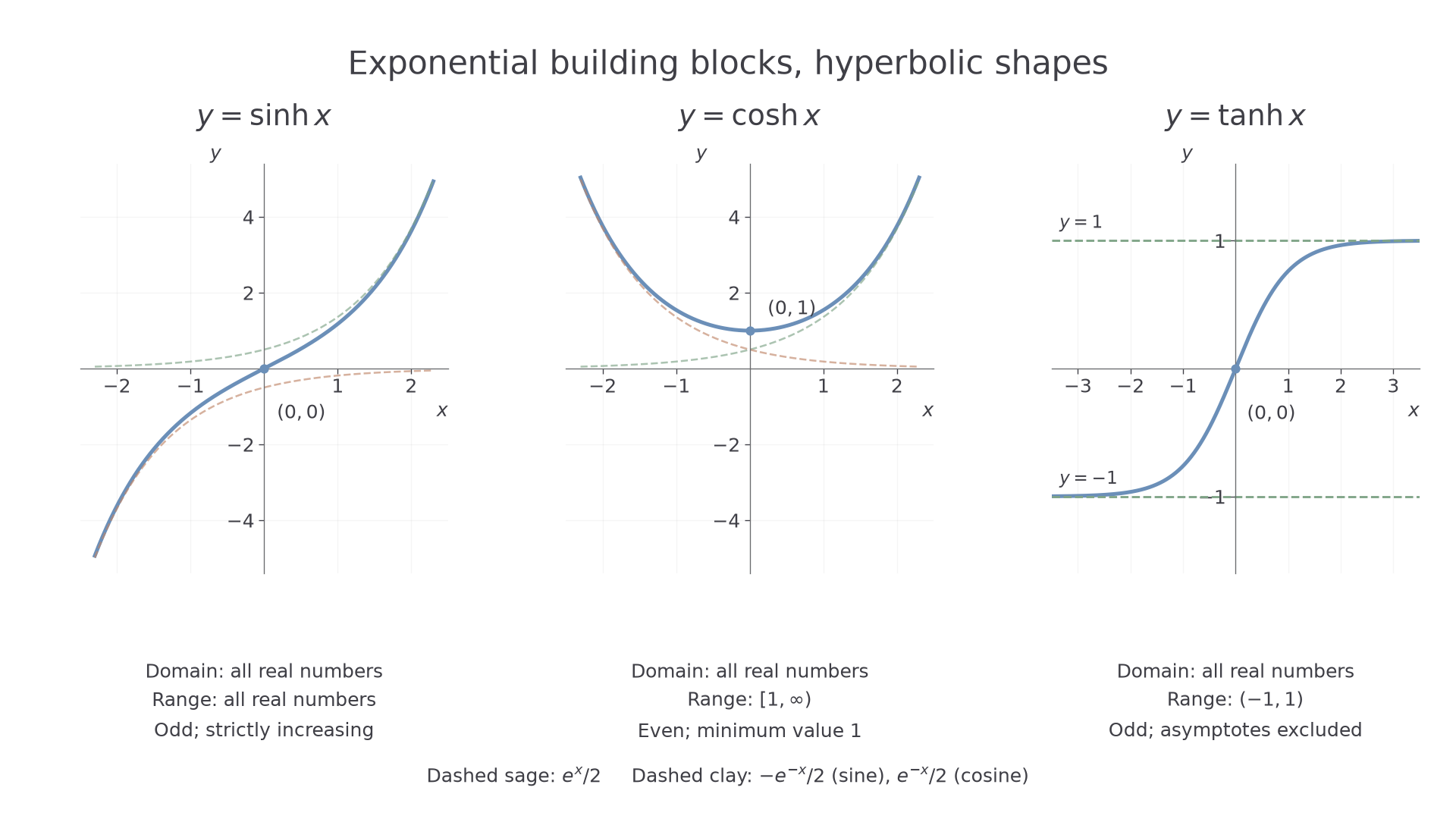
For , increasing makes larger and smaller, so their difference increases strictly. It tends without bound in both directions. Thus each horizontal line crosses the sine graph exactly once.
For , set . Then
Equality holds only when , so only when . The graph decreases to , then increases symmetrically. A line therefore crosses it twice for , once for , and never for .
For , put . The expression increases as increases. It approaches as and as , but reaches neither value.
Domain and range
The domain is the set of allowed inputs; the range is the set of outputs actually attained. For the real hyperbolic functions:
| Function | Domain | Range | Symmetry |
|---|---|---|---|
| odd | |||
| even | |||
| odd |
For example, belongs to the range of , but not to the range of .
For a sketch, label the intercept, the symmetry and any asymptotes, then draw the correct end behaviour. Hyperbolic functions have no repeating periods: these curves do not oscillate like their trigonometric namesakes. The domain/range facts and sketch features are not in the formula booklet; learn them.
Key idea
for every real ; . Endpoints belong to the cosine range but not to the tangent range.
Use those precise inequalities, rather than a rough picture, to reject impossible values.
Proving and using identities
The functions satisfy identities because their exponential definitions fit together, rather than because you can copy a trigonometric identity and change its name.
Continue this lesson.
You’re previewing NovaLearn without an account. Create a free account to read the rest.
Create free account